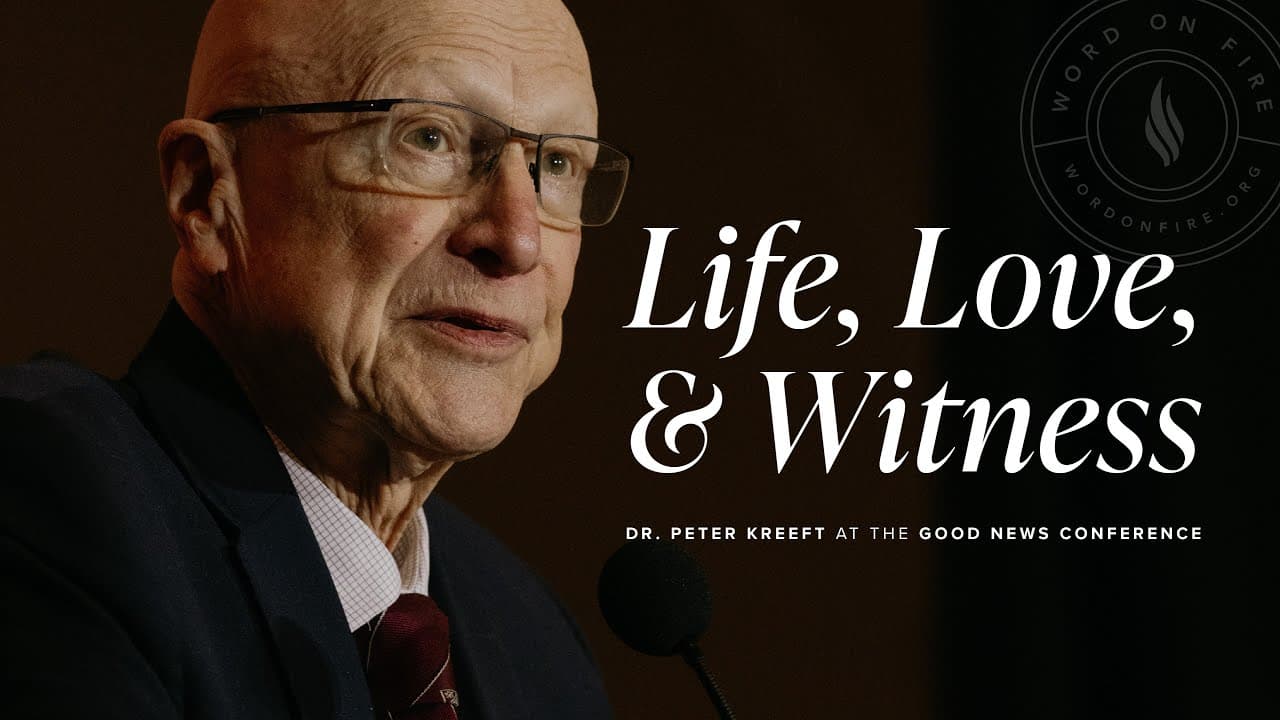
Teach The Truth By Living It - Dr Peter Kreeft
TL;DR
Christians are called to witness truth through life and martyrdom.
Transcript
[Applause] well that's an introduction I can't possibly live up to thank you very much I have to start with a confession I am here as an outsider I am a philosopher among the saints in biblical language all Christians are Saints the word means holy and set apart I don't think any of us here are going to be Canon Iz Saints which are First Rate first... Read More
Key Insights
- Dr. Peter Kreeft emphasizes the role of all Christians in evangelization, not just clergy, highlighting the universal call to witness truth.
- Witnessing involves three key actions: seeing truth, speaking truth, and suffering for truth, which together define a Christian's mission.
- Socrates serves as a model for witnessing by living truthfully and being willing to suffer for it, paralleling Christian martyrdom.
- The philosophical debate around truth and witnessing involves nominalism and postmodernism, which challenge universal truths and definitions.
- The act of witnessing is not just verbal but also involves living a life that reflects Christian values, which is essential for effective evangelization.
- Martyrdom is the ultimate form of witnessing, demonstrating sincerity and commitment to truth, and is essential for renewing faith in modern society.
- The modern world struggles with witnessing due to a lack of saints and martyrs, which diminishes the credibility of Christian testimony.
- Love and suffering are intertwined in Christian witnessing, with true love being a powerful force that transcends mere words and arguments.
Install to Summarize YouTube Videos and Get Transcripts
Explore YouTube Video Summarizer or Get YouTube Transcript Extractor
Questions & Answers
Q: What are the three forms of witnessing discussed by Dr. Kreeft?
Dr. Peter Kreeft discusses three forms of witnessing: seeing, speaking, and suffering for truth. Seeing involves perceiving reality accurately, speaking involves testifying to what is true, and suffering involves enduring hardships, even martyrdom, for the sake of truth. These forms collectively define a Christian's mission and are essential for effective evangelization.
Q: How does Dr. Kreeft relate Socrates to Christian witnessing?
Dr. Kreeft draws parallels between Socrates and Christian witnessing by highlighting Socrates' commitment to living truthfully and his willingness to suffer for it. Socrates' method of questioning and seeking universal truths aligns with the Christian call to witness truth through life and potentially martyrdom, serving as a philosophical model for Christians.
Q: What philosophical challenges to witnessing does Dr. Kreeft address?
Dr. Kreeft addresses philosophical challenges such as nominalism and postmodernism, which deny the existence of universal truths and definitions. These philosophies undermine the concept of witnessing by questioning the very nature of truth, making it difficult for Christians to assert and live by universal moral and spiritual truths.
Q: Why does Dr. Kreeft emphasize martyrdom in witnessing?
Dr. Kreeft emphasizes martyrdom as the ultimate form of witnessing because it demonstrates the sincerity and commitment of the witness to truth. Martyrdom is a powerful testament to one's faith and conviction, serving as a compelling example that can inspire others and reaffirm the credibility of Christian testimony in a skeptical world.
Q: What role does love play in Christian witnessing according to Dr. Kreeft?
According to Dr. Kreeft, love plays a crucial role in Christian witnessing as it embodies the essence of the Christian message. True love involves self-sacrifice and suffering, which are powerful forces that go beyond words and arguments. This love, exemplified by Christ, is the most compelling form of witness and is essential for effective evangelization.
Q: How does Dr. Kreeft view the current state of Christian witnessing?
Dr. Kreeft views the current state of Christian witnessing as weakened by a lack of saints and martyrs, which diminishes the credibility of Christian testimony. He argues that the modern world struggles to believe in Christ because it does not see the authentic witness of lives fully committed to truth and love, as demonstrated by past saints and martyrs.
Q: What is the relationship between witnessing and living a Christian life?
The relationship between witnessing and living a Christian life is intrinsic, as true witnessing involves not only speaking about faith but also embodying it through actions. A Christian's life should reflect the values and truths of their faith, serving as a living testament to the transformative power of Christ and providing a credible witness to others.
Q: What does Dr. Kreeft suggest is necessary for reclaiming Christian credibility in society?
Dr. Kreeft suggests that reclaiming Christian credibility in society requires a revival of saintly lives and authentic witnessing. This involves living out Christian values with sincerity, embracing the possibility of suffering for truth, and demonstrating love in action. Such witness can renew faith and inspire others by providing a compelling example of the Christian message.
Summary & Key Takeaways
-
Dr. Peter Kreeft discusses the importance of witnessing for Christians, emphasizing that it is not limited to religious leaders but is a universal call. He outlines three forms of witnessing: seeing, speaking, and suffering for truth, drawing parallels with Socratic and Christ-like examples.
-
The lecture delves into philosophical challenges to witnessing, such as nominalism and postmodernism, which question universal truths. Kreeft argues that true witnessing requires living a life that embodies Christian values and is supported by the ultimate act of martyrdom.
-
Kreeft highlights the role of love and suffering in Christian witnessing, asserting that they are essential for authentic evangelization. He calls for a revival of saintly lives to reclaim the credibility of Christian testimony in a world skeptical of traditional religious claims.
Read in Other Languages (beta)
Share This Summary 📚
Summarize YouTube Videos and Get Video Transcripts with 1-Click
Try YouTube Summary with ChatGPT & Claude or YouTube Transcript Generator
Explore More Summaries from Word on Fire Institute 📚
Summarize YouTube Videos and Get Video Transcripts with 1-Click
Try YouTube Summary with ChatGPT & Claude or YouTube Transcript Generator