Mark Carney and Richard Curtis on Climate Action and Finance
TL;DR
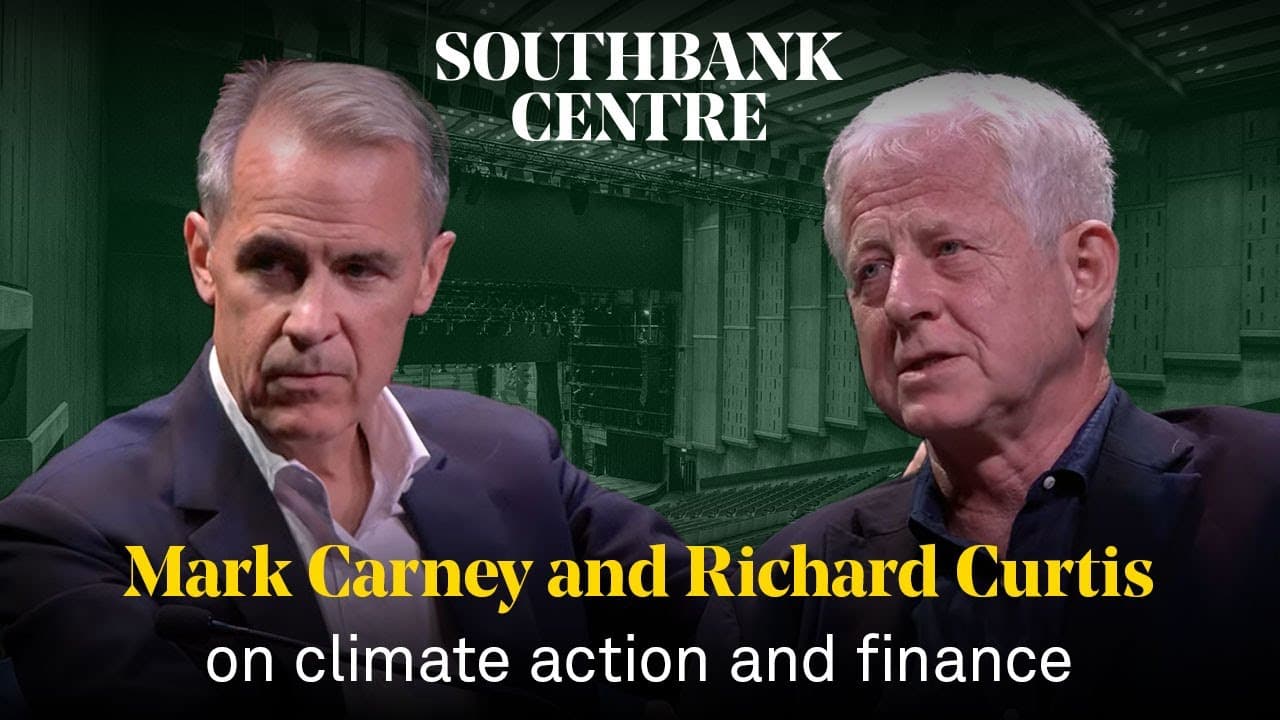
Mark Carney and Richard Curtis discuss climate finance strategies.
Transcript
good evening everybody my name is Mark Ball and I'm the artistic director of the Southbank Center and it's my absolute pleasure to welcome you all tonight soon the Queen Elizabeth hall for this very special event one of the highlights of our planet summer season of climate care hope and activism Planet summer takes its inspiration from our current ... Read More
Key Insights
- Mark Carney emphasizes the need for a sustainable revolution akin to the Industrial Revolution but at a digital pace, requiring over three trillion dollars annually for investment.
- Carney highlights the critical role of private finance in achieving net-zero goals, stressing that markets need to align with human values to drive climate action.
- Richard Curtis co-founded Make My Money Matter to encourage individuals to ensure their pension funds are invested sustainably, emphasizing the power of collective financial influence.
- The discussion underscores the importance of transition plans for companies and financial institutions to decarbonize effectively, with mandatory disclosures needed for transparency.
- Carney and Curtis both stress the urgency of addressing climate change, noting the interconnectedness of climate issues with global poverty and the need for immediate action.
- The conversation touches on the role of governments and major oil companies, with Carney criticizing the latter for insufficient investment in renewable energy.
- Curtis advocates for public pressure on banks to cease financing fossil fuel expansion, highlighting the role of consumer choice and activism in driving change.
- Carney points to the Inflation Reduction Act in the U.S. as a significant step forward, but notes the need for global cooperation and innovative financial solutions for emerging economies.
Install to Summarize YouTube Videos and Get Transcripts
Explore YouTube Video Summarizer or Get YouTube Transcript Extractor
Questions & Answers
Q: What are Mark Carney's views on the role of financial markets in climate action?
Mark Carney believes that financial markets play a crucial role in addressing climate change by aligning with human values. He emphasizes the need for a sustainable revolution, akin to the Industrial Revolution but at a digital pace, requiring over three trillion dollars annually for investment. Carney stresses that markets need to drive climate action by making value judgments that align with sustainability goals, thus making sustainable investing mainstream.
Q: Why did Richard Curtis co-found Make My Money Matter?
Richard Curtis co-founded Make My Money Matter to empower individuals to ensure their pension funds are invested sustainably. He was inspired by the realization that the world's pension market, worth trillions, is often invested in ways that contradict individual values. Curtis believes that by collectively demanding sustainable investments, individuals can drive significant change in how financial institutions allocate capital, thus supporting climate action and aligning investments with personal values.
Q: What challenges are associated with transition plans for companies?
Transition plans for companies face challenges such as the need for comprehensive and credible strategies to decarbonize effectively. Mark Carney emphasizes that companies must have actionable plans for the next five years, not just long-term goals. These plans should be transparent and subject to mandatory disclosures to ensure accountability. The challenge lies in ensuring that companies are not only committed to net-zero targets but are also taking concrete steps to achieve them, which requires rigorous oversight and public scrutiny.
Q: How do Carney and Curtis view the role of governments in climate action?
Carney and Curtis both see governments as playing a critical role in climate action by setting frameworks and regulations that guide the transition to a net-zero economy. Carney criticizes major oil companies for insufficient investments in renewable energy and suggests that government policies need to create incentives for such investments. Curtis highlights the interconnectedness of climate issues with global poverty, emphasizing that government action is essential in addressing these challenges and supporting vulnerable populations affected by climate change.
Q: What is the significance of the U.S. Inflation Reduction Act according to Carney?
Mark Carney views the U.S. Inflation Reduction Act as a significant step forward in climate action, as it is expected to lead to substantial investments in clean energy and potentially put the U.S. on track for a 50% emission reduction by 2030. The Act is seen as a catalyst for investment and job creation in the renewable energy sector, particularly in states that have traditionally been reliant on fossil fuels. Carney notes that this legislative move reflects a broader recognition of the economic opportunities associated with the energy transition.
Q: How does the discussion address the issue of divestment from fossil fuels?
The discussion addresses divestment from fossil fuels by highlighting the complexities of investment decisions. While Richard Curtis's campaign does not explicitly call for divestment, it emphasizes the need for financial institutions to cease financing fossil fuel expansion. Carney points out that while some companies may not be able to transition quickly enough, others are making strategic decisions to wind down fossil fuel operations. The focus is on encouraging investments in renewable energy and ensuring that financial institutions are transparent about their carbon footprints.
Q: What role does consumer activism play in climate action according to Curtis?
According to Richard Curtis, consumer activism plays a vital role in climate action by pressuring financial institutions and corporations to adopt sustainable practices. He advocates for public pressure on banks to stop financing fossil fuel expansion and encourages individuals to scrutinize where their money is invested. Curtis believes that consumer choice and activism can drive significant change, as companies and financial institutions respond to public demand for greater transparency and accountability in their environmental impact.
Q: What are the implications of the anti-ESG backlash in the U.S.?
The anti-ESG backlash in the U.S. is part of a broader political strategy that includes anti-woke sentiments. Mark Carney notes that this backlash may intensify as the presidential election approaches. However, the Inflation Reduction Act and the focus on U.S.-China competition in climate technology are tempering factors. The backlash presents challenges for climate action but is counterbalanced by significant investments in renewable energy and a growing recognition of the economic and national security benefits of transitioning to a low-carbon economy.
Summary & Key Takeaways
-
Mark Carney and Richard Curtis discuss the importance of aligning financial markets with climate goals. Carney emphasizes the need for a sustainable revolution, requiring trillions in investment annually. Curtis highlights the power of individual financial influence through sustainable pension investments.
-
Carney stresses the urgency of comprehensive transition plans for companies and financial institutions, with mandatory disclosures for transparency. Curtis advocates for consumer activism to pressure banks into stopping fossil fuel financing, emphasizing the role of public engagement.
-
The discussion covers the roles of governments and oil companies, with Carney criticizing insufficient renewable investments. Curtis highlights the interconnectedness of climate change and poverty, calling for immediate action. Carney notes the U.S. Inflation Reduction Act as a positive step.
Read in Other Languages (beta)
Share This Summary 📚
Summarize YouTube Videos and Get Video Transcripts with 1-Click
Try YouTube Summary with ChatGPT & Claude or YouTube Transcript Generator
Explore More Summaries from Southbank Centre 📚





Summarize YouTube Videos and Get Video Transcripts with 1-Click
Try YouTube Summary with ChatGPT & Claude or YouTube Transcript Generator