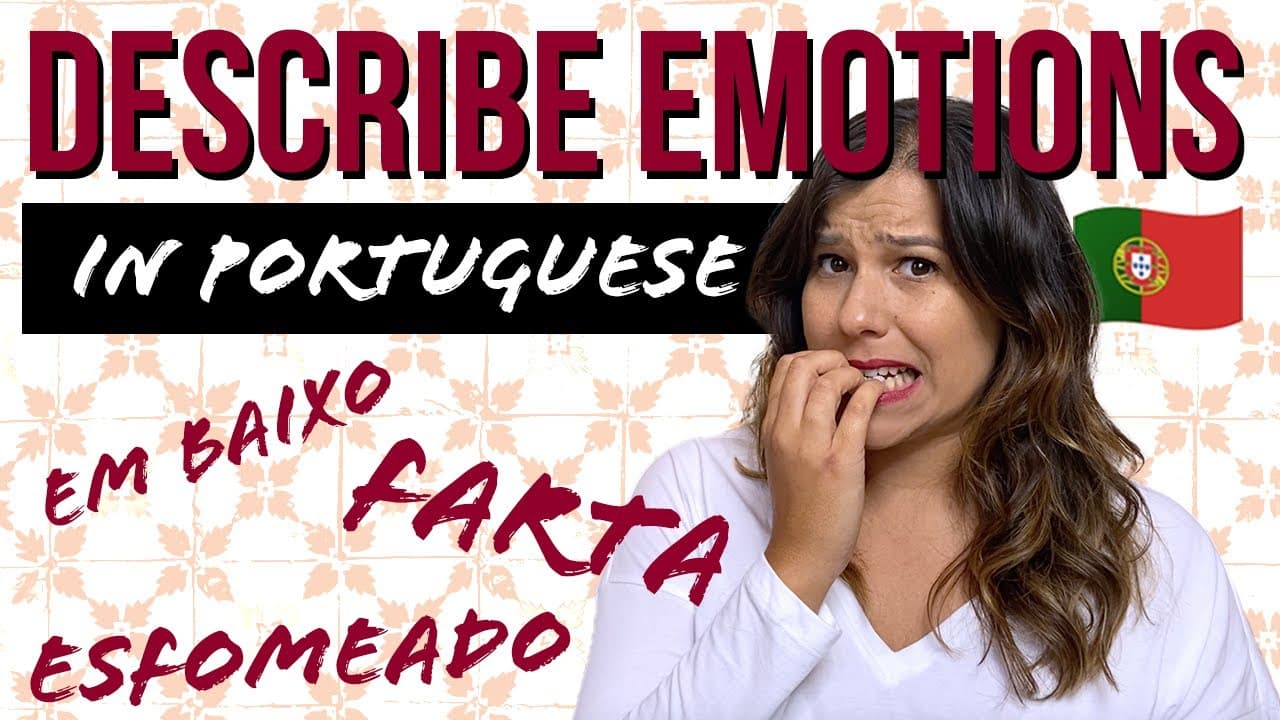
European Portuguese | How to Express Moods & Emotions [19 EASY Phrases]
TL;DR
Learn 19 phrases to express emotions in Portuguese.
Transcript
being able to express how we feel is one of the most important things we can learn in a new language our emotions are what make us us and if we can't express them we can't really connect to those around us so if you're learning Portuguese and you've ever been stuck for words with how to describe how you feel then this video is for you give this vid... Read More
Key Insights
- Understanding how to express emotions in Portuguese is crucial for meaningful communication and connection with others.
- The verb 'estar' is used frequently to describe temporary emotions and moods in Portuguese, highlighting its importance in everyday conversations.
- Pronunciation nuances, such as the subtlety of the 'e' in 'estar,' play a significant role in sounding more natural and fluent.
- Portuguese adjectives are mostly gendered, requiring learners to choose the correct ending based on gender identity.
- Gender-neutral language is evolving in Portuguese, reflecting broader societal changes and the importance of inclusivity.
- Learning simple phrases can significantly enhance your ability to express feelings, making interactions more authentic and engaging.
- The video provides 19 easy phrases for learners to practice, aiming to improve their conversational skills in expressing emotions.
- Additional resources, such as free lessons and pronunciation guides, are available to support learners in mastering European Portuguese.
Install to Summarize YouTube Videos and Get Transcripts
Explore YouTube Video Summarizer or Get YouTube Transcript Extractor
Questions & Answers
Q: Why is expressing emotions in Portuguese important?
Expressing emotions in Portuguese is important because it allows learners to connect more deeply with native speakers. Emotions are a fundamental part of human interaction, and being able to articulate them in a new language enhances communication and fosters more meaningful relationships.
Q: What verb is commonly used to express emotions in Portuguese?
The verb 'estar' is commonly used to express emotions in Portuguese. It is particularly important because it describes temporary states, such as moods and feelings, which are subject to change. Understanding how to use 'estar' correctly is crucial for expressing emotions accurately.
Q: How does pronunciation affect learning Portuguese?
Pronunciation affects learning Portuguese by influencing how natural and fluent a learner sounds. Subtle nuances, like the softening of certain vowels, can make a significant difference in how native speakers perceive a learner's proficiency. Mastering these details helps in achieving clearer and more effective communication.
Q: What challenges might learners face with Portuguese adjectives?
Learners might face challenges with Portuguese adjectives due to their gendered nature. Adjectives often change endings based on the gender of the noun they describe, requiring learners to be mindful of gender agreement. This aspect can be confusing for beginners and requires practice to master.
Q: What is the significance of gender-neutral language in Portuguese?
Gender-neutral language in Portuguese is significant as it reflects a growing awareness of inclusivity and diversity. It allows speakers to express themselves without conforming to traditional gender norms, making communication more inclusive. This evolution in language is important for addressing the needs of all speakers.
Q: How can learners practice expressing emotions in Portuguese?
Learners can practice expressing emotions in Portuguese by using the phrases provided in the video. Repetition and role-playing conversations can help reinforce these expressions. Additionally, engaging with native speakers and seeking feedback can improve their confidence and fluency in expressing emotions.
Q: What additional resources are available for learning Portuguese?
Additional resources for learning Portuguese include free lessons and pronunciation guides offered by the video creator. These resources provide structured learning opportunities and tips for improving pronunciation, making them valuable tools for learners aiming to enhance their proficiency in European Portuguese.
Q: How does this lesson contribute to learning Portuguese?
This lesson contributes to learning Portuguese by equipping learners with practical phrases to express emotions, a key aspect of communication. It also provides insights into verb usage, pronunciation, and gender considerations, offering a comprehensive approach to mastering conversational Portuguese and fostering more authentic interactions.
Summary & Key Takeaways
-
This video lesson focuses on teaching learners how to express their emotions in European Portuguese using 19 easy phrases. It emphasizes the importance of being able to communicate feelings effectively to connect with others.
-
Key language elements such as the verb 'estar' are covered, highlighting its role in describing temporary emotions. The lesson also touches on pronunciation tips to help learners sound more fluent.
-
The video addresses the gendered nature of Portuguese adjectives and introduces some gender-neutral options. It encourages learners to practice these phrases to enhance their conversational skills in Portuguese.
Read in Other Languages (beta)
Share This Summary 📚
Summarize YouTube Videos and Get Video Transcripts with 1-Click
Try YouTube Summary with ChatGPT & Claude or YouTube Transcript Generator
Explore More Summaries from Talk the Streets 📚


![Practice Portuguese with Mixologist Fábio Guerreiro! [English & Portuguese Subtitles] thumbnail](/_next/image?url=https%3A%2F%2Fi.ytimg.com%2Fvi%2F1-T2PNWuiWY%2Fhqdefault.jpg&w=750&q=75)



Summarize YouTube Videos and Get Video Transcripts with 1-Click
Try YouTube Summary with ChatGPT & Claude or YouTube Transcript Generator