What Is Cosine Similarity and How Is It Calculated?
TL;DR
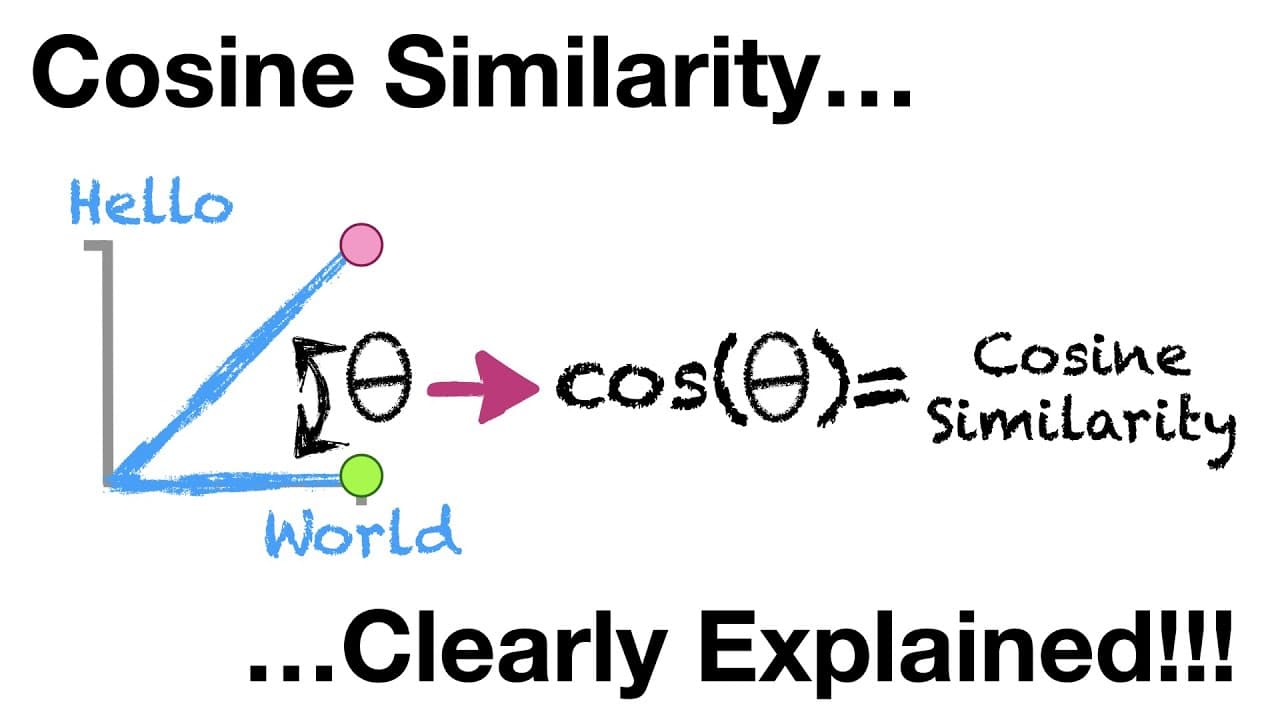
Cosine similarity quantifies the similarity between two text phrases based on the angle between their word vectors in a multidimensional space. It is calculated as the cosine of the angle formed, where a value of 1 indicates identical phrases and 0 indicates no similarity. This metric is crucial for analyzing large text datasets effectively.
Transcript
I think that the cosine is fine so we'll calculate it between this and that line stat Quest hello I'm Josh starmer and welcome to stat Quest today we're going to talk about the cosine similarity and it's going to be clearly explained when you build them and deploy in awesome stuff and it's really fast you're using light now hoor ay this stat Quest ... Read More
Key Insights
- ⚾ Cosine similarity measures text similarity based on word occurrences.
- ❓ It is essential for analyzing text datasets efficiently.
- 📈 The angle between word vectors determines the similarity metric.
- ❓ Cosine similarity simplifies text comparisons and quantifies similarity.
- ❓ It provides a numerical measure of similarity instead of subjective analysis.
- 🌥️ The formula for cosine similarity is computationally efficient for large datasets.
- ❓ Cosine similarity is versatile and applicable in various text analysis scenarios.
Install to Summarize YouTube Videos and Get Transcripts
Explore YouTube Video Summarizer or Get YouTube Transcript Extractor
Questions & Answers
Q: What is the purpose of cosine similarity in text analysis?
Cosine similarity helps quantify text similarity by measuring the angle between word vectors in a multidimensional space, facilitating comparisons between texts based on word occurrences.
Q: How is cosine similarity computed for text analysis?
In text analysis, cosine similarity is calculated by determining the angle between word vectors in multidimensional space, expressing the degree of similarity between texts based on their word occurrences.
Q: Why is cosine similarity more efficient than manual analysis?
Cosine similarity is more efficient for large text datasets as it eliminates the subjectivity of human-eye analysis, providing a quantitative measure of similarity based on word occurrences.
Q: How does cosine similarity differentiate between similar and dissimilar texts?
Cosine similarity assigns a value of 1 for identical texts and 0 for completely dissimilar texts, with values in between denoting varying textual similarities based on word occurrences.
Summary & Key Takeaways
-
Cosine similarity quantifies text similarity based on word occurrences.
-
It is crucial for analyzing large text datasets, unlike human-eye analysis.
-
Calculated by the cosine of the angle between word vectors in multidimensional space.
Read in Other Languages (beta)
Share This Summary 📚
Summarize YouTube Videos and Get Video Transcripts with 1-Click
Try YouTube Summary with ChatGPT & Claude or YouTube Transcript Generator
Explore More Summaries from StatQuest with Josh Starmer 📚

Summarize YouTube Videos and Get Video Transcripts with 1-Click
Try YouTube Summary with ChatGPT & Claude or YouTube Transcript Generator