What Are Fibonacci and Tribonacci Numbers and Their Connection?
TL;DR
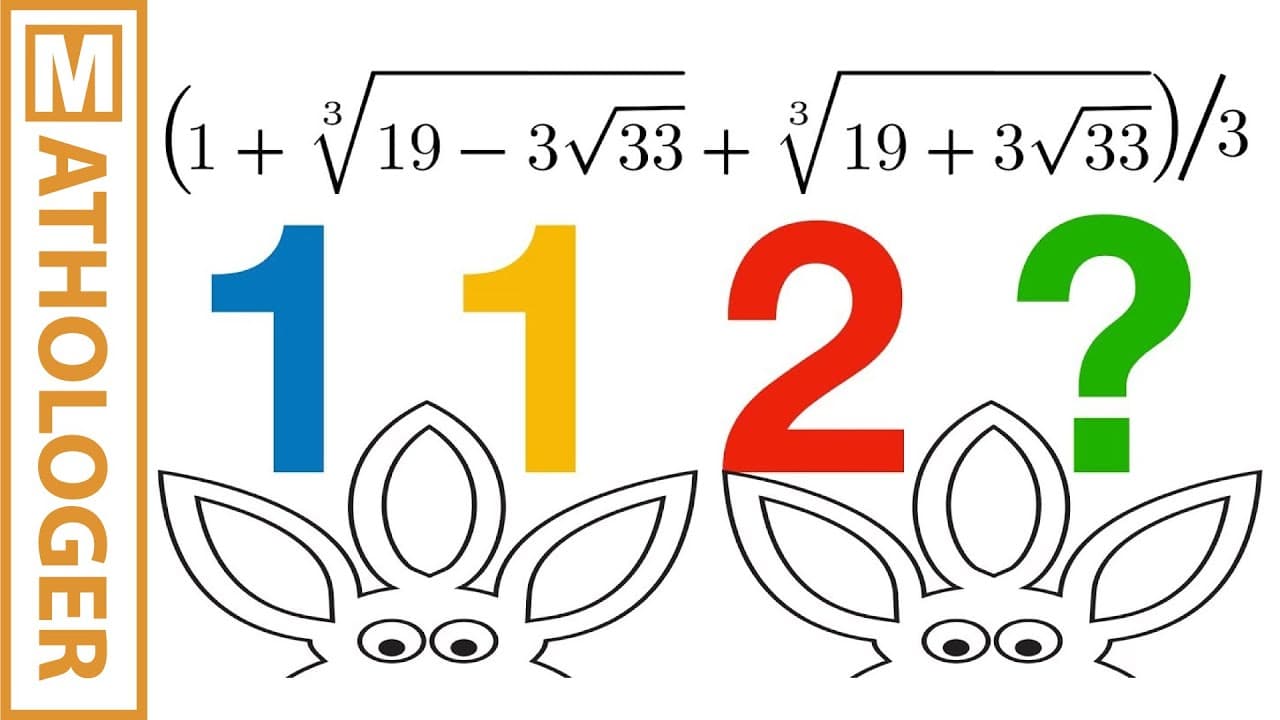
Fibonacci numbers start with 1, 1, 2, summing the previous two, while tribonacci numbers start with 1, 1, 2, summing the previous three. Both sequences have links to the golden ratio and the tribonacci constant, revealing fascinating mathematical properties and appearances in geometry and nature. Binet's formula extends to calculate the n-th Fibonacci and tribonacci numbers accurately.
Transcript
Welcome to another Mathologer video. Today I'd like to invite you to chase down a particularly crazy mathematical rabbit hole. It starts out with some curious properties of the golden ratio Phi and the Fibonacci sequence and it will culminate in some crazy facts about some mutant relatives the tribonacci constant and the tribonacci sequence and som... Read More
Key Insights
- 🥳 The Fibonacci and tribonacci sequences are intriguing mathematical sequences that have connections to the golden ratio and the tribonacci constant.
- 😃 Binet's formula provides an exact formula for calculating the n-th Fibonacci and tribonacci numbers, using powers of Phi or the tribonacci constant.
- 🥳 The golden ratio and the tribonacci sequence have significant implications in geometry and nature, appearing in various patterns and structures.
- 🥳 The Lucas sequence, a relative of the Fibonacci sequence, shares connections with the golden ratio and can be used to calculate the Lucas numbers.
- ❎ Understanding the squaring properties of Phi and the cubic equation for the tribonacci constant helps unveil the formulas and patterns in the sequences.
- 🧊 The snub cube, an Archimedean solid, is filled with tribonacci constants and exhibits symmetrical properties related to the tribonacci numbers.
Install to Summarize YouTube Videos and Get Transcripts
Explore YouTube Video Summarizer or Get YouTube Transcript Extractor
Questions & Answers
Q: How are the Fibonacci and tribonacci sequences related to the golden ratio?
The golden ratio, Phi, is the ratio of consecutive Fibonacci numbers, showing a converging pattern. Similarly, the tribonacci constant is the ratio of consecutive tribonacci numbers, also showing a converging pattern.
Q: What is Binet's formula, and how does it relate to the Fibonacci and tribonacci numbers?
Binet's formula provides an exact formula for calculating the n-th Fibonacci number and can be extended to the tribonacci numbers. The formula involves powers of Phi or the tribonacci constant and can be used to determine specific values in the sequences.
Q: How do the tribonacci and Fibonacci sequences appear in geometry and nature?
The Fibonacci sequence is often seen in natural occurrences, such as the arrangement of leaves on a stem or the spirals of pinecones and sunflowers. Similarly, the tribonacci sequence appears in geometric shapes like the snub cube, where distance ratios and other statistics are based on tribonacci constants.
Q: Can you explain the connection between the Lucas sequence and the golden ratio?
The Lucas sequence is closely related to the Fibonacci sequence and shares connections with the golden ratio. The Lucas numbers, obtained from the Lucas sequence, can be calculated using powers of Phi, similar to how Fibonacci numbers can be calculated using powers of Phi.
Summary & Key Takeaways
-
The Fibonacci sequence and the tribonacci sequence are mathematical sequences where each number is the sum of the previous numbers. Fibonacci starts with 1, 1, 2, while the tribonacci starts with 1, 1, 2, and continues with the sum of the previous three numbers.
-
The golden ratio, Phi, is the ratio of consecutive Fibonacci numbers, while the tribonacci constant is the ratio of consecutive tribonacci numbers.
-
The Lucas sequence, closely related to the Fibonacci sequence, also has connections to the golden ratio and can be used to calculate the Lucas numbers.
-
Binet's formula provides an exact formula for calculating the n-th Fibonacci number and can be extended to the tribonacci numbers.
-
Both the Fibonacci sequence and the tribonacci sequence have significant connections to geometry and nature.
Read in Other Languages (beta)
Share This Summary 📚
Summarize YouTube Videos and Get Video Transcripts with 1-Click
Try YouTube Summary with ChatGPT & Claude or YouTube Transcript Generator
Explore More Summaries from Mathologer 📚
Summarize YouTube Videos and Get Video Transcripts with 1-Click
Try YouTube Summary with ChatGPT & Claude or YouTube Transcript Generator