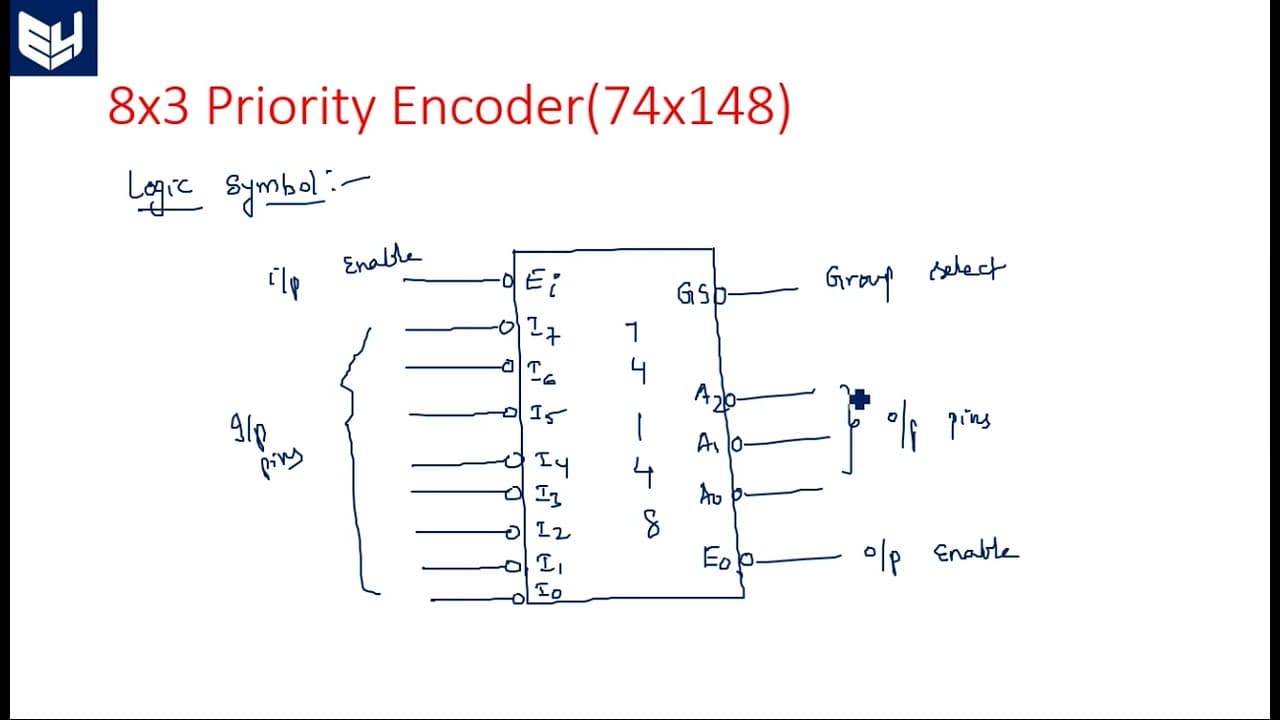
VHDL code for 8x3 Priority Encoder | 74x148 | behavioral |Part-2/2 | Digital Systems Design | Lec-69
TL;DR
This video explains how to write VHDL code for a 74148 priority encoder using a behavioral model.
Transcript
hi everyone in this video I'm going to explain how to write a behavior vhdl code for 7448 8 by3 priority encoder so in the last classes we come across this priority and coder with the logic diagram and Ruth table and the Boolean expressions and later we have gone through the data flow vhdl model for this 741 148 next in this video we are going to s... Read More
Key Insights
- ❓ A thorough understanding of the 74148 priority encoder's specifications is necessary for accurate coding in VHDL.
- 🚰 Behavioral modeling in VHDL involves conditional logic that directly correlates to the encoder’s truth table.
- 👨💻 Maintaining proper syntax in conditional statements, like using 'elsif' effectively, can simplify the structure and readability of the VHDL code.
- 🫦 Clear differentiation between single-bit and multi-bit representations in code is important for syntactical accuracy during implementation.
- 📡 The outputs, including group select and enable signals, are essential for indicating the status of the encoded signal properly.
- 📣 Keeping a gap in the architecture can accommodate future signal additions without structural confusion.
- 🥺 Observing the order of inputs and understanding their priority leads to better encoding logic in VHDL.
Install to Summarize YouTube Videos and Get Transcripts
Explore YouTube Video Summarizer or Get YouTube Transcript Extractor
Questions & Answers
Q: What is the significance of the IC number in writing VHDL code for a priority encoder?
The IC number is crucial because it identifies the specific device and its corresponding behaviors and functionalities. Knowing the number helps in accurately creating the VHDL code that replicates the expected logic and facilitates integration into larger systems, allowing engineers to work with known specifications.
Q: How does the behavioral model differ from data flow in VHDL?
Behavioral models in VHDL focus on describing how a circuit behaves with respect to its inputs and outputs, using conditions like 'if-else' to replicate functionality. In contrast, data flow models outline how data moves through the circuit but may not explicitly define state changes in the same detailed manner as behavior models.
Q: Why is it necessary to start with the MSB (Most Significant Bit) when encoding?
Starting with the MSB is essential because it prioritizes higher value inputs, which can change the output states decisively in priority encoding. Ensuring that the highest input takes precedence aligns with the operational logic of priority encoders, thus avoiding conflicts or misrepresentations in multi-bit signal handling.
Q: What does the 'enable' input do in the context of a priority encoder?
The 'enable' input in a priority encoder dictates whether the encoder should process the input signals or not. If the enable signal is active, the encoder evaluates the input values, producing an output; if it is inactive, the outputs remain fixed, regardless of other input states, ensuring control over the signal processing.
Summary & Key Takeaways
-
The video provides a detailed explanation of writing VHDL code for the 74148 priority encoder, highlighting the significance of IC numbers and understanding the behavior of the encoder based on its truth table.
-
It covers the structure of the behavioral model where the architecture begins with defining the library and includes components such as inputs (enable and data lines) and outputs (group select and enable signal).
-
The video elaborates on the process formatting in VHDL, emphasizing the use of 'if' statements to align the behavior of the code with the truth table conditions for encoding, while ensuring syntax correctness.
Read in Other Languages (beta)
Share This Summary 📚
Summarize YouTube Videos and Get Video Transcripts with 1-Click
Try YouTube Summary with ChatGPT & Claude or YouTube Transcript Generator