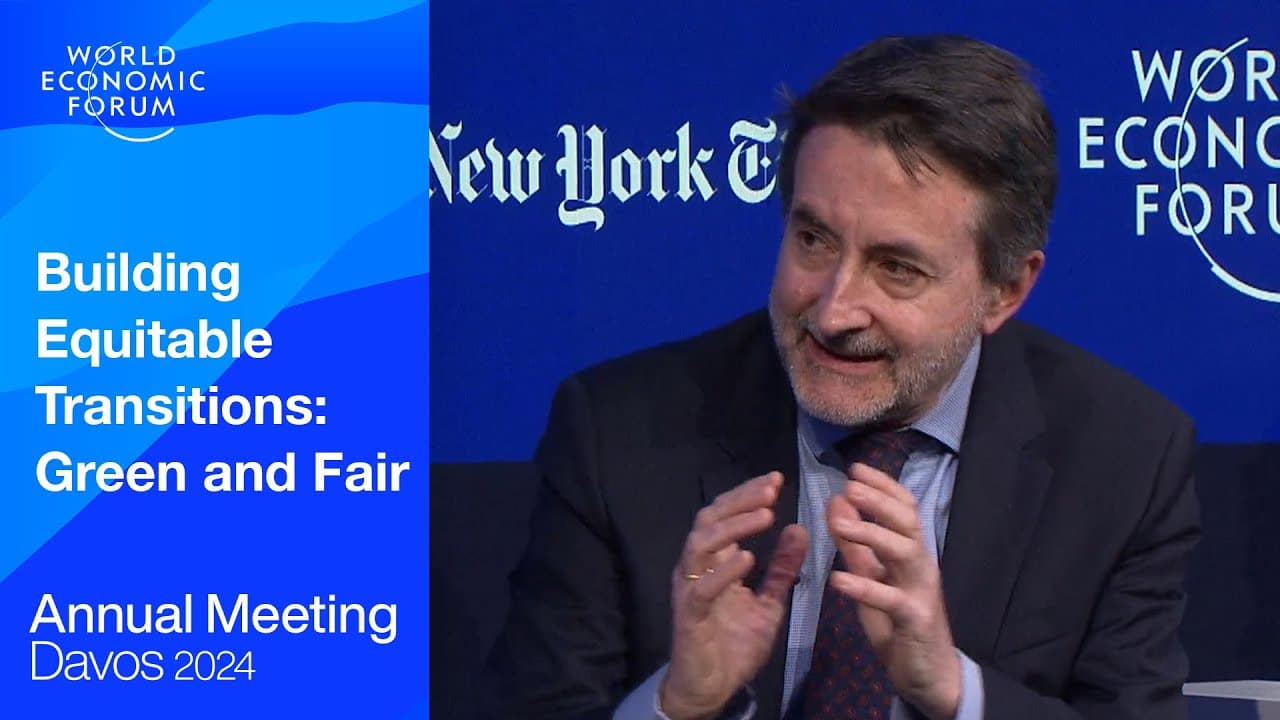
Building Equitable Transitions: Green and Fair | Davos 2024 | World Economic Forum
TL;DR
Global leaders address equitable energy transition challenges, emphasizing skills, finance, and industry shifts for a sustainable future.
Transcript
good morning good afternoon does good evening I don't know what time it is anymore in Davos how's everyone doing uh thank you all for being here um my name is David gallis I'm a managing correspondent for the climate section of the New York Times I write the climate forward newsletter which I would encourage all of you to subscribe to uh I host our... Read More
Key Insights
- ❓ Transition includes diverse sectors like agriculture, housing, and energy, emphasizing equitable reskilling and investment.
- ❓ Renewable energy solutions offer opportunities for job growth and sustainability while incorporating region-specific adaptation strategies.
- 💚 Global policy reforms, agility, and skills development are crucial for navigating the green transition successfully.
- ❓ Affordable housing challenges, regulatory complexities, and skills shortages require cohesive strategies for inclusive, sustainable development.
Install to Summarize YouTube Videos and Get Transcripts
Explore YouTube Video Summarizer or Get YouTube Transcript Extractor
Questions & Answers
Q: How can the green transition impact the agricultural sector, and what opportunities does it present?
The green transition in agriculture involves leveraging technology and biogas production to improve efficiency, linking farm sectors to sustainable energy solutions, and creating economic activities in rural areas.
Q: Why is it essential to address housing affordability and regulatory challenges in the sustainability transition?
Regulatory barriers can hinder affordable housing development, exacerbating affordability crises. Inclusive approaches are vital to balancing sustainability standards with housing accessibility and affordability.
Q: Why is it crucial to reskill the workforce for the green transition, and how can companies ensure workforce inclusivity?
Companies investing in reskilling and upskilling their workforce ensure inclusivity in the transition. Skilled labor shortages require an emphasis on comprehensive, dignified employment that emphasizes vocational trades.
Q: What challenges exist in ensuring a comprehensive and equitable transition strategy for developing countries in green transformation?
Developing countries face obstacles in aligning financial regulations and adapting to blended finance models. Enhanced cooperation and adaptation strategies can support sustainable transitions and adaptation needs.
Summary & Key Takeaways
-
Global energy transition underway with emphasis on the immense shift required in various industries, from transportation to agriculture.
-
Exploration of equitable financing and reskilling needs for developing economies in creating sustainable transitions.
-
Panel discussions at Davos highlight the intersection of skills development, policy reforms, and technological advancements in navigating the green transition.
Read in Other Languages (beta)
Share This Summary 📚
Summarize YouTube Videos and Get Video Transcripts with 1-Click
Try YouTube Summary with ChatGPT & Claude or YouTube Transcript Generator
Explore More Summaries from World Economic Forum 📚
Summarize YouTube Videos and Get Video Transcripts with 1-Click
Try YouTube Summary with ChatGPT & Claude or YouTube Transcript Generator