How to Solve Schrödinger's Equation on a Circle
TL;DR
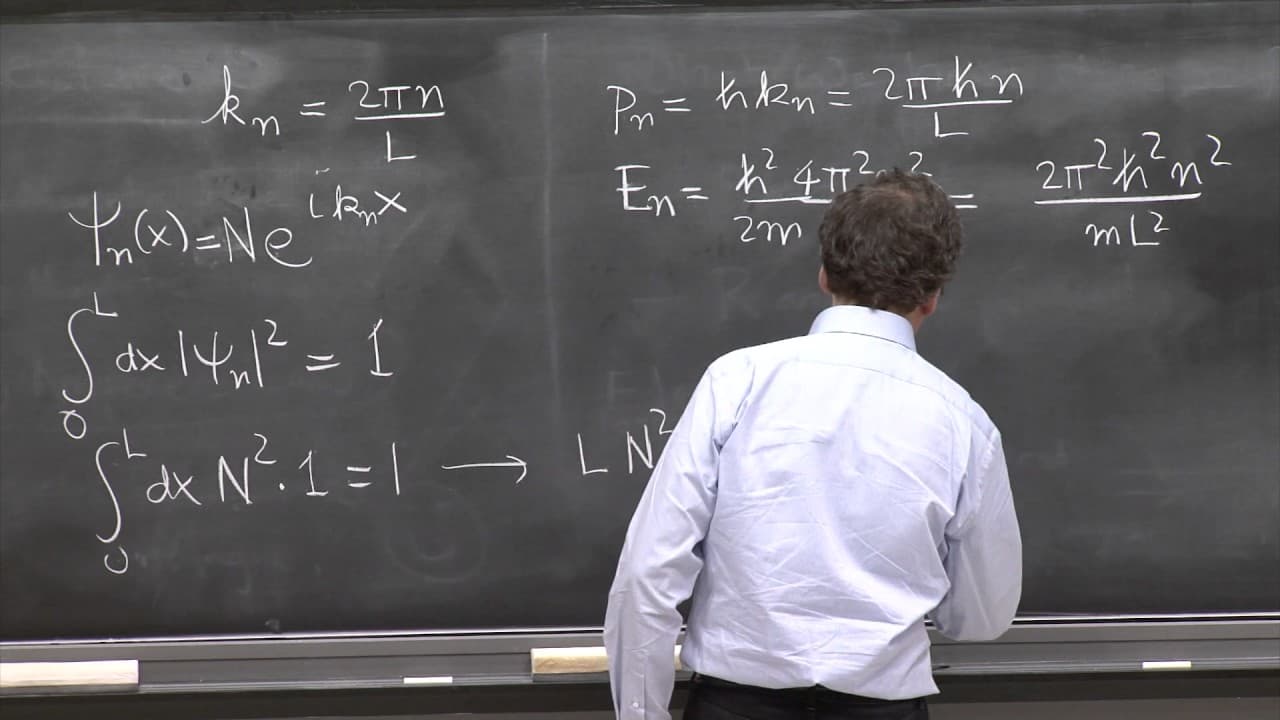
Solving Schrödinger's equation for a particle on a circle yields quantized energy and momentum values represented by exponential wave functions. The solutions must adhere to periodicity and normalization conditions, leading to a comprehensive understanding of the particle's behavior and state properties.
Transcript
PROFESSOR: Last time we talked about particle on a circle. Today the whole lecture is going to be developed to solving Schrodinger's equation. This is very important, has lots of applications, and begins to give you the insight that you need to the solutions. So we're going to be solving this equation all through this lecture. And let me remind you... Read More
Key Insights
- 👋 Solving Schrodinger's equation for a particle on a circle involves finding exponential wave function solutions.
- 👋 The momentum and energy values for each wave function are quantized and related to the integer values of n.
- 👋 Wave functions for a particle on a circle have periodicity and satisfy normalization conditions.
Install to Summarize YouTube Videos and Get Transcripts
Explore YouTube Video Summarizer or Get YouTube Transcript Extractor
Questions & Answers
Q: Why do the wave functions for a particle on a circle have periodicity and what does this imply about the derivatives?
The wave functions have periodicity to satisfy the identification of points on the circle, and this periodicity extends to their derivatives as well. It means that the wave functions repeat after a certain interval, indicating the particle's behavior on the circle.
Q: How are the momentum and energy related to the wave solutions for a particle on a circle?
The momentum is represented by k, which is determined by the integer n. The momentum values are proportional to the quantized values of n and are given by 2pi hbar n/L. The energies, on the other hand, are determined by k squared and can be expressed as 2pi squared h squared n squared / mL squared.
Q: What is the significance of the normalization of wave functions for a particle on a circle?
The normalization allows us to determine the constant in the wave function and ensures that the probability of finding the particle anywhere on the circle is equal to 1. It allows us to make meaningful predictions and calculations using the wave functions.
Q: Are all the integers included in the values of n for a particle on a circle, and why is this important?
Yes, all the integers from negative infinity to positive infinity are included in the values of n. It is important because each integer value of n represents a unique momentum state, and excluding any integer would result in missing momentum states and incomplete understanding of the system.
Summary & Key Takeaways
-
The lecture starts by recapping the concept of a particle on a circle and the periodicity conditions for wave functions and their derivatives.
-
The Schrodinger equation for this system is derived, revealing that the energy must be positive or zero.
-
The solutions to the Schrodinger equation are found to be exponential functions, and the values of k (momentum) and energy are determined.
-
The lecture also highlights the normalization of wave functions and the full stationary states incorporating time dependence.
Read in Other Languages (beta)
Share This Summary 📚
Summarize YouTube Videos and Get Video Transcripts with 1-Click
Try YouTube Summary with ChatGPT & Claude or YouTube Transcript Generator
Explore More Summaries from MIT OpenCourseWare 📚



Summarize YouTube Videos and Get Video Transcripts with 1-Click
Try YouTube Summary with ChatGPT & Claude or YouTube Transcript Generator