Evaporation Loss and It's Measurement - Water Resource Engineering 1
TL;DR
Evaporation losses occur in reservoirs due to factors like surface area, temperature, humidity, wind velocity, and water quality. Standard pan evaporation measurement is used to estimate evaporation losses, and chemicals can be used to reduce evaporation rates.
Transcript
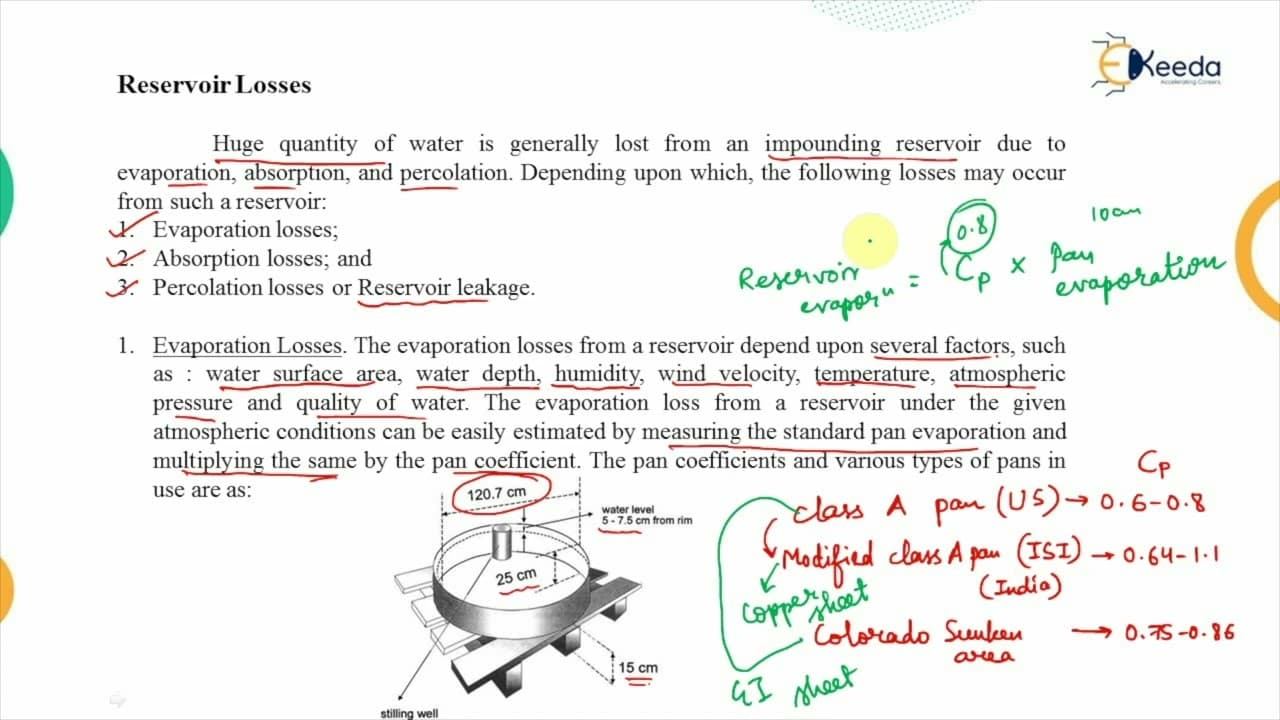
hello everyone in this video we are going to discuss the evaporation losses that is a type of the reservoir loss and how do we measure it so let's start so what are the different types of the reservoir losses that will be the point of discussion and then we will see what are the evaporation losses and how can we reduce them so generally huge quanti... Read More
Key Insights
- 😅 Evaporation losses are a significant issue in hot and humid countries like India.
- 🥇 Evaporation losses vary from place to place and season to season.
- 👿 Evaporation losses can be estimated using standard pan evaporation and pan coefficients.
- 🚱 Chemicals can be used to reduce evaporation rates, but they should be non-toxic and form a thin film over the water surface.
- 💨 Other methods for reducing evaporation include wind breakers, covers, underground storage, and integrated operation of reservoirs.
- 😒 Chemicals for evaporation control are not cost-effective for mass-scale use, and their effectiveness depends on wind velocity, temperature, and water body size.
Install to Summarize YouTube Videos and Get Transcripts
Explore YouTube Video Summarizer or Get YouTube Transcript Extractor
Questions & Answers
Q: What are the different types of reservoir losses?
The different types of reservoir losses are evaporation, absorption, and percolation.
Q: What factors affect evaporation losses in reservoirs?
Factors like surface area, temperature, humidity, wind velocity, and water quality affect evaporation losses in reservoirs.
Q: How is evaporation loss from a reservoir estimated?
Evaporation loss from a reservoir is estimated by measuring standard pan evaporation and multiplying it by the pan coefficient.
Q: What are the methods for reducing evaporation losses from reservoirs?
Methods for reducing evaporation losses include using wind breakers, providing covers on the water surface, reducing exposed surface area, using underground storage, and employing chemicals as evapo-retardants.
Summary & Key Takeaways
-
Reservoir losses include evaporation, absorption, and percolation, with evaporation being the most significant.
-
Evaporation is influenced by factors like surface area, temperature, humidity, wind velocity, and water quality.
-
Standard pan evaporation measurement is used to estimate evaporation losses, and different pan coefficients are used for different geographical conditions.
Read in Other Languages (beta)
Share This Summary 📚
Summarize YouTube Videos and Get Video Transcripts with 1-Click
Try YouTube Summary with ChatGPT & Claude or YouTube Transcript Generator
Explore More Summaries from Ekeeda 📚

Summarize YouTube Videos and Get Video Transcripts with 1-Click
Try YouTube Summary with ChatGPT & Claude or YouTube Transcript Generator