Maths Playing With Numbers part 12 (Questions: Prime, Composites) CBSE Class 6 Mathematics VI
TL;DR
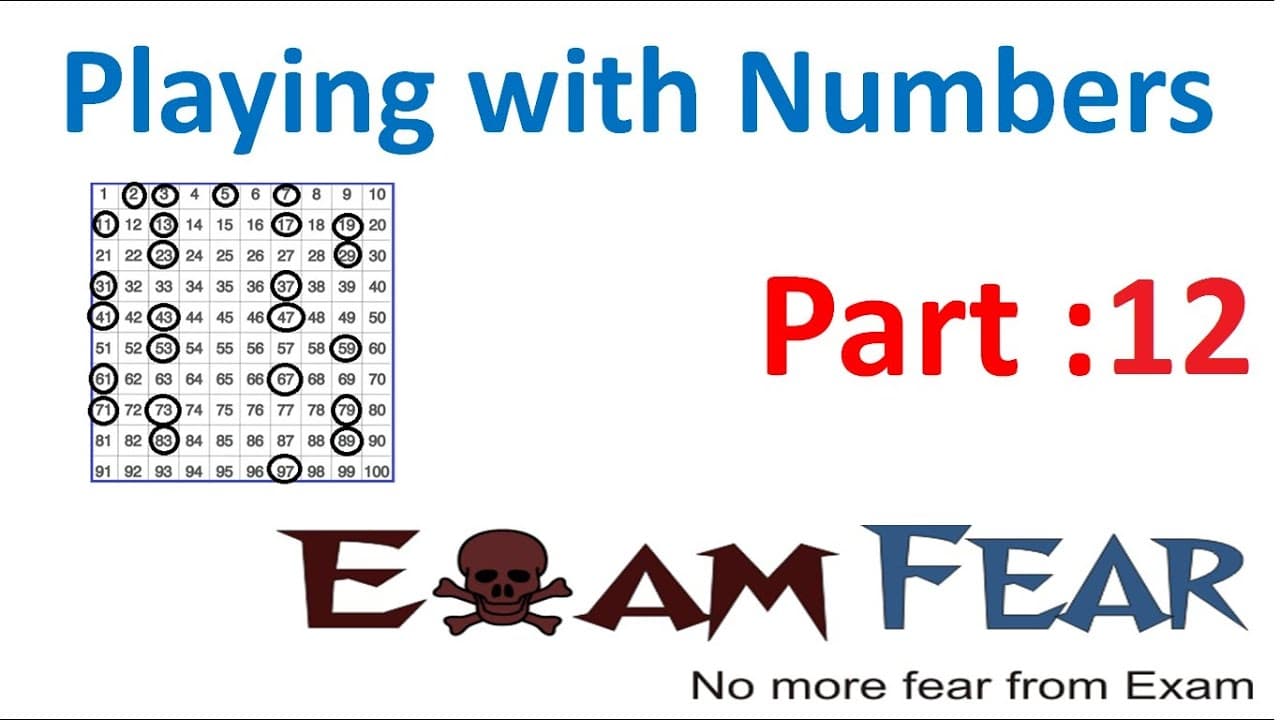
This video explains prime numbers and odd primes, including finding the greatest prime number between 1 and 10 and expressing numbers as the sum of two odd primes.
Transcript
Hello friends this video on playing with numbers Part 12 is brought to you by exam fear.com no more fear from exam question number four what is the greatest prime number between 1 and 10 so what are the numbers that we have between 1 to 10 so these are the numbers between 1 to 10 now which is the smallest prime number 1 one is not a prime number so... Read More
Key Insights
- #️⃣ Prime numbers are only divisible by 1 and themselves.
- #️⃣ The greatest prime number between 1 and 10 is 7.
- #️⃣ Expressing a number as the sum of two odd primes requires finding two primes that add up to the given number.
- #️⃣ Expressing a number as the sum of three odd primes requires finding three primes that add up to the given number.
- #️⃣ Even numbers are not prime numbers because they are divisible by 2.
- 🧑🏭 The smallest composite number is 4, since it has more than two factors.
- 🛩️ The smallest even number is 2 because it is divisible by 2.
Install to Summarize YouTube Videos and Get Transcripts
Explore YouTube Video Summarizer or Get YouTube Transcript Extractor
Questions & Answers
Q: What is the greatest prime number between 1 and 10?
The greatest prime number between 1 and 10 is 7. The video explains that prime numbers are only divisible by 1 and themselves, and 7 fits this criteria.
Q: How do you express a number as the sum of two odd prime numbers?
To express a number as the sum of two odd prime numbers, you need to find two primes that add up to the given number. The video provides examples, such as 19 + 5 = 24, where both numbers are odd primes.
Q: Can a number be expressed as the sum of two even numbers?
No, a number cannot be expressed as the sum of two even numbers and still be prime. This is because even numbers are divisible by 2, which is not a prime number.
Q: How do you express a number as the sum of three odd prime numbers?
To express a number as the sum of three odd prime numbers, you need to find three primes that add up to the given number. The video demonstrates this process with the example of expressing 61 as 19 + 39 + 3.
Summary & Key Takeaways
-
The video starts by discussing the concept of prime numbers and identifying the greatest prime number between 1 and 10, which is 7.
-
It then demonstrates how to express a given number, such as 24, as the sum of two odd prime numbers. The video provides multiple examples to explain the process.
-
The video also explores expressing a number, such as 61, as the sum of three odd prime numbers and guides viewers through the steps to find the appropriate primes.
Read in Other Languages (beta)
Share This Summary 📚
Summarize YouTube Videos and Get Video Transcripts with 1-Click
Try YouTube Summary with ChatGPT & Claude or YouTube Transcript Generator
Explore More Summaries from LearnoHub - Class 11, 12 📚


Summarize YouTube Videos and Get Video Transcripts with 1-Click
Try YouTube Summary with ChatGPT & Claude or YouTube Transcript Generator