Data sufficiency | Ranking & Order | Part-26 | Bharath Kumar
TL;DR
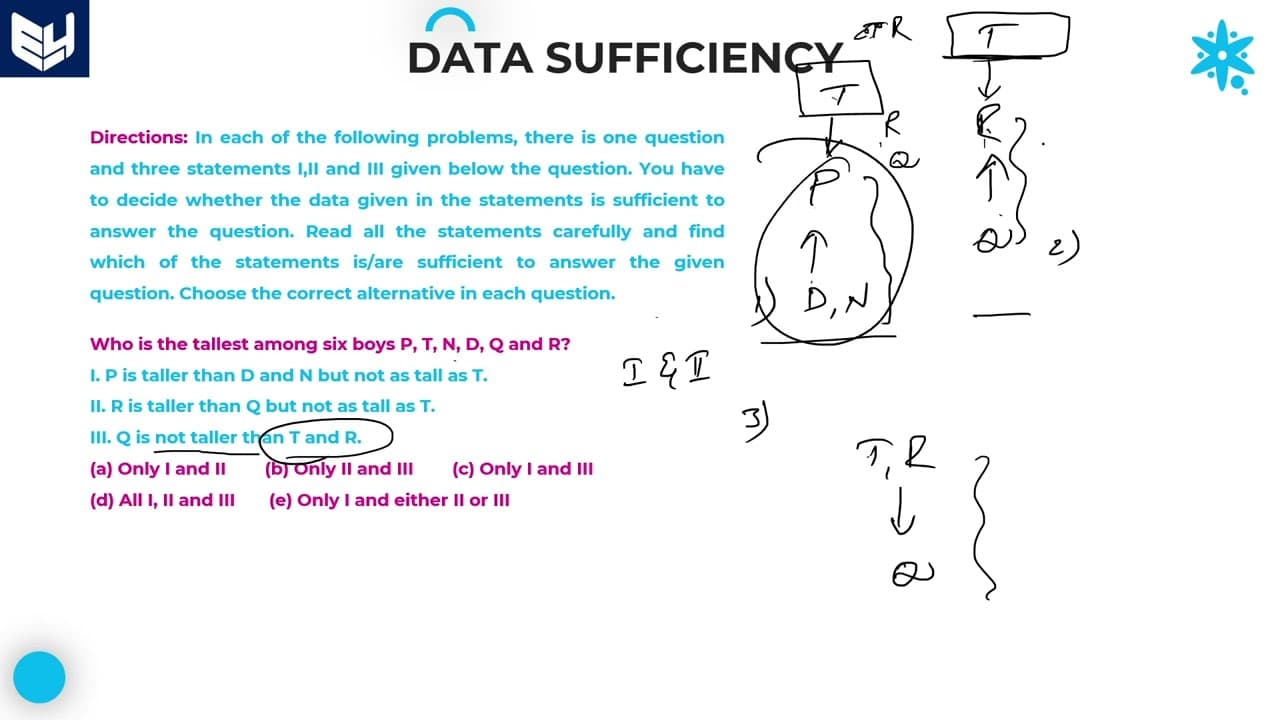
Discussing data sufficiency questions related to member heights and middle positions.
Transcript
hi everyone welcome back in this session i am going to discussing about data sufficiency that is last session uh of uh last session will continue here here the question what he is asking in this session is among r s t total five members are there among p q r s t total five q is second tallest q is second tallest this is the tallest person and given... Read More
Key Insights
- ❓ Understanding height relationships requires careful analysis of the given statements to determine their implications.
- 😜 Height comparisons involve structured reasoning where every person's rank must be deduced logically from available data.
- 🥺 Individual statements can often lead to various interpretations unless combined intelligently to reveal a clear answer.
- 🤔 Data sufficiency questions frequently test critical thinking and logical deduction skills to reach valid conclusions.
- 👂 Each scenario provides an opportunity to practice analyzing relationships and ensuring that the logic is sound for correct answers.
- 🪈 Height order determination is a common theme in logical reasoning problems that can be deeply explored with examples.
- 🥺 Logical analysis emphasizes the need for patience in problem-solving, as overlooking details can lead to incorrect assumptions.
Install to Summarize YouTube Videos and Get Transcripts
Explore YouTube Video Summarizer or Get YouTube Transcript Extractor
Questions & Answers
Q: What is the primary focus of the session?
The primary focus of the session is data sufficiency analysis related to height comparisons among a group of individuals. The equations and scenarios presented investigate how to determine the relative positions of these individuals based on provided statements, ultimately seeking to find out who ranks in specific positions like the tallest or the middle height.
Q: How is the middle person determined among height rankings?
To determine the middle person in a group, participants analyze the height relationships provided by statements. Using logical deductions from these statements can identify the rank order of individuals. For example, if Q is the second tallest and S is the immediate taller than the shortest, the remaining heights can be inferred to find the middle individual.
Q: Can the questions be solved using different combinations of statements?
Yes, the questions can often be solved using different combinations of statements. The analysis typically involves checking the sufficiency of each statement individually and then in pairs. This method ensures that all possibilities are covered, leading to a reliable conclusion about the members' heights.
Q: Why is it crucial not to jump to conclusions?
It's crucial not to jump to conclusions as the relationships among the individuals may not be straightforward. Each statement must be evaluated critically to understand how they interrelate, which ensures an accurate response based on all given information rather than assumptions or incomplete interpretations.
Summary & Key Takeaways
-
The session focuses on data sufficiency questions involving the heights of five individuals, identifying the middle person based on given statements about their relative heights.
-
Several scenarios are analyzed, showcasing how specific statements can be combined to deduce the tallest and shortest individuals, providing clarity on various interpretations.
-
The discussion emphasizes the importance of understanding the relationships among people based on their heights, illustrating how different statements can lead to the same conclusion.
Read in Other Languages (beta)
Share This Summary 📚
Summarize YouTube Videos and Get Video Transcripts with 1-Click
Try YouTube Summary with ChatGPT & Claude or YouTube Transcript Generator