Normalizing and creating sequences Crypto RNN - Deep Learning w/ Python, TensorFlow and Keras p.9
TL;DR
This video tutorial covers the process of implementing a recurrent neural network (RNN) to predict future price movements of a cryptocurrency based on historical prices and volumes.
Transcript
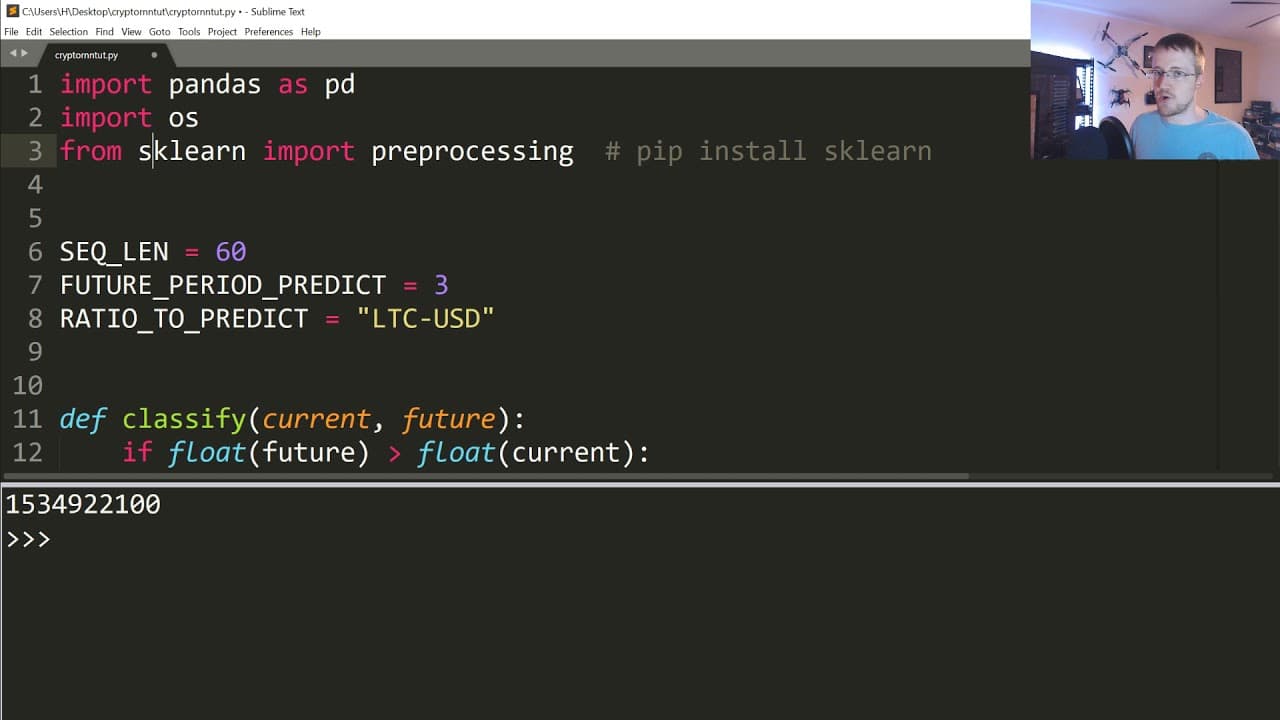
what's up everybody and welcome to another deep learning with Python tensorflow and chaos tutorial series in this video we're going to be continuing along on our little mini project of implementing or recurrent neural network to predict the future price movements of a cryptocurrency based on the sequences of that currencies prices and volumes along... Read More
Key Insights
- ⌛ Separating out-of-sample data in time series prediction is crucial to evaluate the model's performance on unseen data.
- ⚖️ Normalizing and scaling data is necessary to remove differences in magnitude and ensure suitable input for deep learning models.
- 🛝 Sequence generation involves creating sliding windows of fixed length to capture temporal relationships in the data.
Install to Summarize YouTube Videos and Get Transcripts
Explore YouTube Video Summarizer or Get YouTube Transcript Extractor
Questions & Answers
Q: Why is it important to separate out-of-sample data in time series prediction?
Separating out-of-sample data helps to evaluate the performance of a model on unseen data, preventing overfitting and ensuring generalization capability. In sequential data, shuffling data and taking a random sample as out-of-sample can result in close examples, leading to potential overfitting.
Q: Can you explain the process of normalizing and scaling the data?
Normalizing data involves converting raw values to a common scale, such as percent change, to remove differences in magnitude among different features. Scaling, using tools like Scikit-learn, ensures that all features have values between 0 and 1, making them suitable for training deep learning models.
Q: How are sequences created from the data?
Sequences are generated by creating a sliding window of fixed length (e.g., 60 minutes) over the data. Each window represents a sequence of input features, and the target label is the value of the next time step. This allows the model to learn patterns and relationships in the sequential data.
Q: Why is the target excluded from the features when creating sequences?
Excluding the target from the features prevents the model from "cheating" and directly learning the relationship between input features and the target. By predicting the target based on the previous 60 minutes of data, the network learns to capture patterns and make predictions based on historical trends.
Summary & Key Takeaways
-
The video focuses on preparing the data for training an RNN, specifically the need to separate out-of-sample data to avoid overfitting.
-
The last 5% of the historical data is separated as the out-of-sample data to ensure the model does not have close examples to train on.
-
The data is preprocessed by normalizing and scaling the features using Scikit-learn.
-
Sequences are created from the data, with the target being the current label based on the last 60 minutes of data.
Read in Other Languages (beta)
Share This Summary 📚
Summarize YouTube Videos and Get Video Transcripts with 1-Click
Try YouTube Summary with ChatGPT & Claude or YouTube Transcript Generator
Explore More Summaries from sentdex 📚


Summarize YouTube Videos and Get Video Transcripts with 1-Click
Try YouTube Summary with ChatGPT & Claude or YouTube Transcript Generator