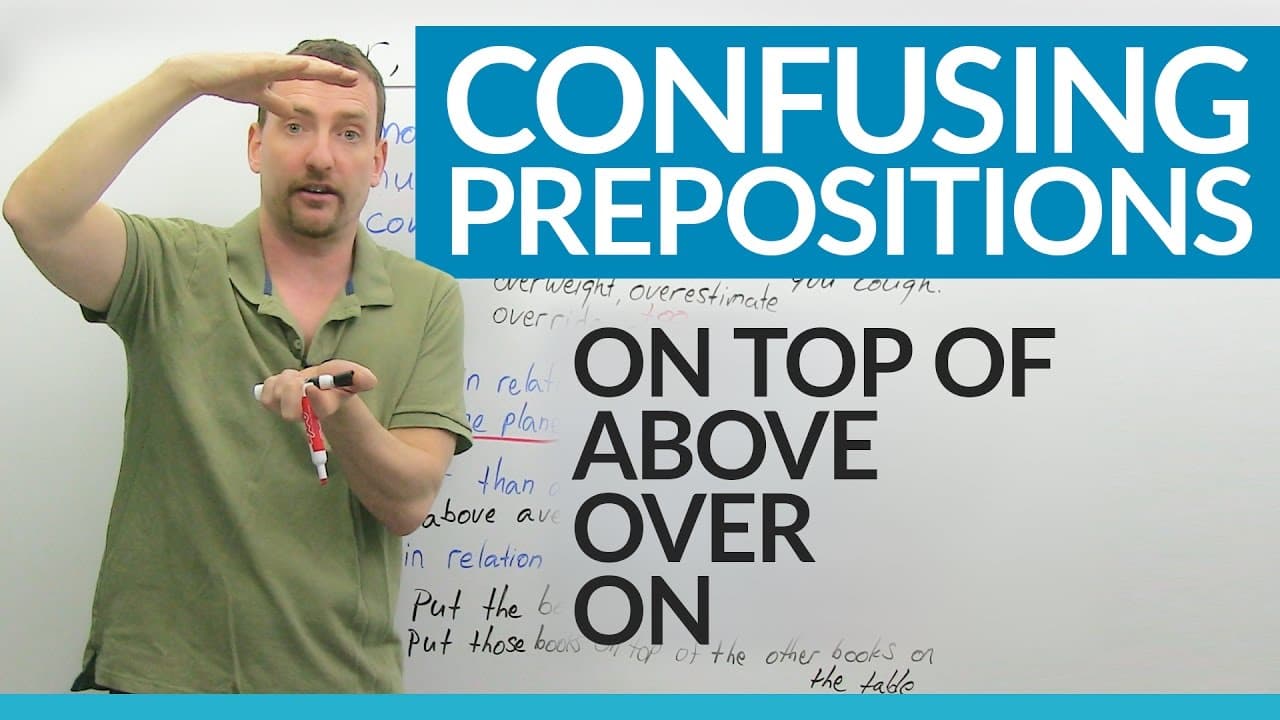
What Is the Difference Between Over, Above, On, and On Top?
TL;DR
The prepositions 'over', 'above', 'on', and 'on top of' indicate higher positions but have distinct uses. 'Over' implies movement, 'above' refers to relative height, and 'on' or 'on top of' denotes contact with a surface, with 'on top of' suggesting stacking. Understanding these nuances is crucial for correct usage.
Transcript
Hi. I'm Adam. Welcome to www.engvid.com. In today's video we're going to look at the difference between the prepositions: "over", "above", "on", and "on top of". Now, in many cases you will find or you will hear native English speakers mixing these up. They're... In some cases they're interchangeable. If you use "over" or "above" or "on", everybody... Read More
Key Insights
- ✋ "Over" suggests movement and passing from a higher position, while "above" indicates a higher position on the same plane.
- ❓ "On" or "on top of" is used when something is touching a surface, with "on top of" implying piling or stacking.
- ❓ The prepositions convey different nuances, and although they are sometimes interchangeable, there are situations where one must be used over the other.
- ❓ The context and specific meaning determine which preposition should be used.
- 💩 Abstract nouns can be used with "on top of" to indicate adding or piling up.
- ❓ "Over" is also used as a prefix to indicate more than or beyond, such as "overweight" or "overestimate".
- 😥 "Above" is used in relation to a reference point, indicating a higher position or level.
Install to Summarize YouTube Videos and Get Transcripts
Explore YouTube Video Summarizer or Get YouTube Transcript Extractor
Questions & Answers
Q: What is the difference between "over" and "above"?
"Over" suggests movement and something passing from a higher position, while "above" is used when something is at a higher position on the same plane or in relation to a reference point.
Q: Can "over" and "above" be used interchangeably?
In some cases, "over" and "above" can be used interchangeably, but there are situations where one must be used over the other to convey the correct meaning.
Q: How is "on" or "on top of" used in relation to surfaces?
"On" or "on top of" is used when something is touching a surface, with "on top of" implying stacking or piling up, like putting books on a table.
Q: Can abstract nouns be used with the preposition "on top of"?
Yes, abstract nouns can be used with "on top of" to indicate piling or adding to existing things, such as having a new boss on top of all other problems.
Key Insights:
- "Over" suggests movement and passing from a higher position, while "above" indicates a higher position on the same plane.
- "On" or "on top of" is used when something is touching a surface, with "on top of" implying piling or stacking.
- The prepositions convey different nuances, and although they are sometimes interchangeable, there are situations where one must be used over the other.
- The context and specific meaning determine which preposition should be used.
- Abstract nouns can be used with "on top of" to indicate adding or piling up.
- "Over" is also used as a prefix to indicate more than or beyond, such as "overweight" or "overestimate".
- "Above" is used in relation to a reference point, indicating a higher position or level.
- Understanding the distinctions between these prepositions helps improve communication skills in English.
Summary & Key Takeaways
-
The prepositions "over", "above", "on", and "on top of" all indicate a higher position, but they have specific uses.
-
"Over" suggests movement of something higher, such as clouds passing over a city or a sheep jumping over a fence.
-
"Above" is used when something is at a higher position on the same plane or in relation to a reference point, such as clouds lingering above a city or a house being above average price.
-
"On" or "on top of" is used when something is touching a surface, with "on top of" implying stacking or piling up, like putting books on a table.
Read in Other Languages (beta)
Share This Summary 📚
Summarize YouTube Videos and Get Video Transcripts with 1-Click
Try YouTube Summary with ChatGPT & Claude or YouTube Transcript Generator
Explore More Summaries from Adam’s English Lessons · engVid 📚

Summarize YouTube Videos and Get Video Transcripts with 1-Click
Try YouTube Summary with ChatGPT & Claude or YouTube Transcript Generator