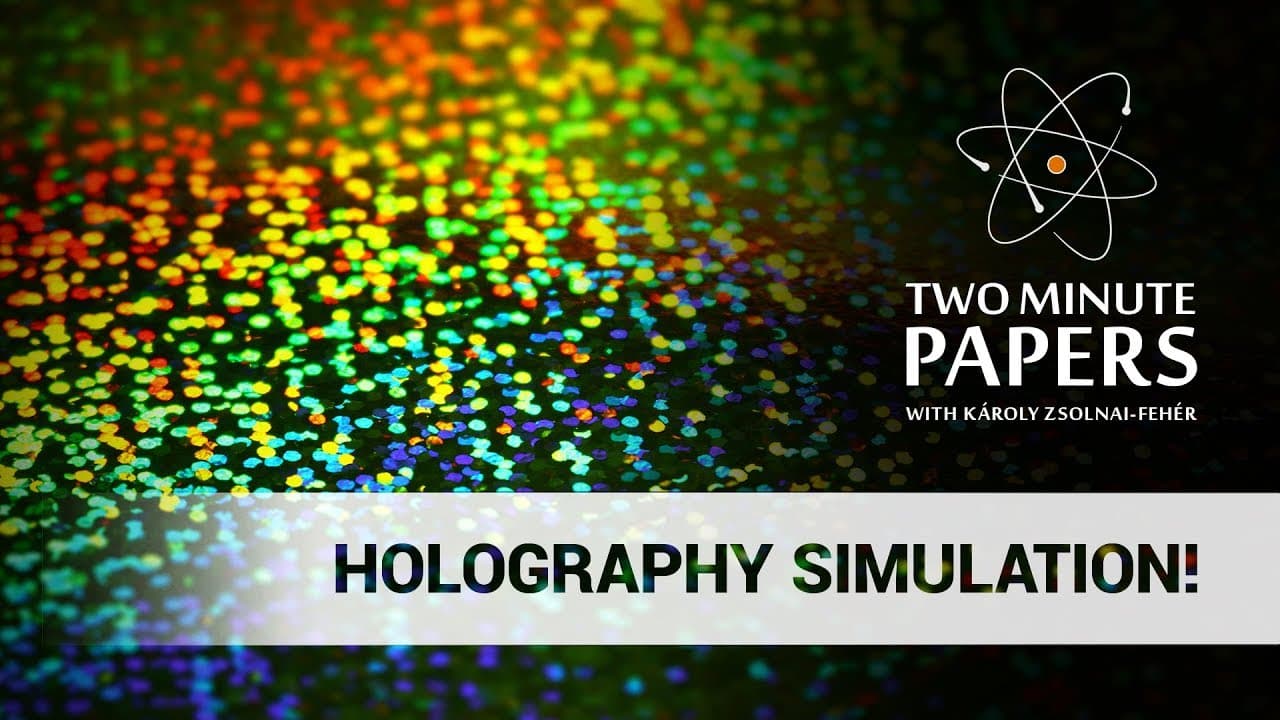
Real-Time Holography Simulation!
TL;DR
New techniques have been developed to digitally replicate holographic materials by capturing their visual structure through a few photographs, allowing for real-time interaction and artistic control.
Transcript
Dear Fellow Scholars, this is Two Minute Papers with Károly Zsolnai-Fehér. If we wish to populate a virtual world with photorealistic materials, the last few years have offered a number of amazing techniques to do so. We can obtain such a material from a flash and no-flash photograph pair of the target material, and having a neural network create a... Read More
Key Insights
- ❓ Virtual replication of photorealistic materials has advanced significantly in recent years.
- ❓ Holographic materials pose unique challenges due to their complex visual structures.
- 🖐️ Neural networks and learning algorithms play a crucial role in material replication.
- 🎚️ The proposed techniques offer different levels of accuracy and hardware requirements.
- ⌛ Real-time interaction and artistic control are possible with the replicated digital materials.
- 🎥 Consumer DSLR cameras are sufficient for capturing holographic materials.
- 🫵 Materials change in appearance with varying viewing angles and surface locations.
Install to Summarize YouTube Videos and Get Transcripts
Explore YouTube Video Summarizer or Get YouTube Transcript Extractor
Questions & Answers
Q: How can neural networks create digital versions of materials?
Neural networks can use flash and no-flash photograph pairs to extract the visual structure of a material and generate a photorealistic digital version of it.
Q: How does the learning algorithm recommend new materials?
The learning algorithm learns user preferences and suggests new materials that the user would enjoy, even without physical access to them.
Q: What are the challenges in acquiring printed holographic materials?
Holographic patterns have diverse and complex visual structures, including rotational effects, diffractive areas, and glitter. Capturing these patterns accurately is a challenge.
Q: What are the proposed techniques for replicating holographic materials?
The first technique assumes repetition in the visual structure and can generate high-quality results with only 1 to 5 photographs. The second technique, although more exhaustive, can handle arbitrary structures and requires at least 4 photographs.
Summary & Key Takeaways
-
The last few years have seen numerous techniques for populating virtual worlds with realistic materials.
-
A neural network can create digital versions of materials using flash and no-flash photograph pairs.
-
Another recent learning algorithm can recommend new materials based on user preferences.
Read in Other Languages (beta)
Share This Summary 📚
Summarize YouTube Videos and Get Video Transcripts with 1-Click
Try YouTube Summary with ChatGPT & Claude or YouTube Transcript Generator
Explore More Summaries from Two Minute Papers 📚




Summarize YouTube Videos and Get Video Transcripts with 1-Click
Try YouTube Summary with ChatGPT & Claude or YouTube Transcript Generator