How to Determine Bond Polarity and Dipole Moments
TL;DR
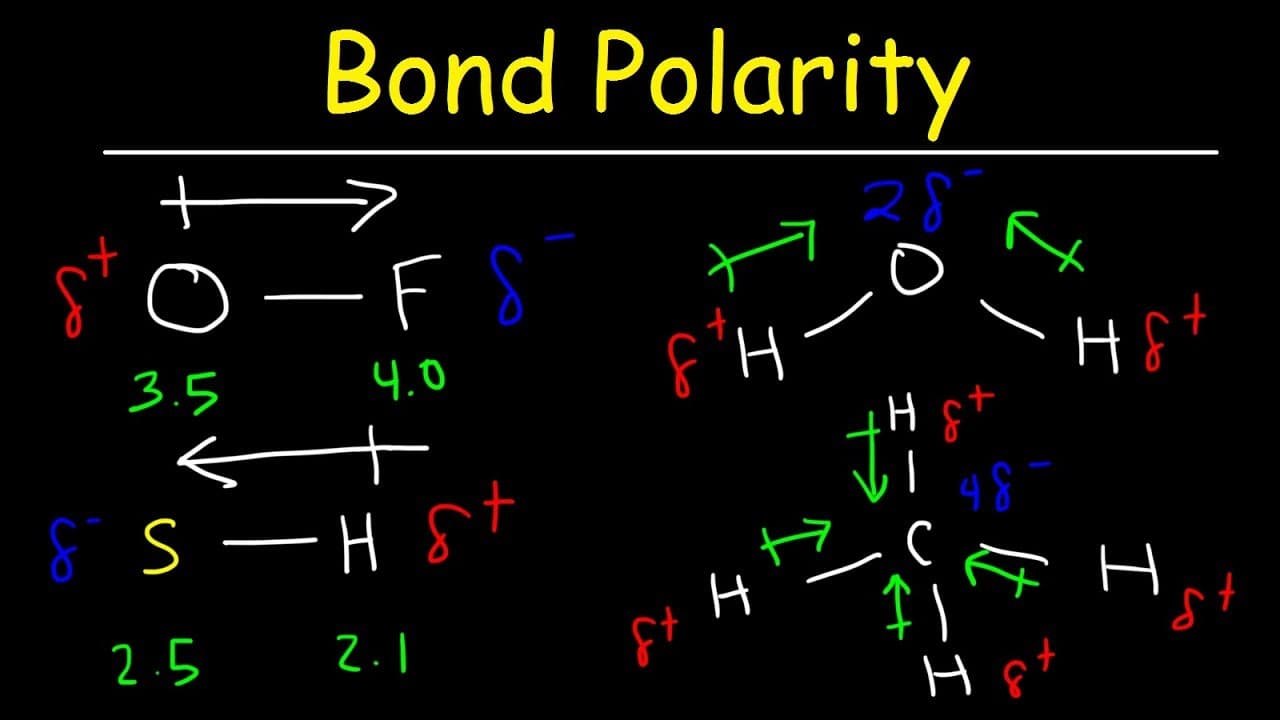
To determine bond polarity, calculate the electronegativity difference between the two atoms: if it’s less than 0.5, the bond is nonpolar; if greater, it’s polar. Dipole moments are indicated by arrows pointing from the positive to the negative end, and a net dipole moment indicates that the molecule itself is polar.
Transcript
so this tutorial is going to be about bond polarity and dipole moments so let's look at this question show the bond polarity and dipole moments in the following bonds and molecules so let's start with the carbon oxygen bond so how can we show the bond polarity and dipole moment and also how can we determine if that bond is going to be polar or nonp... Read More
Key Insights
- 🐻❄️ Covalent bonds between nonmetals can be classified as polar or nonpolar based on the electronegativity difference.
- 🈂️ In polar covalent bonds, one atom gains a partial negative charge, while the other gains a partial positive charge.
- 💘 Dipole moments indicate bond polarity, with the arrow pointing from positive to negative.
- 🐻❄️ A net dipole moment determines whether a molecule is polar or nonpolar.
- 🐻❄️ Polar bonds can exist in nonpolar molecules if the dipole moments cancel out.
- ❓ Understanding electronegativity values is crucial in determining bond polarity.
- 🆘 Lewis structures help in visualizing bond polarity and dipole moments in molecules.
Install to Summarize YouTube Videos and Get Transcripts
Explore YouTube Video Summarizer or Get YouTube Transcript Extractor
Questions & Answers
Q: How do you determine if a covalent bond is polar or nonpolar?
To determine bond polarity, compare the electronegativity values of the atoms involved. If the difference is less than 0.5, it's nonpolar; if greater, it's polar.
Q: How do you indicate bond polarity in a molecule?
Bond polarity is indicated by showing the atom with a higher electronegativity value having a partial negative charge and the other atom having a partial positive charge.
Q: How are dipole moments drawn?
Dipole moments are represented by an arrow that starts from the positive part of the molecule and points towards the negative part.
Q: Can a molecule have polar bonds but be nonpolar overall?
Yes, if the dipole moments in the molecule cancel each other out, there will be no net dipole moment, making the molecule nonpolar overall.
Summary & Key Takeaways
-
Covalent bonds formed between two nonmetals can be polar or nonpolar, determined by the electronegativity difference. If the difference is less than 0.5, it's nonpolar; if greater, it's polar.
-
In a polar covalent bond, the more electronegative atom gains a partial negative charge, while the less electronegative atom gains a partial positive charge.
-
The dipole moment is represented by an arrow pointing from the positive part of the molecule to the negative part. A net dipole moment indicates a polar molecule.
Read in Other Languages (beta)
Share This Summary 📚
Summarize YouTube Videos and Get Video Transcripts with 1-Click
Try YouTube Summary with ChatGPT & Claude or YouTube Transcript Generator
Explore More Summaries from The Organic Chemistry Tutor 📚
Summarize YouTube Videos and Get Video Transcripts with 1-Click
Try YouTube Summary with ChatGPT & Claude or YouTube Transcript Generator