Unit 7: Drivers of Flexibility, Video 2: Economies of Scale
TL;DR
Large plants are often more cost-efficient due to economies of scale, but they can become more expensive if demand is not met.
Transcript
[SQUEAKING] [RUSTLING] [CLICKING] RICHARD DE NEUFVILLE: There are two main reasons why we might not want to delay decisions. The main one is, perhaps, economies of scale. And the second one is competitive gaming. So let me address the first one next. But the answer is there are reasons why you don't want flexibility. And here is an economic one. So... Read More
Key Insights
- 🇨🇷 Economies of scale can result in cost advantages by lowering costs per unit through increased production capacity.
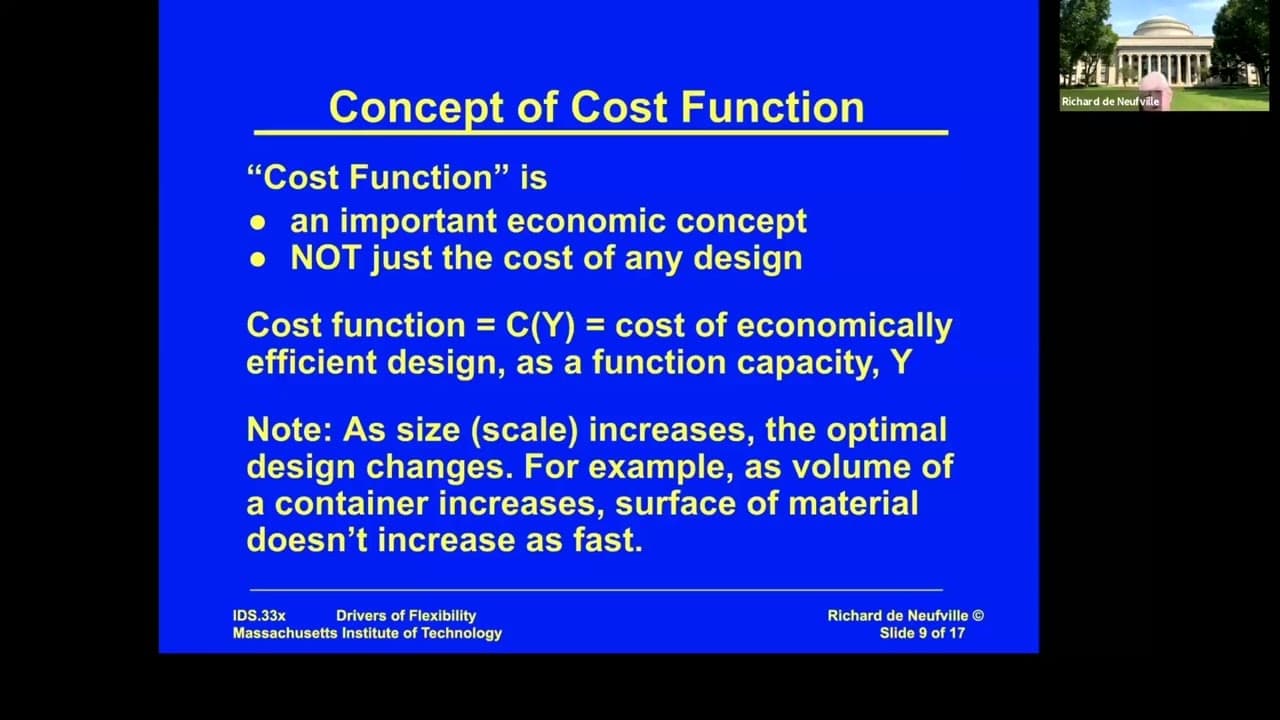
- 🧑🏭 The cost function determines the most efficient design based on capacity and local economic factors.
- 😘 Large plants designed for economies of scale may operate inefficiently if demand is lower than anticipated, leading to higher costs per unit.
- 🇦🇪 The cost per unit produced is not solely dependent on capacity but also influenced by actual demand and utilization of resources.
- 🧑🏭 Economically efficient designs may vary across different regions due to varying factors such as labor and material costs.
- ⚖️ While economies of scale are prevalent in many industries, their effectiveness can vary, with a common threshold for the coefficient alpha around 0.6.
- 🌱 Large plants designed for economies of scale are not always more cost-efficient if they are not operating at their intended capacity.
Install to Summarize YouTube Videos and Get Transcripts
Explore YouTube Video Summarizer or Get YouTube Transcript Extractor
Questions & Answers
Q: What are economies of scale?
Economies of scale refer to the concept where larger production units can achieve lower costs per unit due to increased capacity and efficiency.
Q: Why do large plants designed for economies of scale sometimes operate inefficiently?
Large plants may operate inefficiently if demand is lower than anticipated, resulting in higher costs per unit produced due to underutilization of resources.
Q: How does the cost function vary across different regions?
The cost function is influenced by local economic factors, such as the cost of labor, raw materials, and land. Therefore, economically efficient designs may differ across regions.
Q: Are economies of scale always beneficial?
While economies of scale can lead to cost advantages, they are not always beneficial. If demand is not met or if there is a mismatch between anticipated capacity and actual usage, the cost per unit produced can be higher.
Summary & Key Takeaways
-
Economies of scale refers to the cost advantages gained by increasing the capacity of production units, resulting in lower costs per unit.
-
The cost function is an economic concept that determines the most efficient design based on capacity and local economic factors.
-
Large plants designed for economies of scale may operate inefficiently if demand is not met, leading to higher costs per unit.
Read in Other Languages (beta)
Share This Summary 📚
Summarize YouTube Videos and Get Video Transcripts with 1-Click
Try YouTube Summary with ChatGPT & Claude or YouTube Transcript Generator
Explore More Summaries from MIT OpenCourseWare 📚



Summarize YouTube Videos and Get Video Transcripts with 1-Click
Try YouTube Summary with ChatGPT & Claude or YouTube Transcript Generator