L1.2 Setting up the perturbative equations
TL;DR
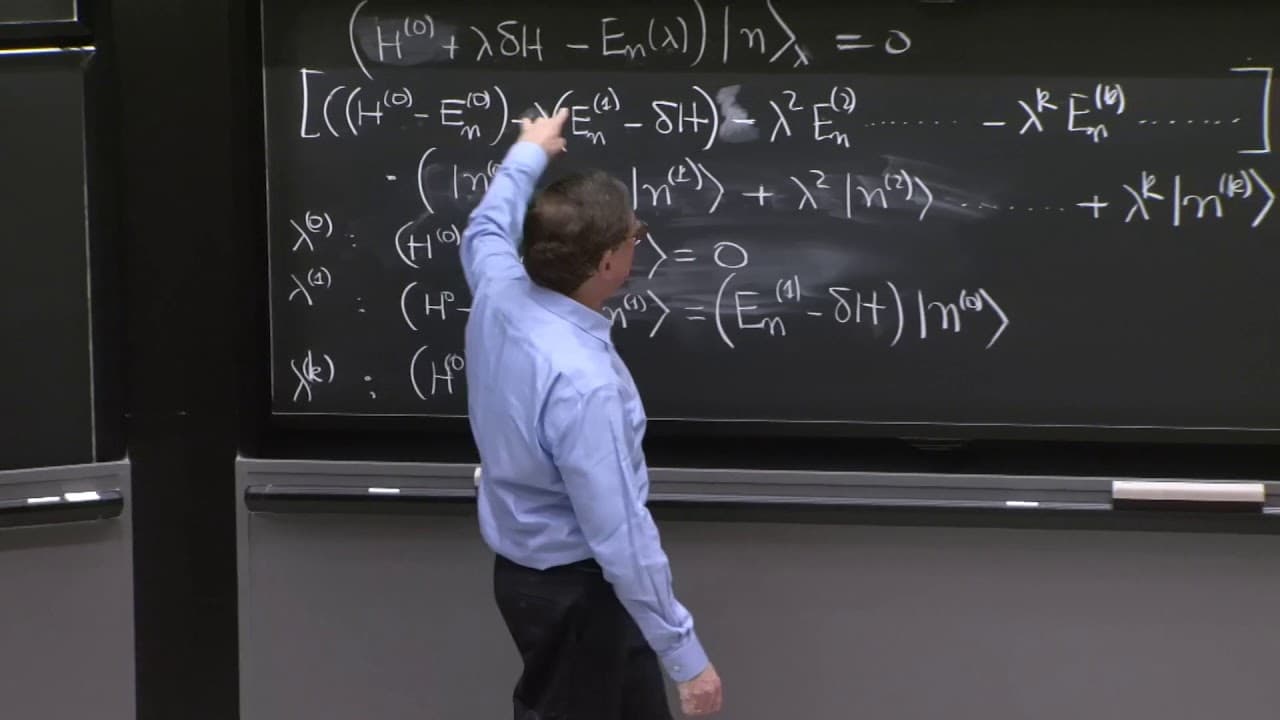
Perturbation theory is used to find corrections to the state and energy levels in quantum mechanics, with lambda representing the expansion parameter.
Transcript
PROFESSOR: So here it is. Suppose you have a serious expansion in lambda. So this is the state-- when lambda is equal to 0, this should be the state. But when lambda is different from 0, that will not be the state. We'll have lambda correction. So this is the first-order correction to this state. So that's why I put the 1. And you should think of i... Read More
Key Insights
- 🦾 Lambda represents the expansion parameter in perturbation theory in quantum mechanics.
- 😫 First-order corrections can be found by solving the Schrodinger equation and setting the lambda terms equal to zero.
- 🪈 Higher order corrections can be calculated recursively, using the solutions from previous orders.
- ❓ Choosing the corrections to be orthogonal to the original state simplifies the calculations.
Install to Summarize YouTube Videos and Get Transcripts
Explore YouTube Video Summarizer or Get YouTube Transcript Extractor
Questions & Answers
Q: What is perturbation theory used for in quantum mechanics?
Perturbation theory is used to find corrections to the state and energy levels of a system in quantum mechanics by using an expansion parameter, lambda.
Q: How are the lambda corrections represented mathematically?
The lambda corrections are represented as lambda, lambda squared, and so on, depending on the order of the correction.
Q: What is the importance of finding the first-order corrections?
Finding the first-order corrections is important because it allows for a more accurate understanding of the system, and if time permits, higher order corrections can also be calculated.
Q: How is the Schrodinger equation used in perturbation theory?
The Schrodinger equation is used to set up the perturbation problem and solve for the corrections to the state and energy levels.
Summary & Key Takeaways
-
Perturbation theory is used to find corrections to the state and energy levels in quantum mechanics.
-
The corrections are represented by lambda, which represents the expansion parameter.
-
The corrections can be found by solving the time-independent Schrodinger equation.
Read in Other Languages (beta)
Share This Summary 📚
Summarize YouTube Videos and Get Video Transcripts with 1-Click
Try YouTube Summary with ChatGPT & Claude or YouTube Transcript Generator
Explore More Summaries from MIT OpenCourseWare 📚


Summarize YouTube Videos and Get Video Transcripts with 1-Click
Try YouTube Summary with ChatGPT & Claude or YouTube Transcript Generator