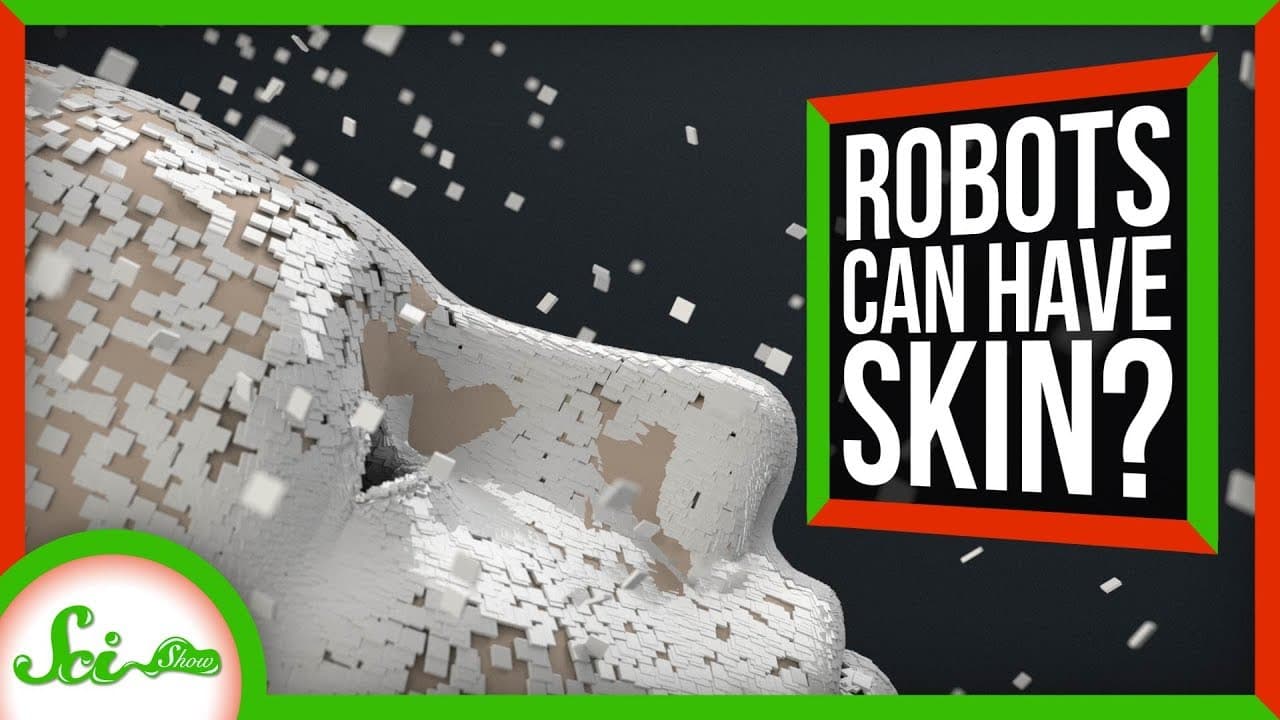
Robots Can Have Skin Now | SciShow News
TL;DR
Scientists have created the first autonomous robot with full-body skin, mimicking human skin's ability to sense and send important data while completing sensitive physical tasks and helping people with spinal cord injuries.
Transcript
[ ♪INTRO ] Robot designs have come a long way. But there’s one thing we haven’t been able to give our mechanical creations: skin. I mean, obviously we’ve been able to coat robots in plastics that look like skin — or, just enough like skin to be terrifying. But a sensitive outer layer that really acts like skin has remained out of reach… until now, ... Read More
Key Insights
- 🤖 Artificial full-body skin for robots has been successfully developed, mimicking human skin's ability to sense and send important data.
- 🎒 The skin is made up of individual hexagonal "cells" packed with sensors for temperature, pressure, and acceleration.
- 🎨 Mimicking human skin's design, the sensors only send signals when there is something significant to share, reducing the overwhelming amount of data.
- 🦻 The robotic skin has been integrated into prosthetics, aiding individuals with spinal cord injuries in learning to walk again.
- 🈸 The breakthrough in robotic skin has potential applications in various industries, such as healthcare, manufacturing, and exploration.
- 😷 Full-body skin can improve a robot's ability to maintain balance and perform delicate medical procedures.
- ❓ The development of robotic skin is a significant advancement in engineering and computing capabilities.
Install to Summarize YouTube Videos and Get Transcripts
Explore YouTube Video Summarizer or Get YouTube Transcript Extractor
Questions & Answers
Q: Why is developing autonomous robots with full-body skin important?
Full-body skin can provide robots with a better sense of touch, enabling them to excel at tasks like maintaining balance and performing delicate medical procedures, ultimately making them more useful in various fields.
Q: How did scientists solve the data problem associated with large sheets of sensors?
The team designed sensors that mimic human skin by only sending signals when important information needs to be shared, similar to how our skin's sensors send signals when there are significant changes. This approach reduced the overwhelming amount of data that would be produced by constantly sending information to a central computer.
Q: How has the robotic skin been applied in the medical field?
The researchers have successfully integrated the artificial skin into prosthetics, assisting people with spinal cord injuries in learning to walk again. The skin's ability to sense and send important data helps improve the functionality of these prosthetics.
Q: What are the potential future applications for robotic skin?
The researchers hope that robotic skin will enable machines to make sense of the world around them, allowing them to be even more useful in various industries. The enhanced sense of touch and ability to gather important data can improve the performance of robots in fields such as healthcare, manufacturing, and exploration.
Summary & Key Takeaways
-
Scientists have developed the first autonomous robot with full-body skin that can mimic the sense of touch. This breakthrough could greatly enhance a robot's ability to maintain balance and perform delicate medical procedures.
-
The team created individual hexagonal "cells" packed with sensors that detect temperature, pressure, and acceleration. These cells can connect to form patches of artificial skin, giving the robot over thirteen thousand sensors.
-
To solve the data problem, the team mimicked human skin by designing sensors that only send signals when there is important information to share. The robotic skin has been successfully integrated into prosthetics and has the potential to help machines make sense of the world around them.
Read in Other Languages (beta)
Share This Summary 📚
Summarize YouTube Videos and Get Video Transcripts with 1-Click
Try YouTube Summary with ChatGPT & Claude or YouTube Transcript Generator
Explore More Summaries from SciShow 📚


Summarize YouTube Videos and Get Video Transcripts with 1-Click
Try YouTube Summary with ChatGPT & Claude or YouTube Transcript Generator