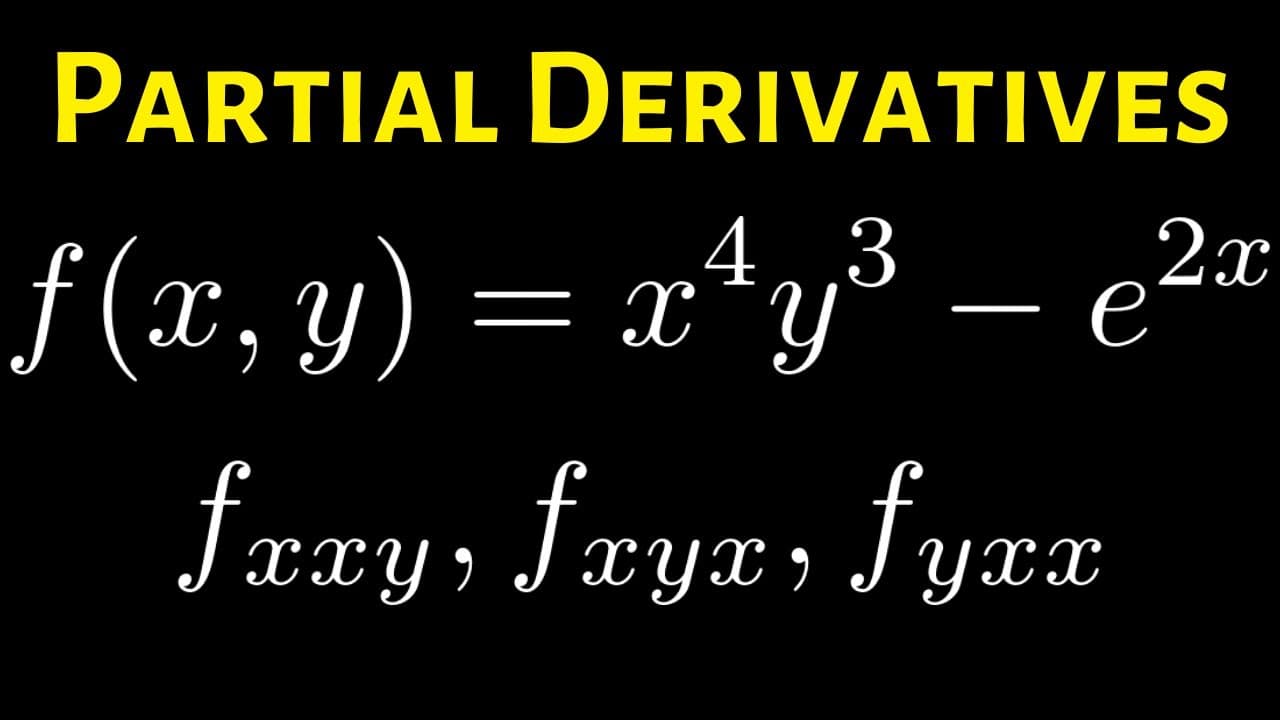
Learn How to Find Third Order Partial Derivatives for a Function of Two Variables
TL;DR
Step-by-step guide to computing third-order partial derivatives with a focus on x and y variables.
Transcript
hi everyone in this problem we have to compute the following third order partial derivatives so these that are written up here for this function here let's go ahead and go through it so let's start by computing the partial with respect to x so f x so this is equal to so when you compute this you treat all of the other variables as constants so in t... Read More
Key Insights
- 🪈 Computing third-order partial derivatives involves treating non-differentiated variables as constants.
- 📏 The chain rule is crucial for deriving partial derivatives involving exponential functions in complex functions.
- ❓ Separate calculations of partial derivatives for different variables provide insights into how each variable affects the function.
- 📏 Understanding the concept of the chain rule and constant treatment is essential for accurate partial derivative computation.
Install to Summarize YouTube Videos and Get Transcripts
Explore YouTube Video Summarizer or Get YouTube Transcript Extractor
Questions & Answers
Q: How do you compute third-order partial derivatives for a given function?
To compute third-order partial derivatives, first calculate the partial derivative with respect to x, treating other variables as constants, followed by the chain rule application for exponentials.
Q: What role does the chain rule play in computing partial derivatives?
The chain rule is essential for differentiating composite functions like exponential functions, where the derivative of the outer function is multiplied by the derivative of the inner function.
Q: Why are the third-order partial derivatives calculated separately for x and y variables?
Separate calculations for x and y variables allow for a more precise determination of how the function changes concerning each variable individually, crucial for understanding complex functions.
Q: How does the derivative with respect to x differ from that with respect to y in the context of the chain rule?
The derivative with respect to x involves treating y as a constant, while the derivative with respect to y treats x as a constant, highlighting the impact of each variable on the function.
Summary & Key Takeaways
-
Explanation of how to compute third-order partial derivatives for a given function with x and y variables.
-
Step-by-step breakdown of deriving partial derivatives with respect to x and y individually.
-
Demonstrates the application of the chain rule in computing derivatives involving exponential functions.
Read in Other Languages (beta)
Share This Summary 📚
Summarize YouTube Videos and Get Video Transcripts with 1-Click
Try YouTube Summary with ChatGPT & Claude or YouTube Transcript Generator
Explore More Summaries from The Math Sorcerer 📚



Summarize YouTube Videos and Get Video Transcripts with 1-Click
Try YouTube Summary with ChatGPT & Claude or YouTube Transcript Generator