Line Graph | Buildings in cities | DI | Reasoning | Part - 21 | Bharath Kumar
TL;DR
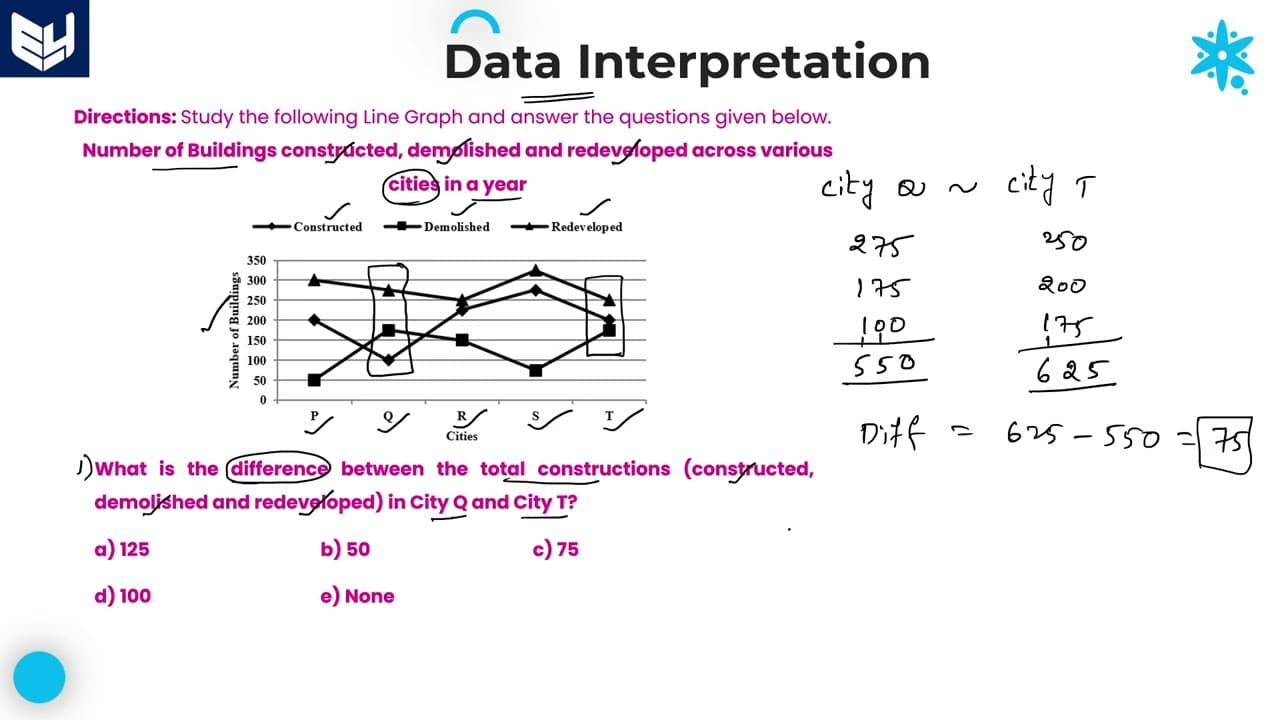
This session explains line graph data interpretation involving constructions and demolitions in cities.
Transcript
hi everyone welcome to the session in this session I am continuing line graph data and operation here I am continuing line graph data interpretation first of all we need to read the information carefully and then according to the given information we need to solve the questions first look at the information which is provided in this line graph data... Read More
Key Insights
- 🫥 A clear understanding of the scale and information presented in line graphs is essential for accurate data interpretation.
- 🏗️ Total constructions are determined by aggregating buildings constructed, demolished, and redeveloped in each city.
- 🏙️ Averages are calculated by the sum of specific categories across cities divided by the number of cities for reliable benchmarks.
- 👷 Computing percentages can provide insights into the comparative impact of construction versus redevelopment activities.
- 📈 Ratios serve as useful tools for expressing relationships and trends between different construction metrics effectively.
- ❓ Each calculation step requires careful notation and addition to avoid errors that can affect final results and their interpretations.
- ❓ The importance of clear documentation and systematic approaches is highlighted throughout the data analysis processes.
Install to Summarize YouTube Videos and Get Transcripts
Explore YouTube Video Summarizer or Get YouTube Transcript Extractor
Questions & Answers
Q: What is the importance of understanding the scale in line graph data interpretation?
Understanding the scale in a line graph is crucial because it provides the context for interpreting values accurately. For instance, if the scale represents increments of 50, each tick on the y-axis corresponds to that value. Misinterpreting the scale can lead to incorrect calculations and conclusions regarding the data represented in the graph.
Q: How is the total number of constructions calculated for a specific city?
The total number of constructions for a specific city is calculated by summing the number of buildings constructed, demolished, and redeveloped in that city. Each category is represented by a distinct shape in the graph. The corresponding values are identified, added together, and give the total constructions, which are essential for making comparative analyses among the cities.
Q: What steps are involved in calculating the average number of buildings demolished?
To calculate the average number of buildings demolished, one must first gather the respective values from different cities, then sum these values. After obtaining the total, divide that sum by the number of cities considered. This average helps to understand the overall trend of demolitions across the cities.
Q: Can you explain how to find the percentage of constructed buildings relative to redeveloped ones?
To find the percentage of constructed buildings relative to redeveloped buildings, first sum the total number of constructed buildings and total redeveloped buildings individually. Then, divide the total constructed by the total redeveloped and multiply by 100 to convert it to a percentage. This calculation illustrates the relationship between new constructions and redevelopment efforts.
Q: What is the significance of ratios in interpreting construction data?
Ratios play a significant role in interpreting construction data as they provide a comparative insight into the relationship between different categories, such as demolished versus redeveloped buildings. They simplify complex numerical relationships into comprehensible forms, allowing for quick assessments of priorities or trends in construction activity within the cities.
Q: How are discrepancies between construction values in different cities addressed?
Discrepancies between construction values in different cities can be addressed by analyzing each city's performance metrics. By calculating totals and averages and comparing these outputs, one can identify significant differences. Additionally, visual representations such as graphs or trend lines can highlight anomalies and support decision-making for urban development.
Summary & Key Takeaways
-
The session focuses on interpreting line graphs that represent the number of buildings constructed, demolished, and redeveloped in various cities labeled as P, Q, R, S, and T.
-
Key calculations were demonstrated, such as determining the total constructions between different cities and computing the average number of buildings demolished across all cities.
-
The video concludes with explanations on calculating percentages, averages, and ratios relevant to construction data, ensuring clarity in problem-solving.
Read in Other Languages (beta)
Share This Summary 📚
Summarize YouTube Videos and Get Video Transcripts with 1-Click
Try YouTube Summary with ChatGPT & Claude or YouTube Transcript Generator