14. Mass Spectroscopy Esterification Lecture Part 2
TL;DR
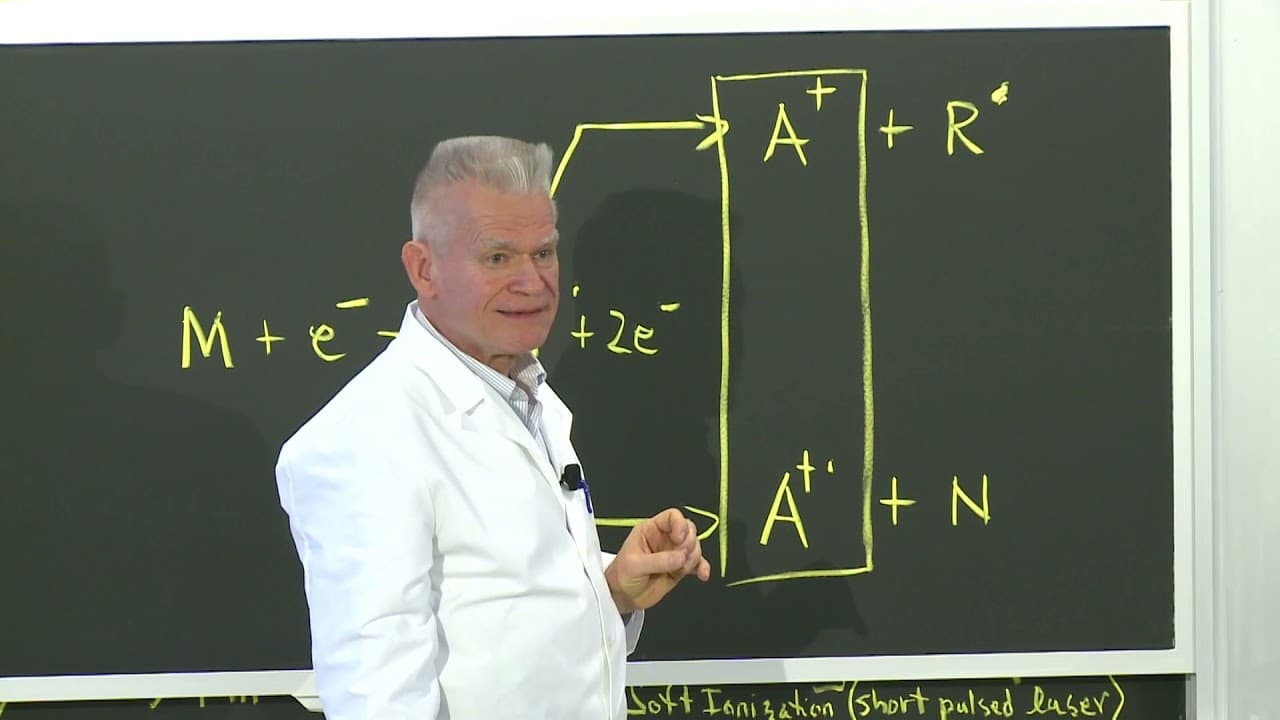
The lecture provides an overview of mass spectrometry, including different ionization techniques and the working principles of various mass spectrometers.
Transcript
[SQUEAKING] [RUSTLING] [CLICKING] JOHN DOLHUN: Hello. Good afternoon, everyone. And welcome to the second to the last lecture. Next week, the X-ray diffraction, Peter Mueller will deliver that, I believe, on Tuesday. And this is the mass spec lecture, and then we'll keep you posted as what happens in between. There are a couple of workshops for the... Read More
Key Insights
- 🈂️ Mass spectrometry relies on ionization techniques, such as electron impact and chemical ionization, to generate charged particles from a sample.
- 🥳 Different mass analyzers, including magnetic sector, time-of-flight, Fourier-transform ion cyclotron resonance, and quadrupole filter radio frequency systems, are used to separate and detect ions based on their mass-to-charge ratios.
Install to Summarize YouTube Videos and Get Transcripts
Explore YouTube Video Summarizer or Get YouTube Transcript Extractor
Questions & Answers
Q: What is the purpose of maintaining a high vacuum in the mass spectrometer?
The high vacuum inside the mass spectrometer allows the ions to have a mean-free pathway from the ion source to the detector without any biomolecular collisions, which ensures accurate mass measurement and prevents interference.
Q: How does chemical ionization differ from other ionization techniques?
Chemical ionization involves using a super acid to protonate the molecule of interest, leading to the formation of a molecular ion peak (M+1) that provides molecular weight information. It is often used for nonvolatile and high molecular weight samples.
Q: What is the advantage of time-of-flight mass spectrometry?
Time-of-flight mass spectrometry has an unlimited mass range and can be used with very small amounts of sample. It works based on the time it takes for ions to reach a detector after being shot out with the same kinetic energy.
Q: How can mass spectrometry help determine the composition and structure of a molecule?
Mass spectrometry can identify the molecular weight, the number of isotopes, and the presence of certain elements in a molecule. By analyzing the fragmentation pattern, it can also provide insights into the structure and connectivity of a molecule.
Summary & Key Takeaways
-
The lecture begins with a demonstration of an incandescent light bulb to illustrate the concept of electron flow and ionization.
-
The different ionization techniques in mass spectrometry are discussed, including electron impact, chemical ionization, fast atom bombardment, electrospray ionization, and matrix-assisted laser desorption ionization.
-
Various types of mass analyzers are explained, such as magnetic sector, time of flight, Fourier-transform ion cyclotron resonance, and quadrupole filter radio frequency systems.
Read in Other Languages (beta)
Share This Summary 📚
Summarize YouTube Videos and Get Video Transcripts with 1-Click
Try YouTube Summary with ChatGPT & Claude or YouTube Transcript Generator
Explore More Summaries from MIT OpenCourseWare 📚



Summarize YouTube Videos and Get Video Transcripts with 1-Click
Try YouTube Summary with ChatGPT & Claude or YouTube Transcript Generator