CoRL 2020, Spotlight Talk 428: BayesRace: Learning to race autonomously using prior experience
TL;DR
BayesRace optimizes autonomous racing using prior experience and model corrections.
Transcript
hi my name is matthew o'kelly today i'm presenting our paper bay's race learning to race autonomously using prior experience to motivate the problem let's draw a comparison to the ways which professional racing drivers prepare for an event you can summarize the driver's work as three steps first the drivers i... Read More
Key Insights
- BayesRace leverages prior experience to enhance autonomous racing by optimizing the racing line and adapting to real-world conditions.
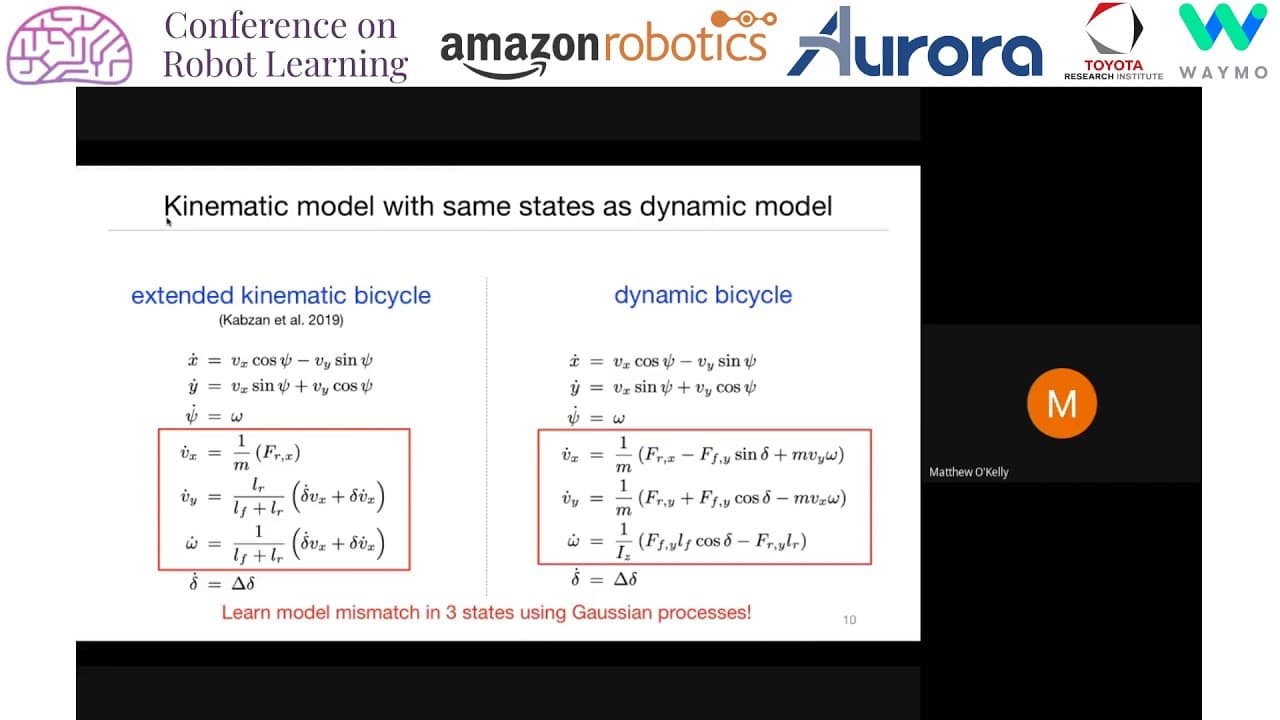
- The approach uses a closed-loop system identification to correct residuals in simpler kinematic models, reducing the complexity of system identification.
- Gaussian processes are employed to predict model mismatches, allowing for more accurate vehicle dynamics simulation.
- The framework combines an extended kinematic model with Gaussian process corrections to improve model predictive control (MPC) performance.
- Experiments conducted on two simulators, ORCA and F110, demonstrate the approach's effectiveness in learning dynamics and reducing lap times.
- The approach achieves 98% of the performance of exact models by using GP-corrected kinematic models, showcasing its efficacy.
- The method allows for continuous improvement by updating GP models with new data from the target environment, refining the controller's accuracy.
- Future work aims to conduct real vehicle experiments and explore more efficient optimization solvers and function approximators.
Install to Summarize YouTube Videos and Get Transcripts
Explore YouTube Video Summarizer or Get YouTube Transcript Extractor
Questions & Answers
Q: What is the main focus of BayesRace?
The main focus of BayesRace is to optimize autonomous racing by leveraging prior experience and correcting model mismatches. It aims to reduce the complexity of system identification and improve model predictive control performance by using a closed-loop system identification approach and Gaussian process corrections.
Q: How does BayesRace handle model mismatches?
BayesRace handles model mismatches by employing Gaussian processes to predict and correct the residual errors in simpler kinematic models. This approach allows for more accurate simulation of vehicle dynamics and enhances the performance of model predictive control, thereby improving the overall efficiency of autonomous racing algorithms.
Q: What are the key components of the BayesRace framework?
The key components of the BayesRace framework include an extended kinematic model, Gaussian process corrections, and a model predictive controller (MPC). These components work together to optimize the racing line, reduce model mismatches, and enhance the performance of autonomous racing systems by learning from prior experience and simulation data.
Q: What experiments validate the BayesRace approach?
Experiments on two open-source simulators, ORCA and F110, validate the BayesRace approach. These experiments demonstrate the framework's effectiveness in learning vehicle dynamics, reducing lap times, and achieving 98% of the performance of exact models. The results highlight the potential of the approach in autonomous racing applications.
Q: How does BayesRace improve autonomous racing performance?
BayesRace improves autonomous racing performance by optimizing the racing line and adapting to real-world conditions using prior experience. It employs Gaussian processes to correct model mismatches, enhancing the accuracy of vehicle dynamics simulation and the effectiveness of model predictive control, resulting in reduced lap times and improved overall performance.
Q: What future work is planned for BayesRace?
Future work for BayesRace includes conducting experiments on real vehicles to further validate the approach. Additionally, the research team aims to explore more efficient optimization solvers and alternative function approximators to enhance the framework's performance and applicability in diverse autonomous racing scenarios.
Q: How does BayesRace handle different vehicle scales?
BayesRace handles different vehicle scales by validating its approach on both 1:43 and 1:10 scale simulators, ORCA and F110. Despite the change in vehicle scale and dynamics, the same model predictive control parameters achieve similar performance improvements, demonstrating the approach's generalization capability and adaptability to various vehicle scales.
Q: What is the significance of Gaussian processes in BayesRace?
Gaussian processes are significant in BayesRace as they predict and correct model mismatches in the extended kinematic model. This correction allows for more accurate simulation of vehicle dynamics, reducing the complexity of system identification and enhancing the performance of model predictive control, which is crucial for optimizing autonomous racing algorithms.
Summary & Key Takeaways
-
BayesRace utilizes prior experience to optimize autonomous racing by learning to adapt to real-world conditions through simulation. It employs a closed-loop system identification approach, correcting residuals in simpler kinematic models using Gaussian processes, thus reducing the complexity of system identification.
-
Experiments on ORCA and F110 simulators validate the approach's effectiveness, achieving 98% of the performance of exact models. The GP-corrected kinematic model significantly reduces lap times, demonstrating the potential of the framework in autonomous racing applications.
-
The method allows for continuous improvement by updating GP models with new data from the target environment. Future work aims to conduct real vehicle experiments and explore more efficient optimization solvers and alternative function approximators.
Read in Other Languages (beta)
Share This Summary 📚
Summarize YouTube Videos and Get Video Transcripts with 1-Click
Try YouTube Summary with ChatGPT & Claude or YouTube Transcript Generator
Explore More Summaries from Conference on Robot Learning 📚
Summarize YouTube Videos and Get Video Transcripts with 1-Click
Try YouTube Summary with ChatGPT & Claude or YouTube Transcript Generator