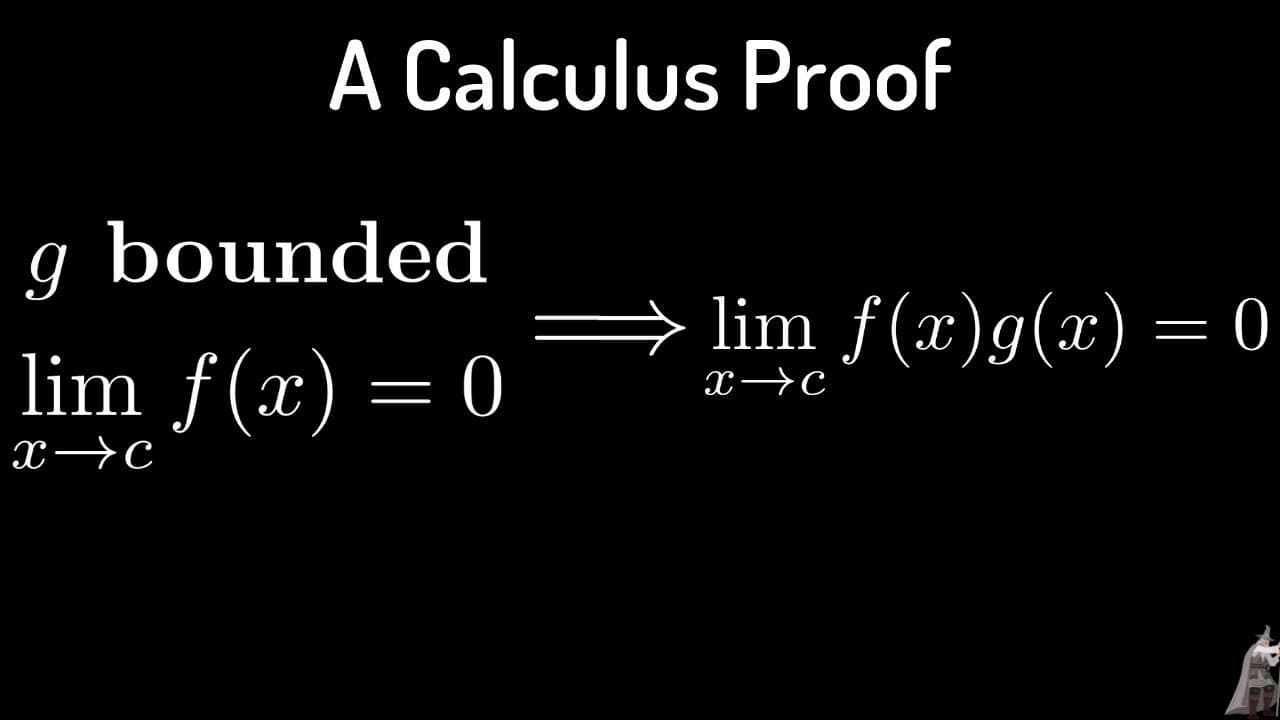
Prove that if g is Bounded and lim f(x) = 0, then lim f(x)*g(x) = 0
TL;DR
If G is bounded and the limit is zero, then the limit of F times G is also zero through the squeeze theorem.
Transcript
prove that if G is bounded and if this limit is zero then the limit of F times G is also zero so proof so we could do this proof with the definition of a limit or we could do it with the squeeze theorem let's do it with the squeeze theorem because something really useful comes from that proof something worth worth seeing so to start the proof we'll... Read More
Key Insights
- 👍 Squeeze theorem is a powerful tool for proving limits in mathematics.
- 🚱 Absolute values help in simplifying the proof process and ensuring non-negative results.
- 🖐️ Bounded functions play a crucial role in limit calculations.
- ❓ The result obtained in the proof has practical implications in mathematical analysis.
- ⛔ Understanding the concept of limits and their properties is essential for advanced mathematical proofs.
- ❓ Utilizing techniques like the squeeze theorem can provide elegant solutions to complex problems.
- ♊ The importance of assumptions, like G being bounded, can streamline proof processes.
Install to Summarize YouTube Videos and Get Transcripts
Explore YouTube Video Summarizer or Get YouTube Transcript Extractor
Questions & Answers
Q: What is the squeeze theorem and how is it used in this proof?
The squeeze theorem is a mathematical technique for proving limits. In this proof, an inequality is created using absolute values to show that the limit of the product approaches zero.
Q: Why is it important to put an absolute value around something when trying to show it is zero?
Putting an absolute value around something ensures that the result is a non-negative value, which helps in proving limits. It also helps simplify the proof process by providing one side of the inequality for free.
Q: How does the assumption of G being bounded impact the proof?
The assumption that G is bounded by M allows for simplification in the proof process. It helps in replacing the absolute value of G with a constant value, making it easier to analyze the limit.
Q: What is the significance of the result obtained in this proof?
The result shows that if a bounded function is multiplied by something approaching zero, the product also approaches zero. This has practical applications in various mathematical contexts.
Summary & Key Takeaways
-
The proof shows if G is bounded by M and the limit of f of X is zero, then the limit of the product f times G is zero.
-
Utilizes the squeeze theorem by creating an inequality with absolute values.
-
Shows that when G is bounded, the product of f and G approaches zero as X approaches C.
Read in Other Languages (beta)
Share This Summary 📚
Summarize YouTube Videos and Get Video Transcripts with 1-Click
Try YouTube Summary with ChatGPT & Claude or YouTube Transcript Generator
Explore More Summaries from The Math Sorcerer 📚


Summarize YouTube Videos and Get Video Transcripts with 1-Click
Try YouTube Summary with ChatGPT & Claude or YouTube Transcript Generator