How to Solve Weak Acid Equilibrium Problems in AP Chemistry
TL;DR
To solve weak acid equilibrium problems in AP Chemistry, use the equilibrium constant expression (Ka) to relate the concentrations of reactants and products. Calculate pH by determining the hydronium ion concentration via an ICE table, and apply the Henderson-Hasselbalch equation for buffer solutions. Practicing example questions will improve familiarity with common formats on the exam.
Transcript
In this video we'll look at a weak acid equilibrium question; this is an example of an AP chemistry free response question. Now this one is a little bit longer because I wanted to get some extra stuff in here, but it's still excellent preparation. So just as a reminder you can get all sorts of resources for AP chemistry here at my websit... Read More
Key Insights
- 😑 Equilibrium in weak acid reactions is expressed through the equilibrium constant expression, Ka.
- 😑 The pH of a weak acid solution can be calculated by determining the concentrations of H+ and conjugate base at equilibrium, using ICE tables and the Ka expression.
- 🥳 The Henderson-Hasselbalch equation is a powerful tool for calculating the pH of a buffer solution, involving the pKa and the ratio of conjugate base to acid concentrations.
- ☺️ Understanding the assumptions made during calculations, such as neglecting x due to small Ka values, can simplify problem-solving.
Install to Summarize YouTube Videos and Get Transcripts
Explore YouTube Video Summarizer or Get YouTube Transcript Extractor
Questions & Answers
Q: What is the equilibrium constant expression (Ka) for formic acid?
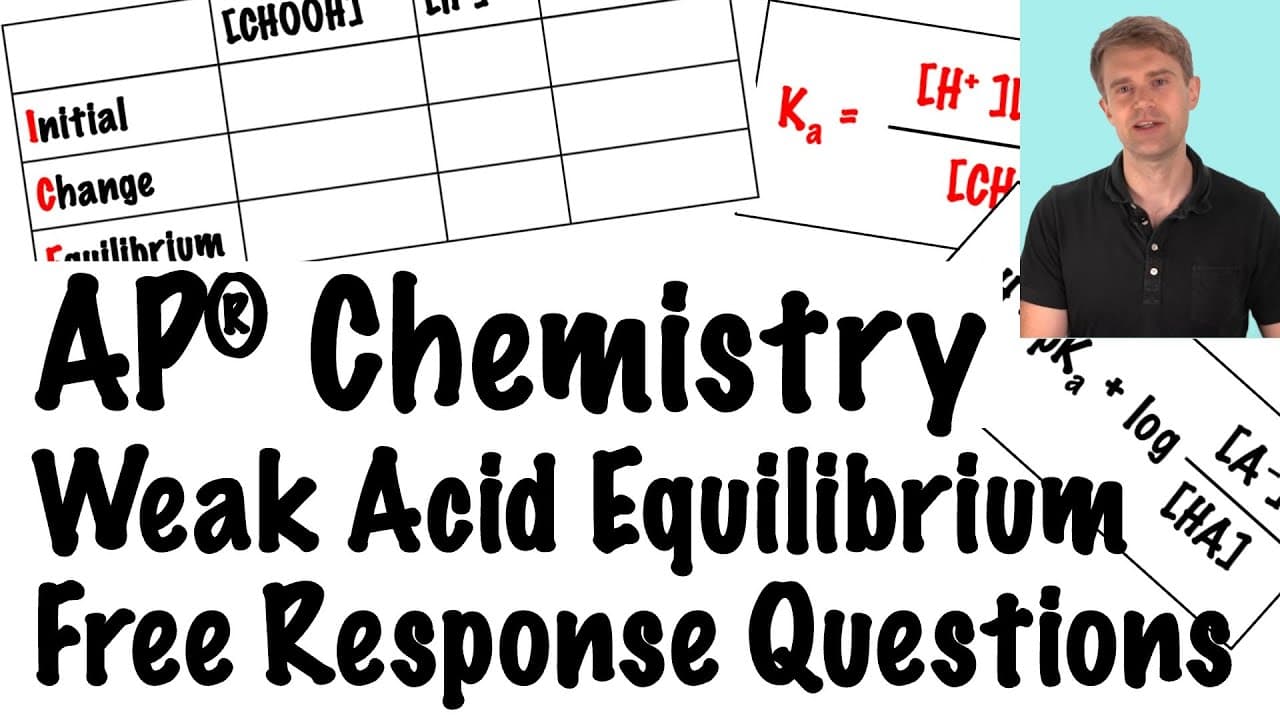
The Ka expression for formic acid is [H+][A-] / [HA], where [H+] represents the concentration of hydronium ion, [A-] represents the concentration of the formate ion, and [HA] represents the concentration of formic acid.
Q: How is the pH of a 0.12 molar aqueous solution of formic acid calculated?
To calculate the pH, an ICE table is used to determine the concentrations of H+ and formate ions at equilibrium. By plugging in these values into the Ka expression and solving for x, the concentration of H+, the negative log of the H+ concentration is taken to obtain the pH.
Q: What assumptions are made when solving for x in the pH calculation?
Due to the small value of Ka, it is assumed that x, the concentration of H+, is negligible compared to the initial concentration of formic acid. This simplifies the calculation and allows the quadratic equation to be bypassed.
Q: How many moles of sodium formate are needed to create a buffer solution with a pH of 3.90?
Using the Henderson-Hasselbalch equation, the concentration of the formate ion is calculated based on the known pH, pKa, and the concentration of formic acid. The moles of sodium formate needed can then be calculated using the molarity equation, given the volume of the solution.
Summary & Key Takeaways
-
The video explores a specific AP Chemistry free response question on weak acid equilibrium.
-
It explains the equilibrium constant expression for formic acid and emphasizes the interchangeability of H+ and hydronium ions.
-
The video then demonstrates the calculation of pH for a 0.12 molar aqueous solution of formic acid and discusses the use of ICE tables for weak acid equilibrium problems.
-
Finally, it guides the viewers through solving a buffer solution problem using the Henderson-Hasselbalch equation and molarity calculation.
Read in Other Languages (beta)
Share This Summary 📚
Summarize YouTube Videos and Get Video Transcripts with 1-Click
Try YouTube Summary with ChatGPT & Claude or YouTube Transcript Generator
Explore More Summaries from Tyler DeWitt 📚

Summarize YouTube Videos and Get Video Transcripts with 1-Click
Try YouTube Summary with ChatGPT & Claude or YouTube Transcript Generator