Matched filter | Characteristics and correlation | Relation | Radar Systems | Lec-56
TL;DR
This video discusses the relationship between matched filters and correlation functions in signal processing.
Transcript
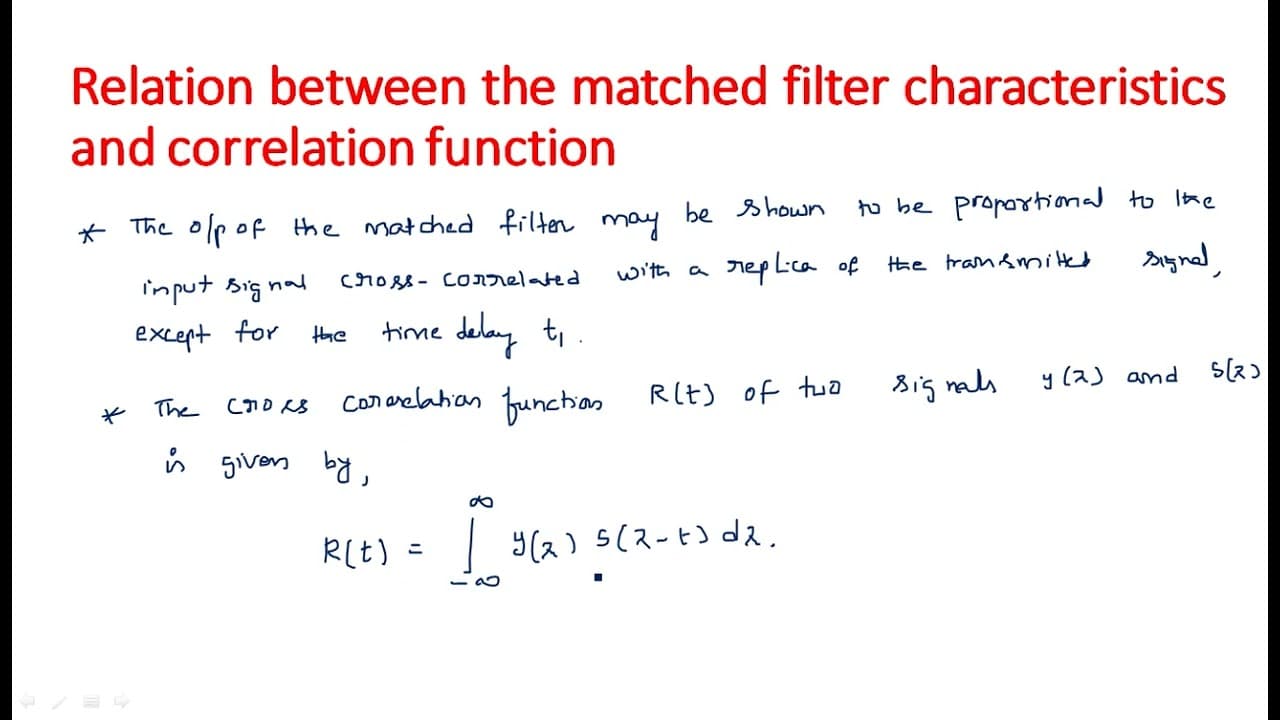
hi everyone in this video I am going to explain about the relation between the Matched filter for your characteristics and correlation function so here there are two types of correlations you might have studied in a signals and systems or other subject like rbsp cross correlation and autocorrelation cross correlation and autocorrelation what do you... Read More
Key Insights
- 📡 Cross-correlation is useful for comparing different signals, while auto-correlation analyzes the same signal's behavior over time.
- 📡 The matched filter outputs the cross-correlation between the input signal and a replica of the transmitted signal, improving detection accuracy.
- 🪩 The performance of the matched filter is defined by its impulse response, which mirrors the expected transmitted signal.
- ❓ Delays in the matched filter output are considered during the correlation process, particularly when accounting for timing differences.
- 📡 The overall efficacy of the received signal heavily relies on the peak signal-to-noise ratio improved by the filter.
- 📡 Understanding these fundamental principles is crucial for signal processing in communications, radar, and other applications.
- 📡 Correlation functions serve as mathematical tools to quantify the similarity between signals, aiding in signal processing techniques.
Install to Summarize YouTube Videos and Get Transcripts
Explore YouTube Video Summarizer or Get YouTube Transcript Extractor
Questions & Answers
Q: What is the difference between auto-correlation and cross-correlation?
Auto-correlation involves a single signal that is compared with itself over different time delays, whereas cross-correlation involves comparing two different signals. Auto-correlation helps in analyzing the inherent properties of a signal, while cross-correlation is useful for understanding the interdependence between two different signals.
Q: How does a matched filter improve signal detection?
A matched filter enhances the peak signal-to-noise ratio by correlating the incoming signal with a known replica of the expected transmitted signal. This process maximizes the output signal's energy when the incoming signal closely matches the replicated signal, allowing for better detection in the presence of noise.
Q: What is meant by the term "impulse response" in a matched filter?
The impulse response of a matched filter is the system's reaction to a Dirac delta function input. It is essentially a time-reversed version of the transmitted signal, which allows the filter to achieve optimal performance by aligning the filter’s response with the received signal's characteristics.
Q: In what way does noise affect the input signal to the matched filter?
Noise impacts the input signal by distorting its characteristics, which can obscure the transmitted signal. The matched filter is designed to mitigate this effect, enhancing the desired signal while minimizing the influence of noise, thus improving the reliability of the signal recovery.
Summary & Key Takeaways
-
The video explains two correlation types: cross-correlation and auto-correlation, differentiating their definitions by examining signals and their relationships.
-
It details the output of a matched filter as proportional to the cross-correlation of the input signal with a replica of the transmitted signal, factoring in a time delay.
-
The matched filter's impulse response is characterized as the mirror image of the received signal, emphasizing its role in improving the peak signal-to-noise ratio.
Read in Other Languages (beta)
Share This Summary 📚
Summarize YouTube Videos and Get Video Transcripts with 1-Click
Try YouTube Summary with ChatGPT & Claude or YouTube Transcript Generator