Center of mass and relative motion wavefunctions
TL;DR
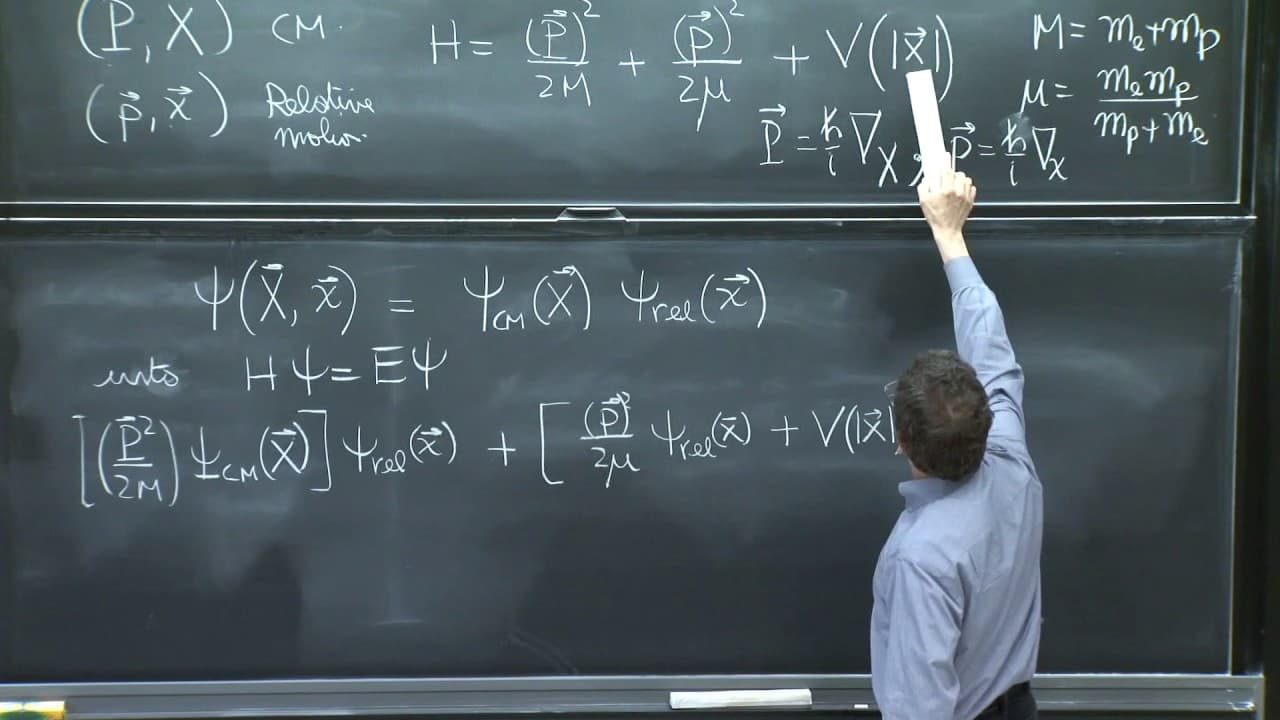
Analysis of the hydrogen atom Hamiltonian and the derivation of the Schrodinger equation for the relative motion component.
Transcript
PROFESSOR: We have the hydrogen atom Hamiltonian. Hamiltonian. And that was given by the kinetic operator for the proton plus the kinetic operator for the electron plus the potential, which was a function of the distance between the proton and the electron. And what we achieved last time was the introduction of two new pairs of canonical variables.... Read More
Key Insights
- 👻 The introduction of canonical variables simplifies the hydrogen atom Hamiltonian and allows for a separation of variables in the Schrodinger equation.
- 🫀 The center of mass and relative motion of the hydrogen atom can be treated independently due to the independence of their canonical variable pairs.
- 🥶 The reformulated Hamiltonian represents a free particle motion for the center of mass and a central potential equation for the relative motion.
- 🫀 The total energy of the hydrogen atom system is the sum of the center of mass energy and the relative energy.
- 🥺 The separation of variables in the Schrodinger equation leads to a central potential equation for the relative motion of the hydrogen atom.
- 🥶 Solutions to the center of mass equation are plane waves, representing free particle motion.
Install to Summarize YouTube Videos and Get Transcripts
Explore YouTube Video Summarizer or Get YouTube Transcript Extractor
Questions & Answers
Q: What is the hydrogen atom Hamiltonian composed of?
The hydrogen atom Hamiltonian includes the kinetic operators for the proton and electron and a potential function determined by their distance from each other.
Q: How were canonical variables introduced to simplify the Hamiltonian?
Canonical variables were introduced for the electron and proton's position and momentum, as well as two additional pairs associated with the center of mass and relative motion.
Q: What does the reformulated Hamiltonian simplify to?
The reformulated Hamiltonian simplifies to a free particle motion for the center of mass and a kinetic energy term and potential for the relative motion between the proton and electron.
Q: How can the Schrodinger equation be written for the hydrogen atom?
The Schrodinger equation for the hydrogen atom involves the separation of variables, where the total wave function is represented as a product of wave functions for the center of mass and the relative motion.
Summary & Key Takeaways
-
The hydrogen atom Hamiltonian consists of the kinetic operators for the proton and electron and a potential function based on their distance.
-
Canonical variables for the electron and proton's position and momentum were introduced, along with two more pairs associated with the center of mass and relative motion.
-
The reformulated Hamiltonian simplifies to a free particle motion for the center of mass and a kinetic energy term and potential for the relative motion.
Read in Other Languages (beta)
Share This Summary 📚
Summarize YouTube Videos and Get Video Transcripts with 1-Click
Try YouTube Summary with ChatGPT & Claude or YouTube Transcript Generator
Explore More Summaries from MIT OpenCourseWare 📚



Summarize YouTube Videos and Get Video Transcripts with 1-Click
Try YouTube Summary with ChatGPT & Claude or YouTube Transcript Generator