How to Quickly Learn C Programming Basics
TL;DR
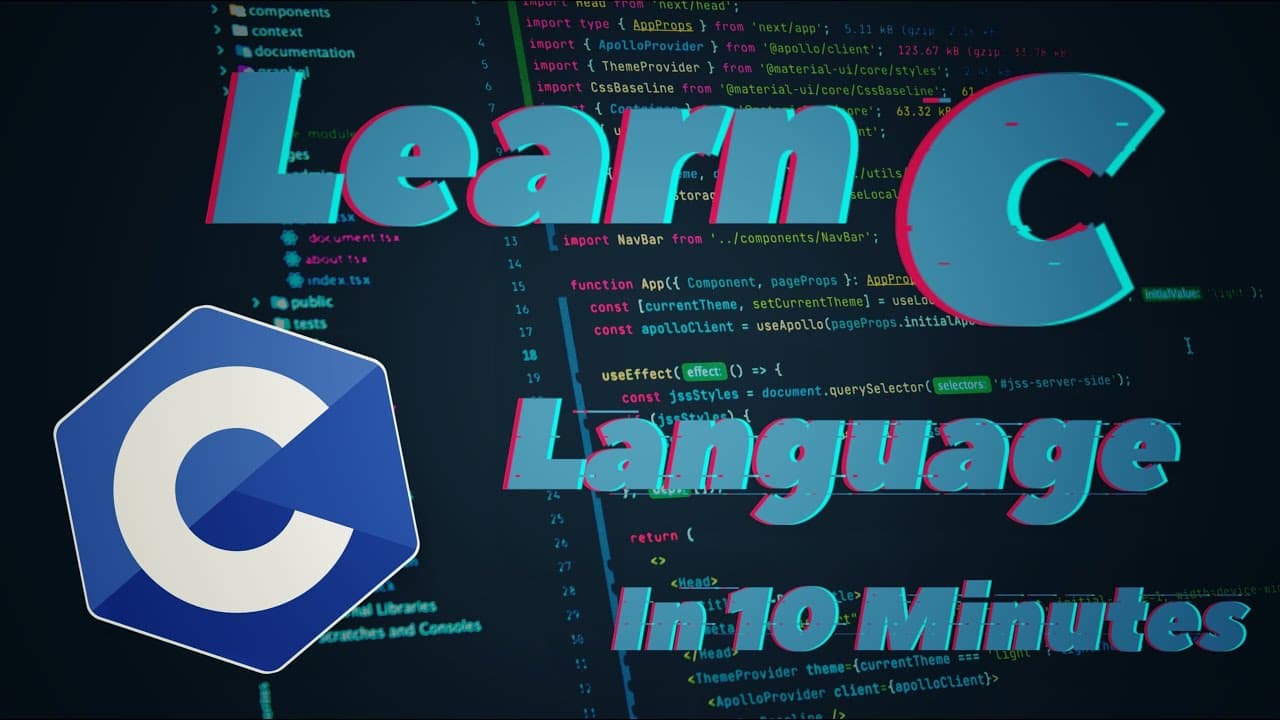
C is a versatile, middle-level programming language suitable for system-level programming and application development. It requires a compiler like GCC or Clang and uses a structured approach with functions and modules. Key concepts include data types, operators, control structures, arrays, pointers, and memory management, making it foundational for understanding more advanced languages.
Transcript
C language invented by Dennis Ritchie at atnt Bill Laboratories in the early 1970s many of the ideas of C language were taken from the earlier B language and its ancestors C is a middle level programming language because of that we can use C for system level programming like writing operating systems and also for developing games and applications i... Read More
Key Insights
- C is a middle-level programming language, useful for both system-level and application development.
- Developed by Dennis Ritchie, C evolved from the B language and is foundational to many modern languages.
- C utilizes a structured programming approach, allowing for modular code using functions and modules.
- A compiler, such as GCC or Clang, is necessary to write and run C programs.
- C programs require a main function and can include other files known as header files, ending with .h.
- The language supports various data types, including int, float, double, char, and void.
- C uses control structures like if-else, switch statements, and loops (while, do-while, for) for flow control.
- Memory management is crucial in C, with pointers used to store memory addresses and manage data efficiently.
Install to Summarize YouTube Videos and Get Transcripts
Explore YouTube Video Summarizer or Get YouTube Transcript Extractor
Questions & Answers
Q: What is the C programming language used for?
C is a versatile, middle-level programming language used for system-level programming, such as writing operating systems, as well as for developing applications and games. Its structured programming approach allows for modular code development using functions and modules, making it foundational for understanding more advanced languages.
Q: How do you start programming in C?
To start programming in C, you need to have a C compiler installed, such as GCC or Clang. A C program requires a main function and can include other files known as header files, which end with a .h extension. Programs are structured using functions and follow specific syntax rules for declaring variables and functions.
Q: What are the primary data types in C?
The primary data types in C include int for integers, float for decimal values up to six digits after the decimal point, double for decimal values up to fifteen digits, char for characters, and void for functions that do not return a value. These data types are fundamental for variable declaration and manipulation in C programs.
Q: How do control structures work in C?
Control structures in C, such as if-else statements, switch statements, and loops (while, do-while, for), manage the flow of a program by executing code blocks based on specific conditions. These structures allow for decision-making, iteration, and branching in programs, enabling the creation of complex and dynamic applications.
Q: What is a pointer in C?
A pointer in C is a variable that stores the memory address of another variable. Pointers are essential for dynamic memory management and efficient data manipulation. They are declared using an asterisk (*) before the variable name and can be used to access and modify the data stored at the memory address they point to.
Q: How are arrays used in C?
Arrays in C are collections of data items of the same data type, allowing for the storage and manipulation of multiple values using a single variable name. Arrays are declared with a specified size, and elements are accessed using their index, starting from zero. They support operations like iteration, sorting, and searching.
Q: What are header files in C?
Header files in C, ending with a .h extension, contain declarations of functions and macros to be shared between multiple source files. They are included at the beginning of a C program using the #include directive. Standard library header files provide essential functions like input/output operations, string manipulation, and memory allocation.
Q: What is the significance of the main function in C?
The main function in C is the entry point of a program, where execution begins. Every C program must have a main function, which can return an integer value to indicate the success or failure of the program. The main function can also receive command-line arguments, enabling interaction with the operating system and other programs.
Summary & Key Takeaways
-
C is a versatile programming language developed in the early 1970s by Dennis Ritchie. It supports system-level programming and application development, offering a structured approach with functions and modules. To start programming in C, a compiler like GCC or Clang is necessary, and programs require a main function and can import other files known as header files.
-
C language supports primary data types such as int, float, double, char, and void. It uses control structures like if-else, switch statements, and loops (while, do-while, for) for managing program flow. Functions allow for code reusability and modularity, while arrays and pointers facilitate efficient data handling and memory management.
-
Understanding C language concepts such as data types, operators, control structures, arrays, pointers, and memory management is foundational for learning more advanced programming languages. C's structured programming approach allows for the development of complex applications and system software, making it a valuable skill for programmers.
Read in Other Languages (beta)
Share This Summary 📚
Summarize YouTube Videos and Get Video Transcripts with 1-Click
Try YouTube Summary with ChatGPT & Claude or YouTube Transcript Generator
Explore More Summaries from AmanBytes 📚
Summarize YouTube Videos and Get Video Transcripts with 1-Click
Try YouTube Summary with ChatGPT & Claude or YouTube Transcript Generator