How Does the Higgs Mechanism Give Mass to Particles?
TL;DR
The Higgs mechanism generates mass for particles through spontaneous symmetry breaking of the Higgs field, giving rise to massive gauge bosons like the W and Z bosons. This occurs when the complex scalar field acquires a vacuum expectation value, revealing how particle masses are intertwined with the fundamental forces of nature.
Transcript
[SQUEAKING] [RUSTLING] [CLICKING] PROFESSOR: Welcome back to 8.701. So in this lecture, we talk about the Higgs mechanism. As you might know, the Higgs boson was discovered in 2012 by the LHC Experiment, but the theoretical discovery of the Higgs boson happened much, much earlier than that did. In the mid 1960s, Peter Higgs and a few others propose... Read More
Key Insights
- 🖐️ The Higgs boson was discovered in 2012, but its theoretical groundwork was laid in the 1960s.
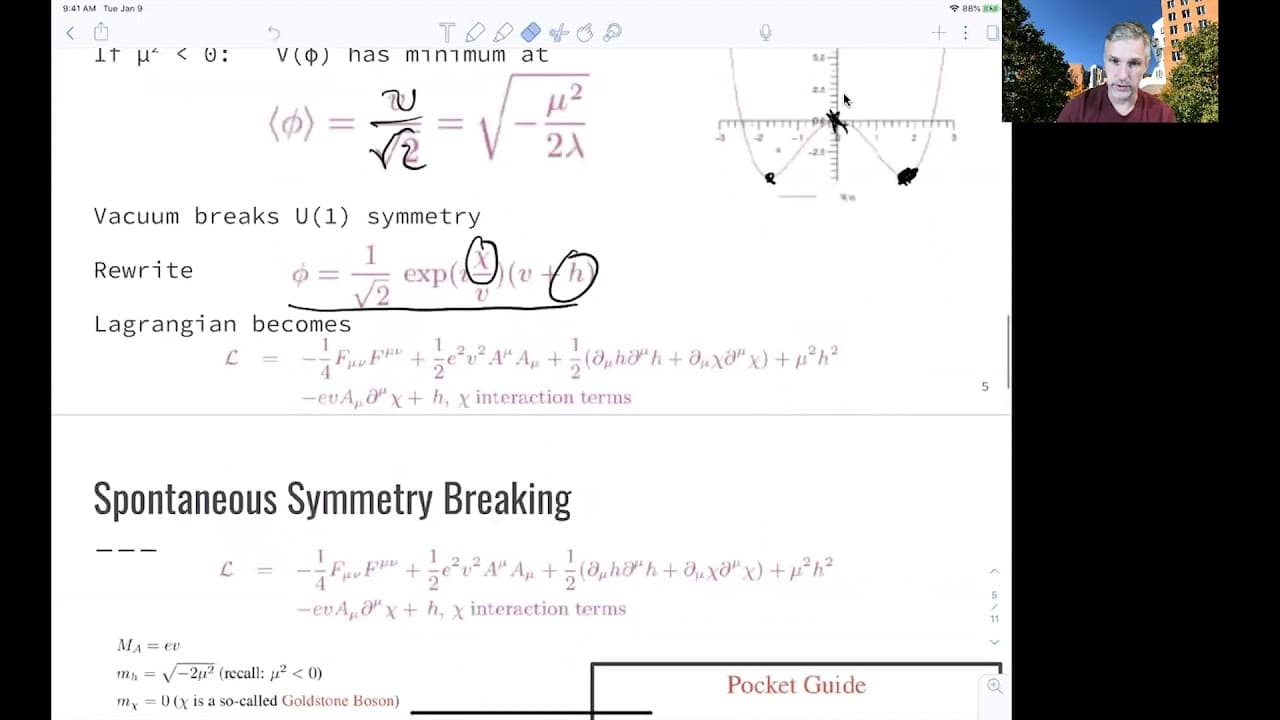
- 🥺 The Higgs mechanism involves spontaneous symmetry breaking, where a complex scalar field acquires a vacuum expectation value, leading to mass generation.
- 🤪 The Higgs mechanism explains how gauge bosons, like the w and z bosons, acquire mass.
Install to Summarize YouTube Videos and Get Transcripts
Explore YouTube Video Summarizer or Get YouTube Transcript Extractor
Questions & Answers
Q: What is the Higgs mechanism?
The Higgs mechanism is a theoretical framework that explains how the Higgs boson gives mass to other particles by breaking symmetry in the electroweak forces. It involves the spontaneous symmetry breaking of a complex scalar field.
Q: How does spontaneous symmetry breaking work in the context of the Higgs mechanism?
Spontaneous symmetry breaking occurs when the vacuum of the scalar field deviates from its symmetrical minimum. This breaks the symmetry and leads to the generation of mass terms for particles. In the Higgs mechanism, the vacuum expectation value of the scalar field is responsible for this symmetry breaking.
Q: How does the Higgs mechanism generate mass for the gauge bosons?
In the Higgs mechanism, the coupling of the Higgs field to the gauge bosons leads to their acquiring mass. The strength of the coupling and the vacuum expectation value of the Higgs field determine the mass of the gauge bosons.
Q: What happens to the Goldstone bosons in the Higgs mechanism?
In the Higgs mechanism, the Goldstone bosons, which arise from the symmetry breaking, are absorbed by the gauge bosons, giving them mass. The absorption of the Goldstone bosons corresponds to the longitudinal polarization of the gauge bosons.
Summary & Key Takeaways
-
The Higgs boson was theoretically proposed in the 1960s to explain the origin of mass for gauge bosons and fermions.
-
The Higgs mechanism involves spontaneous symmetry breaking, where a complex scalar field acquires a vacuum expectation value, leading to the generation of mass terms.
-
In a simplified model, the Higgs field breaks the symmetry and gives rise to massive gauge bosons, while a Goldstone boson is absorbed by the gauge bosons.
-
In the standard model, the Higgs field is a complex scalar field in the su2 gauge group, and the w and z bosons acquire mass through its coupling.
-
The Higgs boson remains as an additional massive scalar field.
Read in Other Languages (beta)
Share This Summary 📚
Summarize YouTube Videos and Get Video Transcripts with 1-Click
Try YouTube Summary with ChatGPT & Claude or YouTube Transcript Generator
Explore More Summaries from MIT OpenCourseWare 📚



Summarize YouTube Videos and Get Video Transcripts with 1-Click
Try YouTube Summary with ChatGPT & Claude or YouTube Transcript Generator