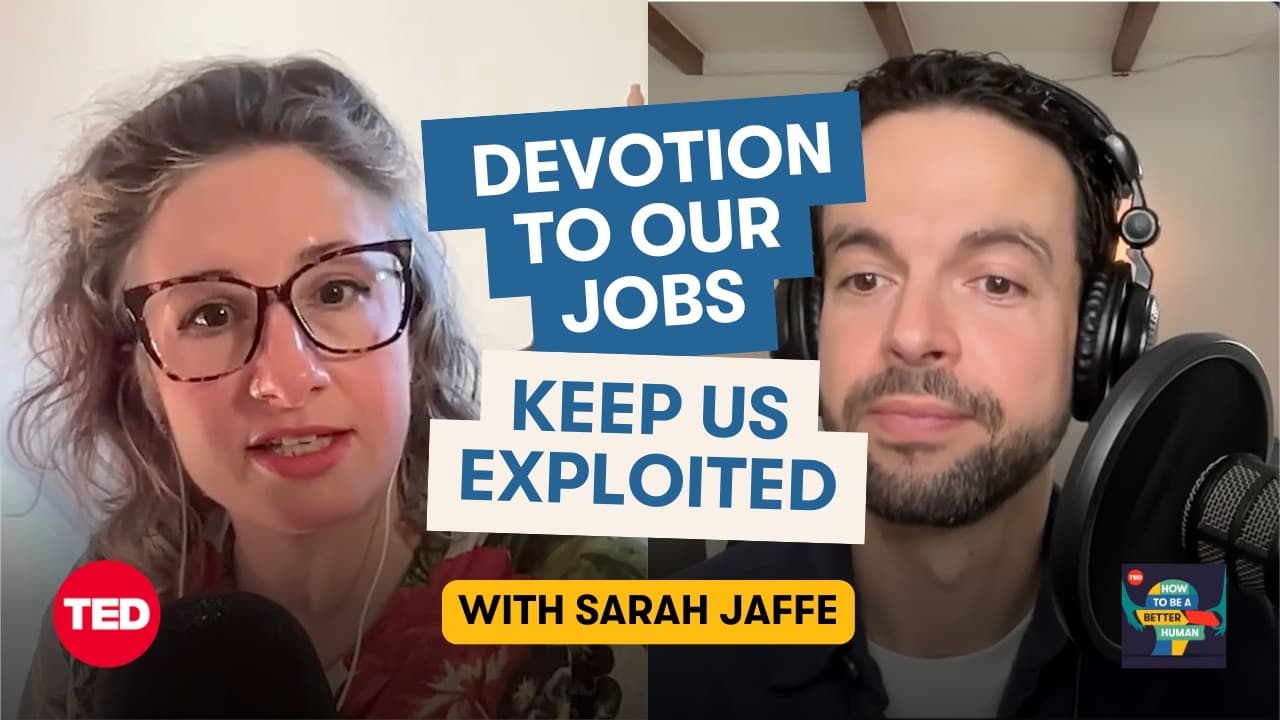
Why Work Won’t Love You Back (and That’s OK) (w/ Sarah Jaffe) | How to Be a Better Human | TED
TL;DR
Discusses work culture's emotional toll and community's importance.
Transcript
You're watching How to be a Better Human. I'm your host, Chris Duffy, and I love my job. I feel so lucky that I get to interview interesting, intelligent people about their work and that you watch. That is incredible to me. I'm so grateful. And yet today's guest, Sarah Jaffy, the author of Work won't Love You Back, Sarah argues that a lot of times ... Read More
Key Insights
- Sarah Jaffe argues that jobs perceived as meaningful often lead to burnout because employees feel compelled to give all their energy to work, neglecting personal life.
- The pandemic and economic disruptions have amplified feelings of grief and loss, which can be unacknowledged in society. Jaffe highlights the concept of 'disenfranchised grief.'
- Jaffe's experience in both service jobs and journalism reveals that work conditions and financial struggles persist across different job types, challenging the notion of a 'dream job.'
- The Chicago teachers' strike in 2012 exemplified 'bargaining for the common good,' linking teachers' working conditions to students' learning environments, advocating for community-wide benefits.
- Care workers face unique challenges in labor strikes, as their emotional connection to patients complicates decisions to protest against poor working conditions.
- Jaffe illustrates how personal grief can mirror societal challenges, suggesting that individual experiences of loss can inform broader social change and community solidarity.
- The erosion of stable public sector jobs reflects a societal shift away from valuing collective well-being, with Jaffe advocating for a return to prioritizing public good over individual profit.
- Jaffe emphasizes the importance of community and solidarity in navigating both personal and societal grief, suggesting that collective care can drive meaningful change.
Install to Summarize YouTube Videos and Get Transcripts
Explore YouTube Video Summarizer or Get YouTube Transcript Extractor
Questions & Answers
Q: What is the main argument of Sarah Jaffe's book 'Work Won't Love You Back'?
Sarah Jaffe argues that jobs perceived as meaningful often lead to burnout because employees feel compelled to give all their energy to work, neglecting personal life. She emphasizes the importance of finding a balance between work and personal life to avoid exploitation and exhaustion.
Q: How does the concept of 'disenfranchised grief' relate to modern work culture?
Disenfranchised grief refers to grief that is unacknowledged or not openly mourned. In modern work culture, this concept relates to the unrecognized emotional toll of job-related stress and burnout, especially in meaningful jobs. Jaffe highlights the need to acknowledge this grief to foster healthier work environments.
Q: What insights does Jaffe provide about the relationship between personal and societal grief?
Jaffe draws parallels between personal grief and societal challenges, suggesting that individual experiences of loss can inform broader social change. She emphasizes that personal grief can serve as a roadmap for understanding communal issues, advocating for collective care and solidarity to address societal problems.
Q: How does Jaffe view the role of unions in improving work conditions?
Jaffe views unions as essential in advocating for better work conditions, linking individual workers' rights to community benefits. She cites the Chicago teachers' strike as an example of 'bargaining for the common good,' where improved teacher conditions directly benefit students, highlighting the power of collective action.
Q: Why does Jaffe emphasize the importance of community in addressing work-related issues?
Jaffe emphasizes community because it provides the support and solidarity needed to navigate work-related challenges. She argues that collective care and mutual aid can alleviate the emotional toll of work and drive meaningful change, as seen in various social movements that offer material and emotional support.
Q: What challenges do care workers face during labor strikes, according to Jaffe?
Care workers face the emotional challenge of balancing their commitment to patients with the need to protest poor working conditions. Jaffe highlights that their emotional connection to those they care for complicates decisions to strike, as they are reluctant to abandon those in need despite difficult work environments.
Q: How does Jaffe's personal experience in different job sectors inform her views on work culture?
Jaffe's experience in both service jobs and journalism reveals that work conditions and financial struggles are consistent across job types. Her firsthand knowledge challenges the notion of a 'dream job,' illustrating that meaningful work can still lead to burnout and exploitation, underscoring the need for systemic change.
Q: What societal shifts does Jaffe identify regarding public sector jobs and collective well-being?
Jaffe identifies a shift away from valuing stable public sector jobs that prioritize collective well-being. She argues for a return to prioritizing public good over individual profit, emphasizing the importance of well-staffed public services, such as healthcare and infrastructure, for societal stability and community health.
Summary & Key Takeaways
-
Sarah Jaffe discusses how jobs that feel meaningful can lead to burnout, as employees often sacrifice personal life for work. She highlights the emotional toll of modern work culture and the need for a work-life balance.
-
The conversation explores the impact of the pandemic and economic disruptions on societal grief. Jaffe introduces 'disenfranchised grief,' emphasizing the importance of acknowledging collective mourning to foster social connections.
-
Jaffe's experiences in various job sectors reveal persistent work conditions and financial struggles. She advocates for community solidarity and emphasizes the role of unions in improving work conditions for the common good.
Read in Other Languages (beta)
Share This Summary 📚
Summarize YouTube Videos and Get Video Transcripts with 1-Click
Try YouTube Summary with ChatGPT & Claude or YouTube Transcript Generator
Explore More Summaries from TED 📚





Summarize YouTube Videos and Get Video Transcripts with 1-Click
Try YouTube Summary with ChatGPT & Claude or YouTube Transcript Generator