MOS Layout layers | Color Coding | Representation | VLSI | Lec-31
TL;DR
This video explains how to create layout diagrams for CMOS transistors and their various layers.
Transcript
hi everyone till now we have seen the stick diagrams how to draw the stick diagrams of various logic functions using CMOS now in this video I am going to start the layout diagrams so before going into drawing of layout diagrams first we should know what are the different layers and how to represent each layer in The Mask layout and as well as how t... Read More
Key Insights
- 🦮 Layout diagrams are crucial for the final stages of CMOS fabrication, serving as a detailed guide for fabricators.
- ❓ Each layer in the layout is characterized by unique colors and dimensions that convey important electrical properties.
- ❓ Understanding sheet resistance and capacitance is essential for accurately modeling device performance.
- 👨💻 Effective color coding in layout diagrams assists in preventing mistakes during the fabrication process.
- 🖐️ The design engineer plays a pivotal role in the success of the layout by verifying accuracy and functionality prior to fabrication.
- 🥳 Length-to-width ratios critically inform channel resistance calculations in CMOS devices.
- 🎨 The layout design process involves careful representation of various types of transistors and their corresponding layers.
Install to Summarize YouTube Videos and Get Transcripts
Explore YouTube Video Summarizer or Get YouTube Transcript Extractor
Questions & Answers
Q: Why is it important to understand the representation of different layers in layout diagrams?
Understanding the representation of different layers is crucial as it directly influences the fabrication process and the electrical performance of CMOS devices. Each layer, defined by its length and width, helps engineers to accurately model resistance and capacitance, which are fundamental to the functionality of the transistors being created.
Q: What are the different color codes used in layout diagrams and their meanings?
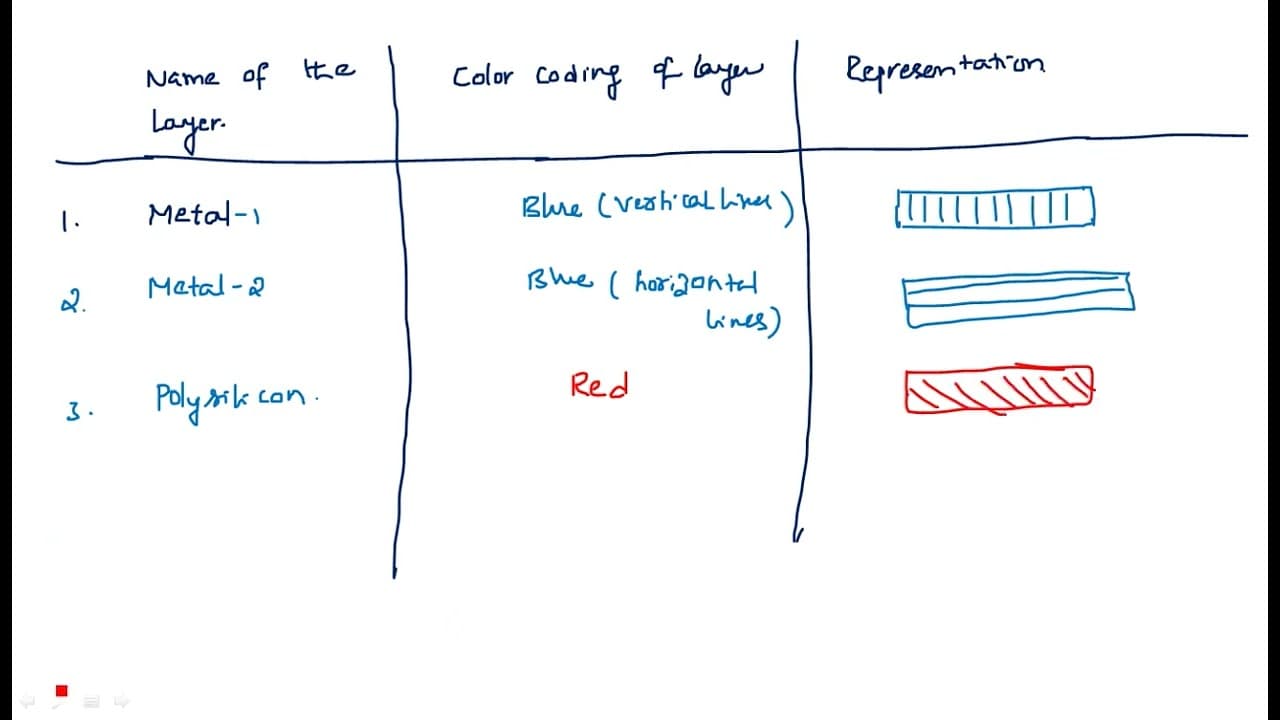
In layout diagrams, each material or layer is represented by specific colors to facilitate differentiation. For example, metal layers are colored in blue, polysilicon is represented in red, and n-plus diffusion in green. This color coding allows for faster identification and reduces errors during the fabrication process.
Q: How does the length and width of layers impact transistor performance?
The length and width of the layers in a layout diagram directly affect the resistance and capacitance of the transistors. Shorter lengths decrease resistance, while appropriate widths ensure sufficient current capacity. Ultimately, these dimensions influence the transistor's ability to switch efficiently and function reliably in a circuit.
Q: What is the significance of Z in layout design?
The variable Z, defined as the ratio of length (L) to width (W), is essential for calculating total channel resistance in MOSFETs. This ratio is vital for ensuring that the transistor performs within its desired specifications, particularly in minimizing power loss and maximizing switching speed.
Q: What is the role of the design engineer in the layout process?
The design engineer is responsible for creating the layout diagrams that serve as a blueprint for fabrication. They ensure that the design meets electrical specifications and standards, conducting necessary verifications before passing the design to a fabrication engineer, who then translates the layout into physical silicon structures.
Q: Can you explain the representation of an nMOS and pMOS transistor in layout diagrams?
In layout diagrams, an nMOS transistor is typically represented with red-over-green layers depicting p-plus and n-plus diffusion, while a pMOS transistor is similarly depicted but uses different color indicators for its layers, ensuring clear differentiation. This visual representation aids in understanding the function and connection of the devices within a circuit.
Summary & Key Takeaways
-
The video discusses the fundamentals of layout diagrams in CMOS fabrication, focusing on the representation of different layers using specific colors and dimensions in the mask layout.
-
It details the significance of understanding layer thickness, resistance, and capacitance when drawing layout diagrams, emphasizing how these factors impact the performance of transistors.
-
The content prepares viewers for more complex topics by outlining how to represent various types of transistors and other essential components within CMOS layout designs.
Read in Other Languages (beta)
Share This Summary 📚
Summarize YouTube Videos and Get Video Transcripts with 1-Click
Try YouTube Summary with ChatGPT & Claude or YouTube Transcript Generator