Lecture 19: Refolding & Smooth Folding
TL;DR
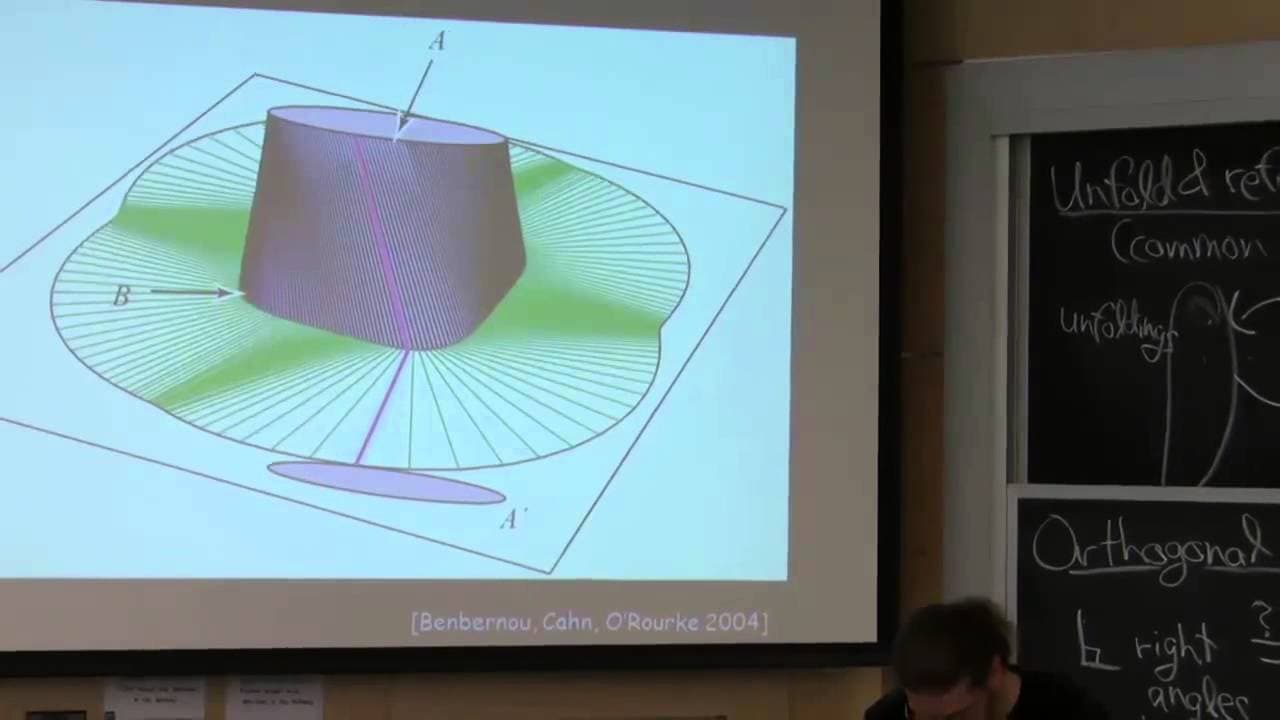
Different wrappings, such as petal and strip folding, are used to wrap spherical objects, with some wrappings achieving optimal area and perimeter ratios.
Transcript
PROFESSOR: I'm excited about today's lecture because there's so many fun topics. This is like many fun things all in one lecture. We're going to start with a cool little problem, which is about unfolding and re-folding. You could think of them-- they're kind of like hinged dissections although they're from between surfaces of polyhedra. You can als... Read More
Key Insights
- 🪭 Wrapping a spherical shape can be achieved through contractive folding and various techniques, such as petal unfolding and strip folding.
- ❓ The choice of wrappings can have an impact on area, perimeter, and manufacturing constraints.
- 😄 Different wrappings offer unique advantages and trade-offs, such as area preservation, ease of manufacturing, and aesthetic qualities.
Install to Summarize YouTube Videos and Get Transcripts
Explore YouTube Video Summarizer or Get YouTube Transcript Extractor
Questions & Answers
Q: What is the difference between strip folding and petal unfolding?
Strip folding involves using long, rectangular paper to create parallel lines that wrap around the spherical shape. Petal unfolding, on the other hand, uses individual petals that unfold to cover the shape.
Q: Are there any limitations to using certain wrappings?
Wrappings must adhere to certain constraints, such as maintaining convexity and avoiding self-intersection. Additionally, some wrappings may not be suitable for manufacturing due to their complexity or material wastage.
Q: What is the advantage of using petal unfolding?
Petal unfolding offers a way to cover the surface of a sphere using crossed paths, resulting in a reasonable area and low perimeter. It also provides a visually appealing pattern.
Summary & Key Takeaways
-
Wrapping a spherical shape can be done using different techniques, such as petal and strip folding.
-
Contractive folding allows for the creation of smooth, convex shapes, while maintaining the ability to fold a sphere.
-
The minimum area wrapping for a sphere can be achieved through strip folding or petal unfolding techniques.
-
The shape and size of the wrappings can vary, depending on the desired outcomes and constraints.
Read in Other Languages (beta)
Share This Summary 📚
Summarize YouTube Videos and Get Video Transcripts with 1-Click
Try YouTube Summary with ChatGPT & Claude or YouTube Transcript Generator
Explore More Summaries from MIT OpenCourseWare 📚


Summarize YouTube Videos and Get Video Transcripts with 1-Click
Try YouTube Summary with ChatGPT & Claude or YouTube Transcript Generator