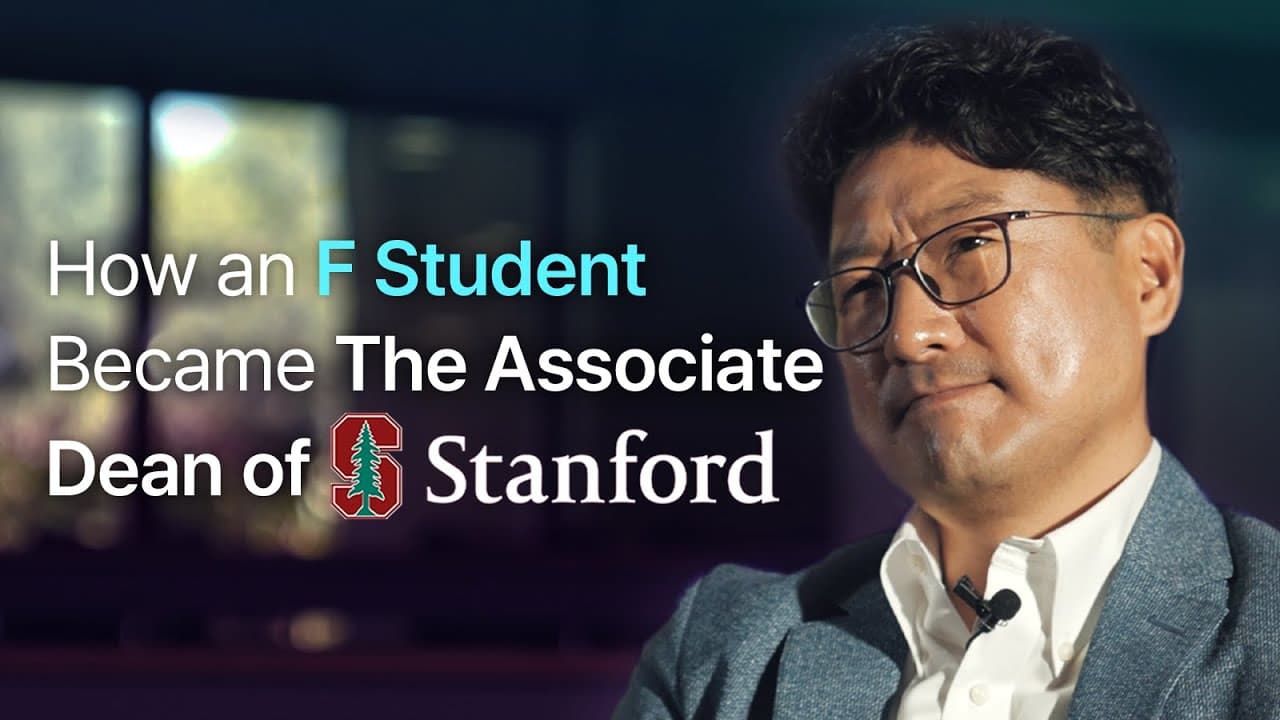
How Paul Kim Transformed from Struggling Student to Stanford Leader
TL;DR
Paul Kim, once a low-performing student in Korea, became an influential educator and Associate Dean at Stanford. By embracing curiosity and leveraging his technical skills, he developed innovative educational technologies like SMILE. His journey underscores the importance of personalized education and fostering critical thinking in students to prepare them for future challenges.
Transcript
For my school years in Korea, for 12 years from elementary school and all the way to high school. I always got beat up by the teacher because I was a bad performer. I always did not agree with how we were supposed to be learning in schools. My father was an engineer and so he had a lot of different tools. I used a lot of his tools to design things ... Read More
Key Insights
- Paul Kim struggled academically in Korea but found his passion in hands-on learning and exploration.
- He moved to the US, improved his English, and excelled in college, discovering the value of personalized education.
- Kim advocates for understanding students individually to foster effective learning environments.
- He developed the SMILE program to encourage inquiry-based learning and critical thinking in students.
- Education systems often lack innovation due to rigid structures and insufficient focus on individual student needs.
- Future education should emphasize self-regulation, adaptability, and effective use of technology.
- Kim believes education can transform lives and should be accessible to all, regardless of background.
- Technological advancements can facilitate high-quality education, promoting peace and prosperity globally.
Install to Summarize YouTube Videos and Get Transcripts
Explore YouTube Video Summarizer or Get YouTube Transcript Extractor
Questions & Answers
Q: How did Paul Kim's early education in Korea influence his career?
Paul Kim's early education in Korea, characterized by traditional and rigid teaching methods, did not align with his learning style, leading to poor academic performance. This experience motivated him to seek alternative educational environments, ultimately shaping his career as an advocate for personalized and innovative education, emphasizing critical thinking and student engagement.
Q: What role did curiosity play in Paul Kim's educational journey?
Curiosity was central to Paul Kim's educational journey. Despite struggling in traditional school settings, his curiosity drove him to explore and learn independently, such as dismantling household items to understand their mechanics. This hands-on, inquiry-based approach to learning later influenced his educational philosophy and the development of programs like SMILE that promote critical questioning and exploration.
Q: How did Paul Kim succeed academically in the US?
In the US, Paul Kim succeeded academically by leveraging a more flexible and supportive educational environment. He improved his English skills and embraced subjects like music appreciation, where he could express his ideas creatively. This experience taught him the value of personalized education and motivated him to pursue higher education, ultimately leading to his success in academia.
Q: What is the SMILE program, and how does it benefit students?
The SMILE program, developed by Paul Kim, stands for Stanford Mobile Inquiry-Based Learning Environment. It encourages students to engage in inquiry-based learning by formulating and exploring questions. This approach helps students develop critical thinking and problem-solving skills, fostering a deeper understanding of subjects and promoting lifelong learning habits essential for success in an ever-changing world.
Q: Why does Paul Kim believe education systems need innovation?
Paul Kim believes education systems need innovation because traditional models often fail to address individual student needs and stifle creativity. Current systems prioritize efficiency and safety over personalized learning, limiting students' potential. By innovating, education can become more adaptive, fostering critical thinking, self-regulation, and effective use of technology, preparing students for future challenges.
Q: What future skills does Paul Kim emphasize for students?
Paul Kim emphasizes the importance of self-regulation, adaptability, and technological proficiency as future skills for students. He believes these skills are crucial for navigating an ever-evolving world, enabling students to manage their learning, leverage available tools effectively, and adapt to new challenges, ensuring their success in personal and professional endeavors.
Q: How does Paul Kim view the role of education in society?
Paul Kim views education as a transformative force in society, capable of changing lives and providing opportunities for all. He believes education should be accessible to everyone, regardless of background, and serve as a foundation for peace and prosperity. By fostering critical thinking and innovation, education can empower individuals and contribute to global progress.
Q: What challenges do public schools face in implementing innovative education models?
Public schools face challenges in implementing innovative education models due to rigid structures, limited resources, and administrative burdens. Teachers often lack the authority to make significant changes, and large class sizes hinder personalized education. These factors contribute to a stagnant educational environment, making it difficult to adopt new teaching methods that emphasize critical thinking and individual student engagement.
Summary & Key Takeaways
-
Paul Kim's early educational experience in Korea was challenging due to traditional teaching methods that didn't suit his learning style. After moving to the US, he thrived in a more flexible educational environment, highlighting the importance of personalized and student-centered education.
-
Kim's journey from a struggling student to an Associate Dean at Stanford illustrates the transformative power of education. He emphasizes the need for educators to understand individual student needs and encourages inquiry-based learning through programs like SMILE.
-
The future of education, according to Kim, should focus on developing students' self-regulation, adaptability, and technological skills. He advocates for accessible, high-quality education for all, leveraging technology to overcome barriers and foster global peace and prosperity.
Read in Other Languages (beta)
Share This Summary 📚
Summarize YouTube Videos and Get Video Transcripts with 1-Click
Try YouTube Summary with ChatGPT & Claude or YouTube Transcript Generator
Explore More Summaries from EO 📚




Summarize YouTube Videos and Get Video Transcripts with 1-Click
Try YouTube Summary with ChatGPT & Claude or YouTube Transcript Generator