How to work out Engine Capacity
TL;DR
Learn how to calculate engine capacity by understanding the basics of engine mechanics and using a simple formula.
Transcript
good day welcome to Tech maath Channel this video is a special request from one of my patrons H who wanted to know how to work out engine capacity so uh we'll launch straight into it and a big shout out to all my patrons if you want to support the techmath channel you'll see that there's a link below the uh video and in the description and you can ... Read More
Key Insights
- 🚒 Engine capacity is a measurement of the total volume inside an engine and is typically expressed in liters or cubic centimeters (cc).
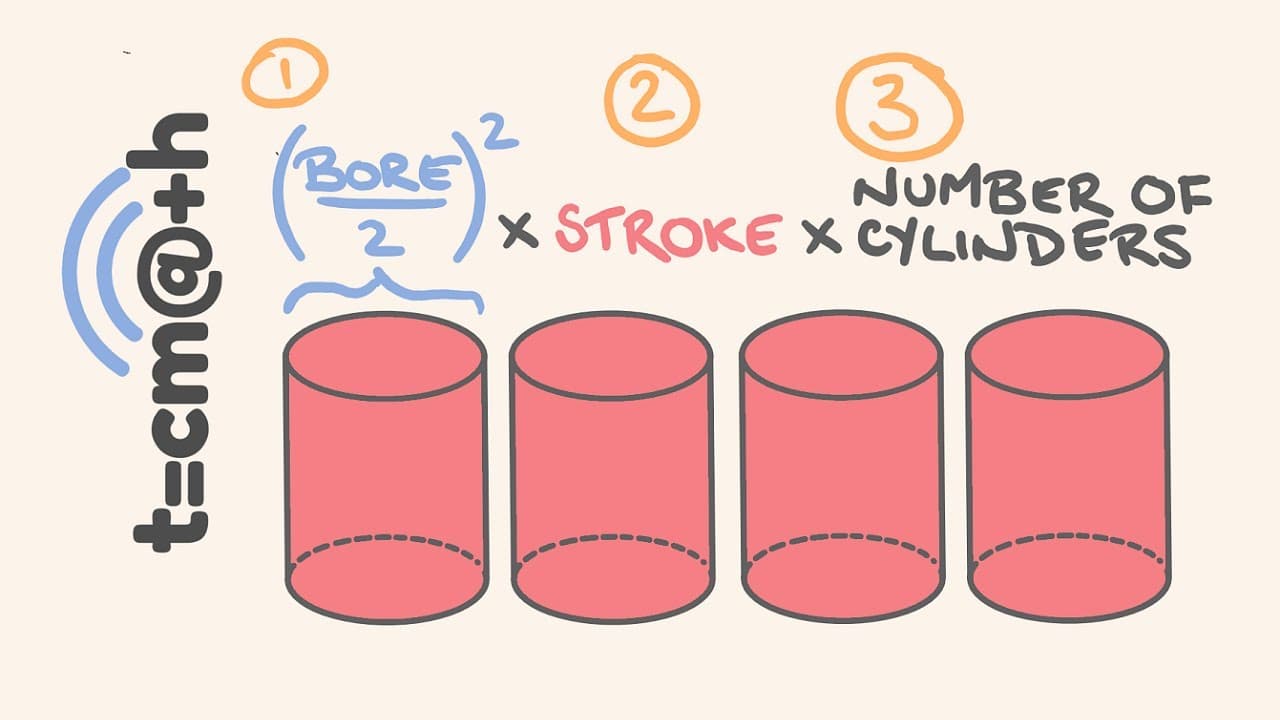
- 🚒 To calculate engine capacity, you need to know the bore (diameter of the cylinder), stroke (how much the piston moves up and down), and the number of cylinders.
- 🚒 Engine capacity plays a significant role in determining an engine's power, performance, and fuel efficiency.
- ☺️ The formula for calculating engine capacity is: Engine Capacity = Pi x (Bore/2)^2 x Stroke x Number of Cylinders.
- 🚒 Engine capacity can be converted between liters and cubic centimeters by dividing or multiplying by 1,000.
- 🚒 Larger engine capacities generally indicate more power and torque, while smaller engine capacities are often more fuel-efficient.
- 🚒 Engine capacity is an important specification to consider when purchasing a vehicle, as it affects its performance and fuel consumption.
Install to Summarize YouTube Videos and Get Transcripts
Explore YouTube Video Summarizer or Get YouTube Transcript Extractor
Questions & Answers
Q: What is engine capacity?
Engine capacity is a measurement of the total volume inside an engine and is typically expressed in liters or cubic centimeters. It helps in determining the power and performance of the engine.
Q: How do you calculate engine capacity?
To calculate engine capacity, you need to know the bore (diameter of the cylinder), stroke (how much the piston moves up and down), and the number of cylinders. Use the formula Engine Capacity = Pi x (Bore/2)^2 x Stroke x Number of Cylinders to calculate the engine capacity.
Q: Why is engine capacity important?
Engine capacity is important because it gives an indication of the engine's power and performance. A larger engine capacity generally means more power and torque, while a smaller engine capacity is often more fuel-efficient.
Q: Can engine capacity be converted to different units?
Yes, engine capacity can be converted between liters and cubic centimeters (cc). One liter is equal to 1,000 cubic centimeters. So, to convert from cc to liters, divide the engine capacity by 1,000, and to convert from liters to cc, multiply the engine capacity by 1,000.
Summary & Key Takeaways
-
Engine capacity refers to the volume measurement of an engine and is often expressed in liters or cubic centimeters (cc).
-
The engine capacity is determined by calculating the volume of each cylinder and multiplying it by the number of cylinders in the engine.
-
The formula for calculating engine capacity is: Engine Capacity = Pi x (Bore/2)^2 x Stroke x Number of Cylinders.
Read in Other Languages (beta)
Share This Summary 📚
Summarize YouTube Videos and Get Video Transcripts with 1-Click
Try YouTube Summary with ChatGPT & Claude or YouTube Transcript Generator
Explore More Summaries from tecmath 📚



Summarize YouTube Videos and Get Video Transcripts with 1-Click
Try YouTube Summary with ChatGPT & Claude or YouTube Transcript Generator