How Does Accumulation, Manipulation, and Distribution Work in Forex?
TL;DR
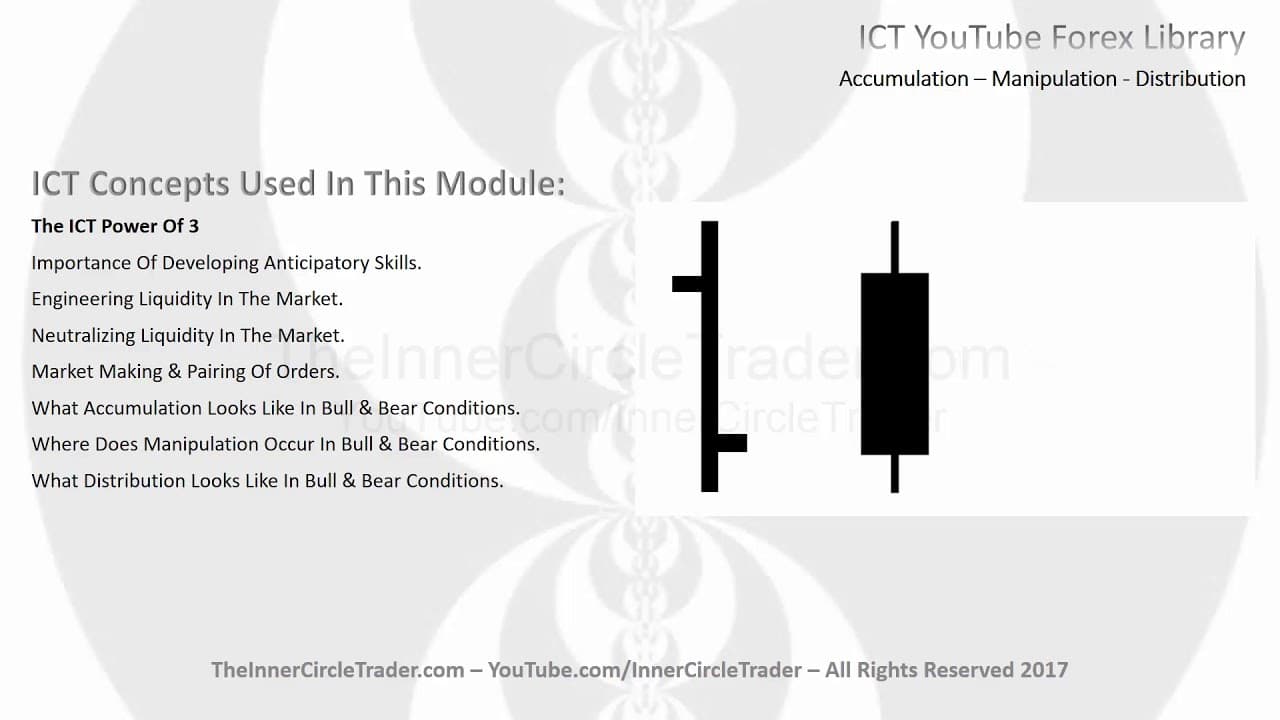
Accumulation occurs when smart money builds long positions around the opening price in bullish markets, while manipulation involves creating liquidity by enticing traders to sell at lower prices. During distribution, smart money exits positions by selling to buyers above old highs, making these concepts essential for effective trading strategies.
Transcript
okay folks welcome back okay this teaching is going to be specifically dealing with accumulation manipulation and distribution okay the ICT concepts used in this module the ICT power of three importance of developing anticipatory price skills engineering liquidity in the market neutralizing liquidity in the market market making and pairing of order... Read More
Key Insights
- The ICT Power of Three involves understanding accumulation, manipulation, and distribution in trading, applicable across various timeframes.
- Accumulation occurs when long positions build up around the opening price, especially in bullish conditions, driven by smart money.
- Manipulation involves engineering liquidity by enticing traders to sell or buy at incorrect times, allowing smart money to capitalize.
- Distribution represents the exit phase for smart money, where they sell to buying interest above old highs in bullish markets.
- In bearish conditions, accumulation involves short positions around the opening price, while manipulation entices buying at higher prices.
- Smart money uses sell stops to neutralize long positions and buy stops to neutralize short positions during manipulation phases.
- Distribution in bearish markets involves smart money covering shorts below old lows, taking advantage of increased selling interest.
- Understanding these market cycles helps traders anticipate price movements and make informed trading decisions based on market maker concepts.
Install to Summarize YouTube Videos and Get Transcripts
Explore YouTube Video Summarizer or Get YouTube Transcript Extractor
Questions & Answers
Q: What is the ICT Power of Three?
The ICT Power of Three is a concept in trading that involves understanding the phases of accumulation, manipulation, and distribution. It applies to various timeframes and helps traders anticipate price movements by recognizing how smart money builds positions, manipulates market sentiment, and exits positions.
Q: How does accumulation occur in bullish markets?
In bullish markets, accumulation occurs when smart money builds long positions around the opening price. This phase involves identifying areas where long positions can be established, often just above or below the opening price, to capitalize on anticipated bullish range expansions.
Q: What role does manipulation play in trading?
Manipulation in trading involves engineering liquidity by enticing traders to make incorrect decisions, such as selling at low prices or buying at high prices. This allows smart money to take advantage of these moves, either by buying at a discount or selling at a premium, depending on market conditions.
Q: What is the distribution phase in trading?
The distribution phase in trading is where smart money exits their positions by selling to buying interest at higher prices in bullish markets or covering shorts at lower prices in bearish markets. This phase involves strategic exits to maximize profits while taking advantage of market sentiment shifts.
Q: How does manipulation differ in bearish conditions?
In bearish conditions, manipulation involves enticing traders to buy at higher prices, creating a false sense of market strength. Smart money uses this opportunity to sell short to these traders, capitalizing on the subsequent market decline and neutralizing long liquidity through engineered buy stops.
Q: What is the significance of sell stops and buy stops in manipulation?
Sell stops and buy stops are crucial in manipulation phases, as they represent points where traders are forced to exit or enter positions. Smart money uses these stops to create liquidity, allowing them to buy or sell at advantageous prices, thus manipulating market sentiment and capitalizing on price movements.
Q: How does smart money use distribution in bearish markets?
In bearish markets, smart money uses distribution to cover their short positions by buying back at lower prices. This is done by targeting areas below old lows where sell stops are triggered, creating a flood of sellers and allowing smart money to exit their shorts profitably.
Q: Why is understanding market cycles important for traders?
Understanding market cycles, such as accumulation, manipulation, and distribution, is crucial for traders as it helps them anticipate price movements and make informed trading decisions. By recognizing how smart money operates, traders can align their strategies with these cycles to improve their chances of success.
Summary & Key Takeaways
-
The video discusses the ICT Power of Three, focusing on accumulation, manipulation, and distribution in trading. It explains how these concepts apply to various timeframes and how smart money uses them to capitalize on market movements.
-
Accumulation in bullish conditions involves long positions building around the opening price, while manipulation entices traders to sell at lower prices. Distribution occurs when smart money exits positions by selling to buyers above old highs.
-
In bearish conditions, accumulation involves short positions around the opening price, with manipulation enticing buying at higher prices. Distribution occurs as smart money covers shorts below old lows, taking advantage of increased selling interest.
Read in Other Languages (beta)
Share This Summary 📚
Summarize YouTube Videos and Get Video Transcripts with 1-Click
Try YouTube Summary with ChatGPT & Claude or YouTube Transcript Generator
Explore More Summaries from The Inner Circle Trader 📚
Summarize YouTube Videos and Get Video Transcripts with 1-Click
Try YouTube Summary with ChatGPT & Claude or YouTube Transcript Generator