Cathode Ray Oscilloscope ( CRO )| Simple | Electrical Instruments ( EIM ) | Lec - 30
TL;DR
This video explains the detailed internal operation of a simple Cathode Ray Oscilloscope (CRO).
Transcript
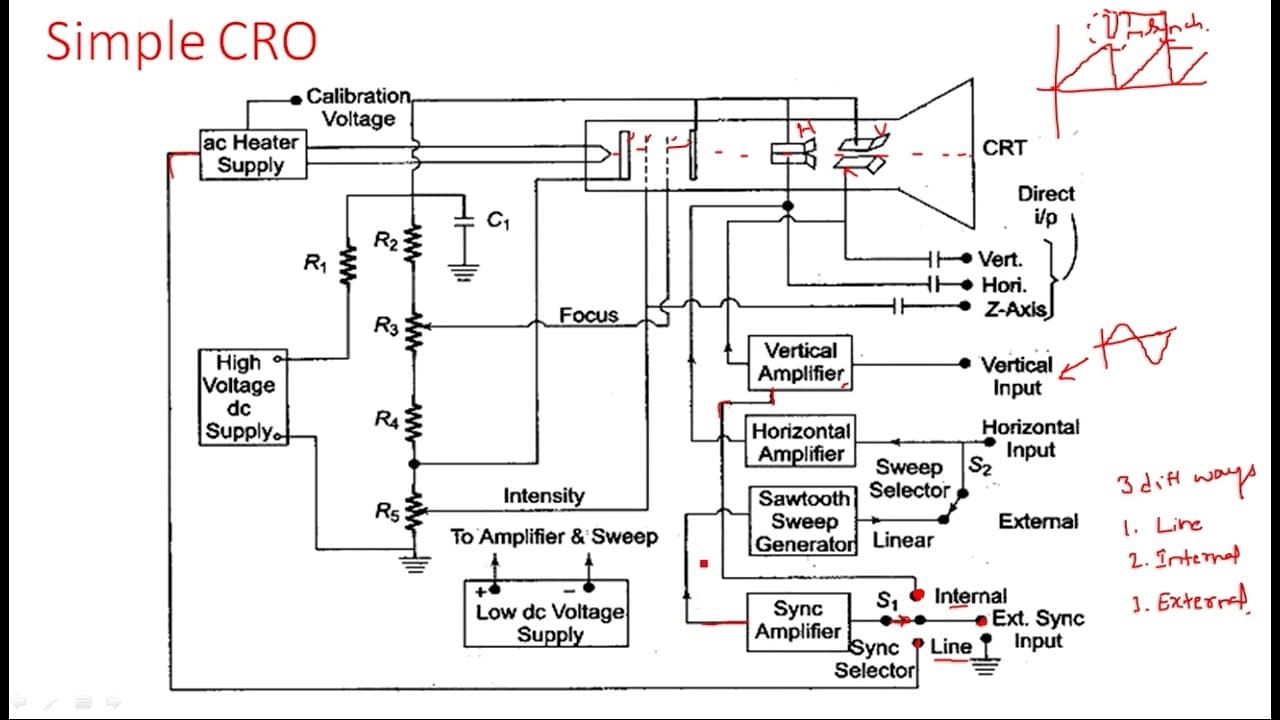
hi everyone in this video i am going to explain the operation block diagram of a simple cro so this is the complete block diagram of a simple cro in the previous video we have learned the basic block diagram of a cro where the vertical amplifier section and horizontal amplifier section means a vertical reflection system and horizontal reflection sy... Read More
Key Insights
- 🤩 The operation of a Cathode Ray Oscilloscope (CRO) is complex but can be distilled into its key components and functions related to signal display.
- 👤 Understanding the internal architecture of a CRO helps grasp how signals are processed and displayed, enhancing the user's ability to interpret waveforms.
- 😁 The electron gun is crucial in creating the electron beam necessary for displaying signals on the CRT screen, relying on proper voltage applications.
- 👻 The vertical and horizontal deflection systems work together to allow comprehensive viewing of waveforms, with additional components like amplifiers amplifying the input signals.
- ⚡ Voltage management through high and low DC supplies is essential for the optimal performance of different CRO components, enabling precise control over the output.
- 📡 Synchronization via the sawtooth waveform generator and sync signals ensures the accuracy and stability of displayed signals, allowing for effective analysis.
- 🚫 CRO operation may appear intimidating due to its complexity, but systematic understanding of each block simplifies the overall process.
Install to Summarize YouTube Videos and Get Transcripts
Explore YouTube Video Summarizer or Get YouTube Transcript Extractor
Questions & Answers
Q: What are the key components of a Cathode Ray Oscilloscope (CRO)?
The primary components of a CRO include the electron gun, vertical and horizontal amplifiers, vertical and horizontal deflecting plates, and the CRT screen. The electron gun generates an electron beam, while the amplifiers modulate this beam's position, allowing it to represent electrical signals on the screen.
Q: How does the electron gun operate in a CRO?
When power is supplied, the electron gun is energized, applying 230 volts to heat it. This process causes the electron beam to emit from the gun towards the CRT screen. The beam then travels through various anodes and reaches the fluorescent screen, creating visible signals based on the input.
Q: What role does the sawtooth waveform generator play in a CRO?
The sawtooth waveform generator creates a linear voltage ramp crucial for the horizontal deflection of the electron beam. It allows for the synchronized movement of the beam across the screen at predetermined intervals, essential for accurately displaying waveforms from electrical signals.
Q: What voltages are required for the operation of a CRO?
A CRO requires both high and low voltage DC supplies. High voltage is necessary for components like focusing and accelerating anodes, while low voltage supplies parts like amplifiers and sweep circuits, ensuring devices are biased correctly for optimal performance.
Q: Can you explain the function of the voltage divider network in a CRO?
The voltage divider network distributes voltages across multiple resistors to provide customized voltage levels to various components, like the focusing and accelerating anodes. This configuration allows for precise control over the electron beam's focus and intensity displayed on the CRT screen.
Q: What is the importance of the sync signal in a CRO?
The sync signal, generated from various sources, is critical for ensuring the sweeping process of the electron beam occurs at regular intervals of time. This synchronization is vital for accurate waveform display, allowing the CRO to portray the input signals precisely.
Q: How do external sync signals affect a CRO's performance?
External sync signals can dictate the timing of the horizontal sweep in a CRO. This allows the user to synchronize the displayed waveform with other devices, providing clarity by ensuring that the waveform appears stable and replicable on the screen, vital for analysis.
Q: How do the controls on a CRO affect its output?
Controls like the intensity and focus knobs directly affect the brightness and clarity of the displayed waveforms. Adjusting these controls alters the voltage applied to the CRT, thus enhancing or dimming the visibility and sharpness of the signals represented on the screen.
Summary & Key Takeaways
-
The video discusses the complete internal block diagram of a simple Cathode Ray Oscilloscope (CRO), detailing components like the vertical and horizontal amplifiers and their roles in signal display.
-
It explains the function of the electron gun, various voltage levels necessary for operation, including high and low voltage DC supplies, and the significance of focusing and accelerating anodes.
-
The horizontal and vertical deflection systems are outlined, emphasizing the importance of the sawtooth waveform generator and trigger pulse for proper timing and synchronization in displaying signals.
Read in Other Languages (beta)
Share This Summary 📚
Summarize YouTube Videos and Get Video Transcripts with 1-Click
Try YouTube Summary with ChatGPT & Claude or YouTube Transcript Generator