How to Detect Potato Plant Diseases Using Deep Learning
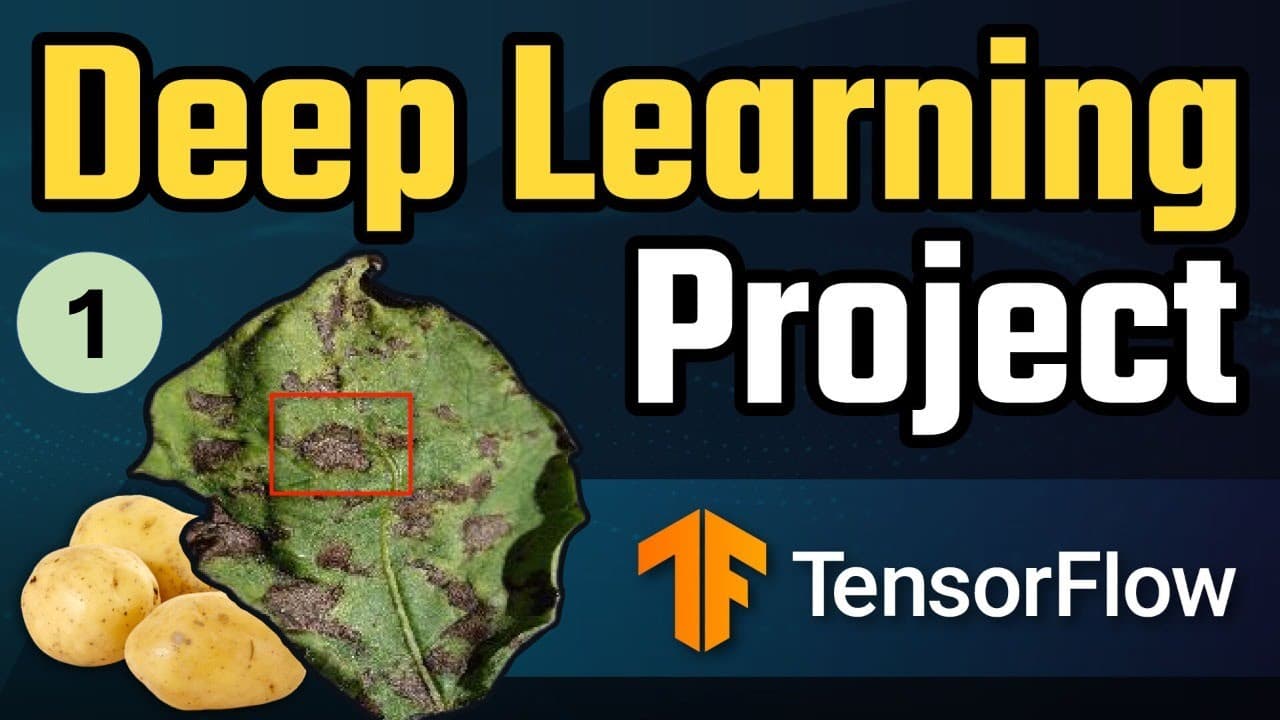
TL;DR
To detect potato plant diseases like early blight and late blight, implement a deep learning project using Convolutional Neural Networks (CNN). This involves data collection of healthy and diseased plant images, followed by data augmentation, model training in TensorFlow, and deployment via a mobile app that farmers can use to identify plant health efficiently.
Transcript
In this video we are beginning an end-to-end deep learning project series in agriculture domain. The series will have total seven to eight videos in which we'll start with data collection first and then we'll look into model building. We'll also look into some of the ML Ops using TF serving. We will build our backend server ... Read More
Key Insights
- The project focuses on detecting potato plant diseases using deep learning, specifically targeting early blight and late blight, which can cause significant economic losses for farmers.
- The solution involves building a mobile application that uses convolutional neural networks (CNN) to classify images of potato plants as healthy or diseased.
- Data collection is crucial, requiring images of healthy and diseased potato plants, followed by data cleaning and augmentation to enhance the training dataset.
- The project utilizes TensorFlow for model building, with data augmentation techniques to increase the diversity of training samples.
- Backend development involves using FastAPI and TensorFlow Serving for model deployment, allowing for scalable and efficient model serving.
- Frontend development includes creating a website using React JS and a mobile app using React Native, providing an intuitive interface for users.
- Model optimization is achieved through quantization and TensorFlow Lite, enabling deployment on edge devices with reduced memory usage and faster inference.
- Deployment is on Google Cloud Platform (GCP), using Google Cloud Functions to support the mobile application, demonstrating a serverless architecture.
Install to Summarize YouTube Videos and Get Transcripts
Explore YouTube Video Summarizer or Get YouTube Transcript Extractor
Questions & Answers
Q: What is the main objective of this deep learning project?
The main objective of this deep learning project is to develop an end-to-end solution for detecting diseases in potato plants, specifically early blight and late blight. By using convolutional neural networks (CNN) for image classification, the project aims to provide farmers with a mobile application that can identify plant diseases early, thereby reducing economic losses and waste.
Q: How does the project plan to collect data for training the model?
Data collection for the project involves gathering images of potato plants, both healthy and those affected by early blight or late blight diseases. These images will serve as the training dataset. The project emphasizes the importance of data cleaning and augmentation, using techniques such as rotation, flipping, and contrast adjustment to increase the diversity and size of the training dataset, ensuring robust model training.
Q: What technologies are used for backend development in this project?
The backend development of this project utilizes FastAPI and TensorFlow Serving. FastAPI is used to create a RESTful API for the application, while TensorFlow Serving is employed to manage and serve the trained models. This combination allows for efficient and scalable model deployment, enabling the application to handle multiple versions of models and serve predictions to the frontend interfaces seamlessly.
Q: How is the model optimized for deployment on mobile devices?
Model optimization for deployment on mobile devices is achieved through quantization and TensorFlow Lite. Quantization reduces the model size and memory footprint, making it suitable for edge devices. TensorFlow Lite further facilitates deploying the model on mobile devices by providing a lightweight runtime. This optimization ensures faster inference speeds and efficient use of resources, making the application responsive and effective for farmers in the field.
Q: What frontend technologies are used in the project?
The project uses React JS for developing the web interface and React Native for creating the mobile application. React JS provides a robust framework for building a responsive and dynamic web application, while React Native enables the development of a cross-platform mobile app. These technologies ensure that the application is accessible and user-friendly, allowing farmers to easily interact with the system and obtain disease predictions.
Q: Why is Google Cloud Platform chosen for deployment?
Google Cloud Platform (GCP) is chosen for deployment due to its robust infrastructure and support for scalable, serverless architectures. The project utilizes Google Cloud Functions, which are similar to AWS Lambda, to handle serverless execution of code in response to events. This choice allows for efficient management of resources and seamless scaling of the application, ensuring that it can handle varying loads and provide reliable service to users.
Q: What are the prerequisites for following this project series?
The prerequisites for following this project series include a basic understanding of Python and deep learning concepts. Specifically, viewers should be familiar with convolutional neural networks (CNN) and image classification techniques. The creator provides resources, such as playlists on Python and deep learning, to help viewers acquire the necessary knowledge. These foundational skills are essential for understanding the technical aspects of the project and successfully implementing the solution.
Q: How can this project be beneficial for aspiring data scientists?
This project is beneficial for aspiring data scientists as it provides a comprehensive, practical example of an end-to-end deep learning solution. By following the series, individuals can learn about data collection, model building, backend and frontend development, and deployment. This hands-on experience is valuable for building a strong portfolio and gaining skills relevant to real-world applications. Additionally, the project encourages customization, allowing learners to adapt the solution to different scenarios, such as detecting diseases in other crops.
Summary & Key Takeaways
-
This video introduces a deep learning project aimed at detecting potato plant diseases using CNN. The project involves building a mobile app for farmers to identify diseases early, reducing economic losses. It covers data collection, model building, and deployment using a comprehensive tech stack.
-
The project leverages TensorFlow, CNN, and data augmentation for model building. FastAPI and TensorFlow Serving are used for backend development, while React JS and React Native are used for frontend interfaces. Deployment is on Google Cloud Platform, showcasing a complete end-to-end solution.
-
Farmers face significant losses due to potato plant diseases. This project aims to mitigate these losses by deploying a mobile app that uses deep learning to identify diseases. The app is built using a robust tech stack, including TensorFlow, FastAPI, and Google Cloud.
Read in Other Languages (beta)
Share This Summary 📚
Summarize YouTube Videos and Get Video Transcripts with 1-Click
Try YouTube Summary with ChatGPT & Claude or YouTube Transcript Generator
Explore More Summaries from codebasics 📚




Summarize YouTube Videos and Get Video Transcripts with 1-Click
Try YouTube Summary with ChatGPT & Claude or YouTube Transcript Generator