Running with Trained Model - Deep Learning in Halite AI competition p.6
TL;DR
This video showcases the process of building and training ML and deep learning models for the Halite 3 Challenge, with an emphasis on improving model performance.
Transcript
what's going on everybody welcome to part 6 of the ML and deep learning with the highlight 3 challenge tutorials in this video we're just gonna continue building on the last one which I believe I left off fixing a slight bug that we weren't able to train for multiple epochs so let me quickly bring up tensor board tensor board log dirt equals log di... Read More
Key Insights
- 😥 Training for multiple epochs improves model accuracy, but the gains may plateau after a certain point.
- 🥡 Preparing data for training takes considerably more time compared to training without data preprocessing.
- 👋 Achieving an accuracy above random choice is a good indicator of an effective training threshold.
- 👻 Running games with the trained model allows for evaluating its performance and measuring improvements.
- 🆘 Incorporating a random chance in the ML model helps maintain exploration and learning.
- ✋ The ML model shows promising results with a higher distribution of higher halite collected compared to random moves.
- 👾 Building a large number of training games is time-consuming but essential for a fair assessment of model performance.
Install to Summarize YouTube Videos and Get Transcripts
Explore YouTube Video Summarizer or Get YouTube Transcript Extractor
Questions & Answers
Q: What is the accuracy achieved after three epochs of training?
The accuracy achieved after three epochs of training is between 24.5% and 25%, which is impressive considering random choice would yield a 20% accuracy. This indicates that the threshold used for training likely worked well.
Q: What is the purpose of running games with the trained model?
Running games with the trained model helps evaluate its performance and measure any improvements. The goal is to increase the average or mean halite collected, even by a small margin, which can be significant in the early stages of the game.
Q: How is the randomness incorporated in the ML model?
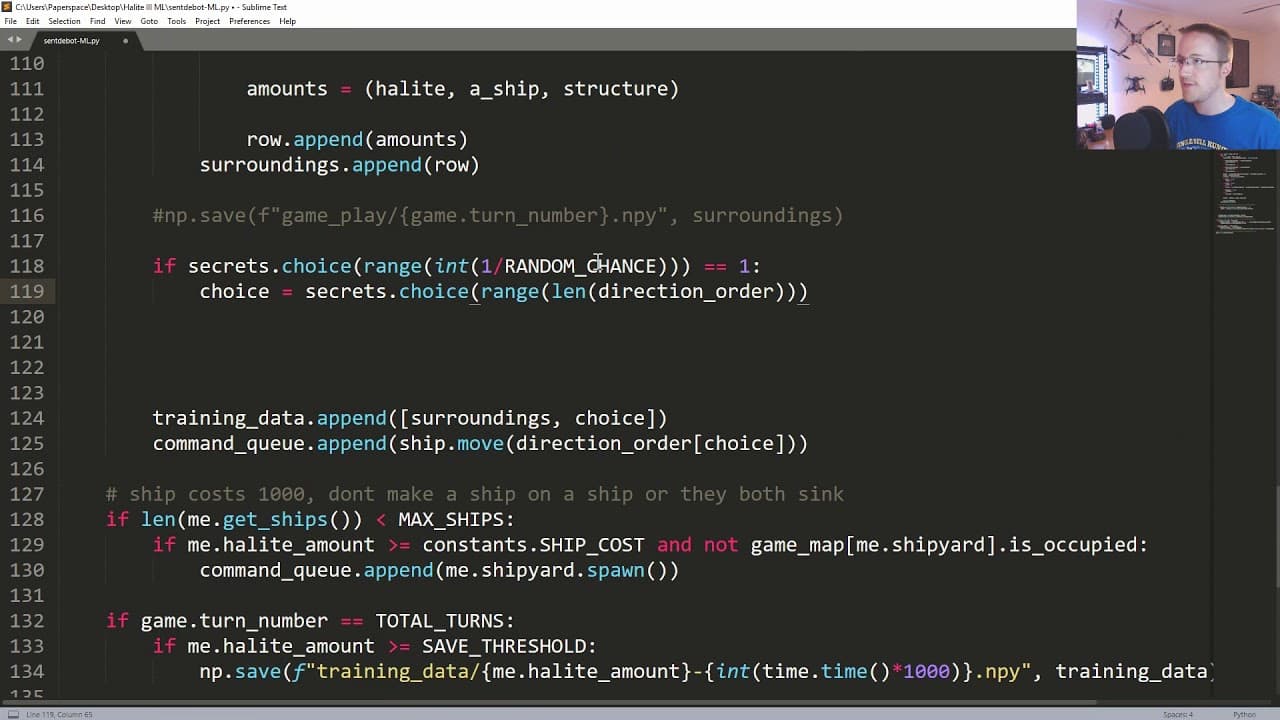
The ML model is designed to have a certain percentage of random moves for exploration. The video demonstrates setting a random chance parameter, which determines the probability of choosing a random move over the model's choice. This ensures continued exploration and learning.
Q: Why is data preparation time-consuming?
Data preparation involves loading and preparing the data before training the model. This process takes significantly longer compared to training without data preparation because of the additional steps involved in organizing and formatting the data.
Summary & Key Takeaways
-
The video demonstrates the process of fixing a bug in the code that prevented training for multiple epochs and showcases the accuracy achieved with three epochs of training.
-
The challenge of preparing the data is highlighted, as it takes significantly longer compared to training without data preparation.
-
The video introduces the next step of the iterative process, which involves running games with the trained model to evaluate its performance and measure improvements.
-
The video demonstrates the implementation of an AI model using ML instead of random moves and explains the rationale behind setting a random chance for exploration.
Read in Other Languages (beta)
Share This Summary 📚
Summarize YouTube Videos and Get Video Transcripts with 1-Click
Try YouTube Summary with ChatGPT & Claude or YouTube Transcript Generator
Explore More Summaries from sentdex 📚

Summarize YouTube Videos and Get Video Transcripts with 1-Click
Try YouTube Summary with ChatGPT & Claude or YouTube Transcript Generator