Astable Multivibrator | Emitter coupled | PDC | Lec-69
TL;DR
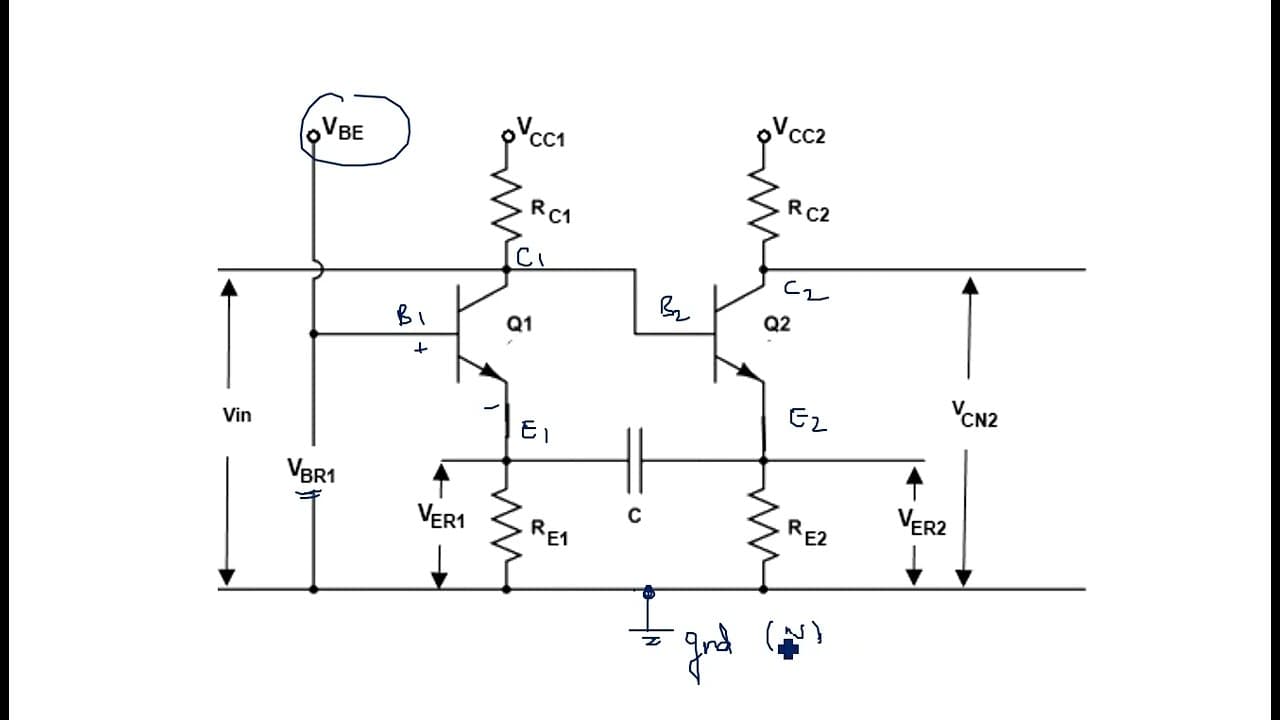
This video explains the emitter coupled stable multivibrator configuration and its circuit components.
Transcript
hi everyone in this video I am going to explain about emitter coupled stable multivibrator in the beginning of htable multivibrator I told you there are two different types of configurations available in a stable multivibrator one is collector coupled stable multivibrator and second one is emitter coupled stable multivibrator we have seen the desig... Read More
Key Insights
- 🧑🤝🧑 The emitter coupled stable multivibrator uses two transistors (Q1 and Q2) and is distinct from collector coupled configurations.
- 👫 Capacitors are strategically placed between the emitters to maintain coupled states and enhance oscillator performance.
- 💁 Biasing of transistors is crucial, which is achieved using resistors grounded to form stable operational voltages needed for switching.
- ✊ The circuit can operate with either separate power supplies for each transistor or a single supply to simplify the design.
- ⚡ Understanding the voltage relationships during transitions is vital for analyzing multivibrator behavior in circuits.
- ⌛ The changes across capacitors help maintain continuous operation, influencing the effectiveness of the multivibrator over time.
- ⚡ Analyzing collector and emitter voltages provides deeper insights into the oscillation periods and dynamics of the circuit.
Install to Summarize YouTube Videos and Get Transcripts
Explore YouTube Video Summarizer or Get YouTube Transcript Extractor
Questions & Answers
Q: What is the primary focus of the video regarding stable multivibrators?
The video focuses on explaining the emitter coupled stable multivibrator, which is a configuration different from the collector coupled stable multivibrator by using capacitive coupling between the emitters of two transistors, Q1 and Q2, to achieve oscillation states.
Q: How do resistors play a role in the operation of the emitter coupled multivibrator?
Resistors in the circuit serve to provide necessary biasing for the transistors’ operation. By creating voltage drops across the emitter terminals, they maintain the required operating states of the transistors, ensuring that when one transistor turns on, the other turns off, stabilizing the circuit.
Q: What happens during the transition of states in the multivibrator?
During state transitions, when Q1 turns off and Q2 turns on, voltages across the emitters change significantly. These changes create a scenario where the collector-emitter voltages fluctuate, causing one transistor's state alteration to influence the other directly due to capacitive coupling, leading to oscillations.
Q: What is the significance of capacitive coupling in this multivibrator setup?
Capacitive coupling between Q1 and Q2's emitters is essential for stabilizing the functioning of the multivibrator. It allows for the transfer of fluctuations between transistors, facilitating smooth transitions and maintaining oscillatory behavior which is crucial for stable operation over time.
Summary & Key Takeaways
-
The video details the emitter coupled configuration of a stable multivibrator, focusing on the use of two coupled transistors, Q1 and Q2, to produce oscillations.
-
The importance of resistors for biasing the transistors and the role of coupling capacitors between the emitters are thoroughly discussed to provide operational stability.
-
Circuit diagrams and calculations are presented to explain how variations in collector and emitter voltages affect transistor states during operation.
Read in Other Languages (beta)
Share This Summary 📚
Summarize YouTube Videos and Get Video Transcripts with 1-Click
Try YouTube Summary with ChatGPT & Claude or YouTube Transcript Generator