Image classification from scratch - Keras Code Examples
TL;DR
Learn how to implement deep learning models using Keras in this detailed tutorial.
Transcript
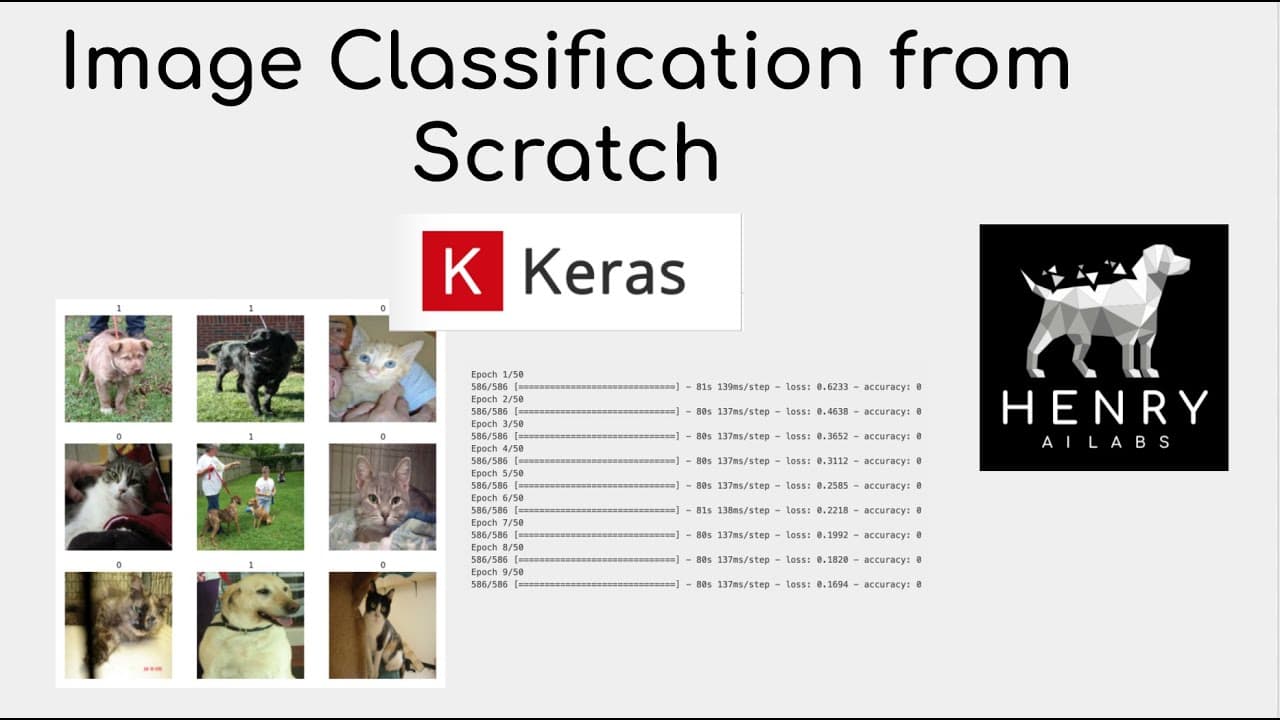
welcome to the henry ai labs walkthrough of keras code examples keras has provided 56 code examples implementing popular ideas in deep learning this ranges from the basics such as simple mnist and imdb text classification all the way to cutting-edge research ideas such as knowledge distillation supervised contrastive learning and transformers we'll... Read More
Key Insights
- 🧡 Keras offers a wide range of tools and structures for building deep learning models, catering to both beginners and advanced users in the field.
- 🍵 Image preprocessing is a critical step that involves loading data correctly, handling corrupt files, and normalizing inputs to improve model training.
- 👻 The tutorial emphasizes the significance of using both data augmentation and standardization to enhance model performance, allowing it to better adapt to various image inputs during training.
- 🥠 Building deep neural networks requires careful planning, including consideration of model architecture and hyperparameter tuning to optimize performance.
- 🏃 Callbacks for saving model states during training are crucial for long-running experiments, helping prevent data loss and facilitating transfer learning.
- 👻 Visualizing the model using Keras utilities allows learners to understand network architecture, making it easier to grasp concepts like skip connections and batch normalization.
- 💦 The tutorial demonstrates efficient data handling between CPUs and GPUs, stressing the need for a structured approach to preprocessing when working at scale.
Install to Summarize YouTube Videos and Get Transcripts
Explore YouTube Video Summarizer or Get YouTube Transcript Extractor
Questions & Answers
Q: What are some essential coding skills taught in the Keras tutorial?
The tutorial covers downloading datasets using shell commands, preprocessing images for deep learning, and building convolutional neural networks (CNNs) from scratch. Viewers learn to use Keras functions to handle data augmentation, normalization, and visualize model architectures. Each step is explained to ensure a comprehensive understanding of the coding process involved in deep learning.
Q: How does the tutorial address handling corrupted images in datasets?
The tutorial discusses the importance of filtering out corrupted images, which may arise from downloading datasets. It explains using Python's 'os' library to loop through directories and identify images that cannot be properly opened, ensuring that only valid JPEG files are included in the training process. This helps maintain the integrity of the training data for more accurate model predictions.
Q: Why is data augmentation important in deep learning?
Data augmentation is crucial as it increases the diversity of the training dataset without collecting new data. This involves applying transformations such as random rotations and flips, which help the model generalize better by learning to recognize objects under different conditions, ultimately improving performance on unseen data. The tutorial provides practical Keras functions for implementing these techniques.
Q: What advantages do GPUs provide for training deep learning models?
GPUs significantly expedite neural network training by allowing parallel computing across large datasets and complex models. This is particularly beneficial since deep learning involves intensive matrix multiplications, which can be computationally heavy. The tutorial highlights the dramatic time savings experienced when switching from CPU to GPU for training Keras models, making it clear why using GPUs is recommended.
Summary & Key Takeaways
-
The video offers a hands-on tutorial with 56 Keras code examples for deep learning, ranging from basic tasks to advanced topics like transformers and knowledge distillation.
-
Viewers learn essential skills such as downloading datasets, preprocessing images, and building convolutional neural networks (CNNs) using the Keras library and TensorFlow.
-
The tutorial emphasizes practical implementation, including visualization of data, data augmentation techniques, and evaluating model performance during training and inference.
Read in Other Languages (beta)
Share This Summary 📚
Summarize YouTube Videos and Get Video Transcripts with 1-Click
Try YouTube Summary with ChatGPT & Claude or YouTube Transcript Generator
Explore More Summaries from Connor Shorten 📚
Summarize YouTube Videos and Get Video Transcripts with 1-Click
Try YouTube Summary with ChatGPT & Claude or YouTube Transcript Generator