Early embryogenesis - Cleavage, blastulation, gastrulation, and neurulation | MCAT | Khan Academy
TL;DR
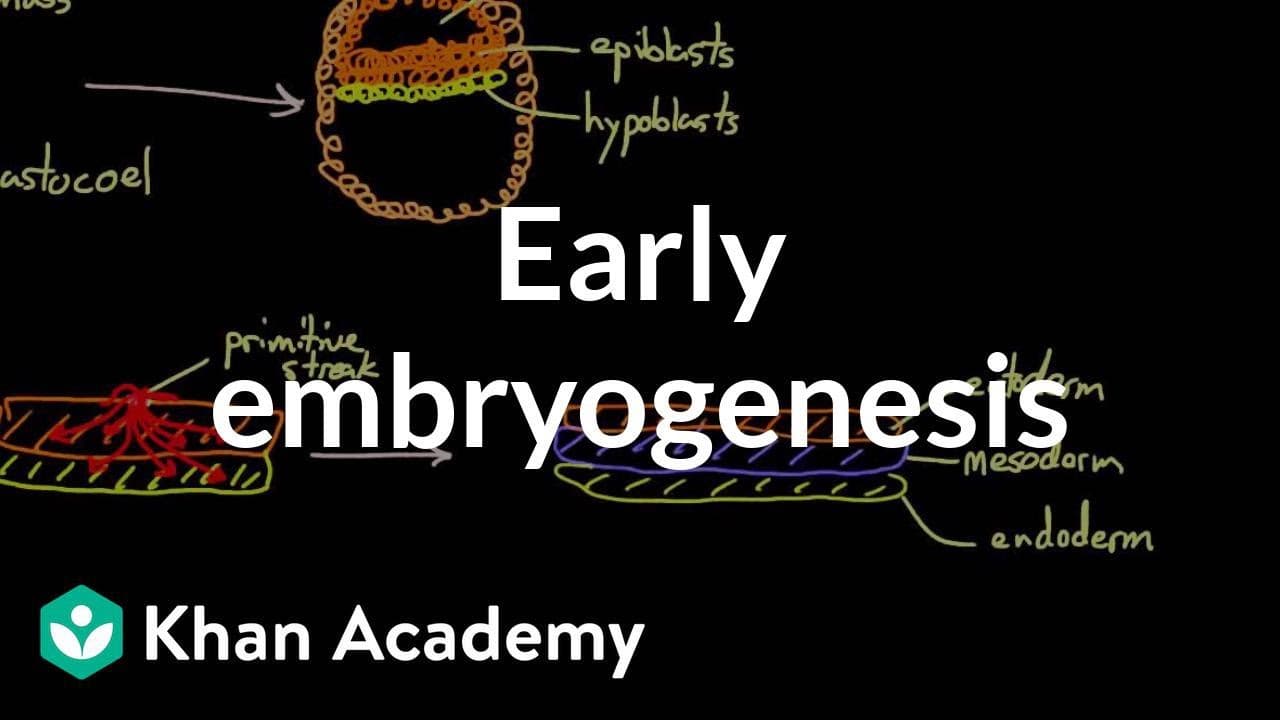
The video provides a detailed explanation of the process of early embryogenesis, including cleavage, compaction, blastulation, gastrulation, and neurolation.
Transcript
- We're gonna talk about early embryogenesis. Say you're an egg cell, and you have this nice, thick outer glycoprotein coat called the zona pellucida, and you've got your plasma membrane just inside of that. And a sperm has made its way through the zone pellucida and managed to get in through your plasma membrane and merged its genetic material wit... Read More
Key Insights
- ❓ Early embryogenesis starts with fertilization and involves processes like cleavage, compaction, blastulation, gastrulation, and neurolation.
- 👻 Cleavage allows for rapid cell division without growth.
- 😚 Compaction leads to cells getting closer, and differentiation begins.
- 💁 Blastulation involves the formation of a blastocyst and the disintegration of the zona pellucida.
- 💁 Gastrulation is responsible for the formation of the three germ layers, ectoderm, mesoderm, and endoderm.
- 💁 Neurolation involves the formation of the neural tube and neural crest cells.
- 🅰️ Each stage of embryogenesis is essential for the development and differentiation of various structures and cell types.
Install to Summarize YouTube Videos and Get Transcripts
Explore YouTube Video Summarizer or Get YouTube Transcript Extractor
Questions & Answers
Q: What is cleavage in the process of early embryogenesis?
Cleavage is the process in which a zygote divides into multiple cells without growing, resulting in an increase in cell number.
Q: What happens during compaction?
Compaction is a process in which cells in the morula start getting closer together, and differentiation occurs, leading to the formation of trophoblast cells on the outside and embryoblast cells in the middle.
Q: What is blastulation?
Blastulation is the process in which the blastocyst cavity, called the blastocoel, forms, and the zona pellucida disintegrates, allowing the trophoblasts to be exposed.
Q: What is the significance of gastrulation?
Gastrulation is a crucial stage where the three germ layers, ectoderm, mesoderm, and endoderm, are formed, allowing further differentiation and development of specific structures.
Key Insights:
- Early embryogenesis starts with fertilization and involves processes like cleavage, compaction, blastulation, gastrulation, and neurolation.
- Cleavage allows for rapid cell division without growth.
- Compaction leads to cells getting closer, and differentiation begins.
- Blastulation involves the formation of a blastocyst and the disintegration of the zona pellucida.
- Gastrulation is responsible for the formation of the three germ layers, ectoderm, mesoderm, and endoderm.
- Neurolation involves the formation of the neural tube and neural crest cells.
- Each stage of embryogenesis is essential for the development and differentiation of various structures and cell types.
- Early embryogenesis is a complex and highly regulated process that lays the foundation for further development.
Summary & Key Takeaways
-
The process of early embryogenesis starts with fertilization, where a sperm merges its genetic material with an egg cell, resulting in the formation of a zygote.
-
The zygote then undergoes cleavage, dividing into multiple cells without growth.
-
The cells continue to divide and differentiate, forming a morula, a blastocyst, and a trilaminar disk, ultimately leading to the development of three germ layers.
Read in Other Languages (beta)
Share This Summary 📚
Summarize YouTube Videos and Get Video Transcripts with 1-Click
Try YouTube Summary with ChatGPT & Claude or YouTube Transcript Generator
Explore More Summaries from khanacademymedicine 📚




Summarize YouTube Videos and Get Video Transcripts with 1-Click
Try YouTube Summary with ChatGPT & Claude or YouTube Transcript Generator