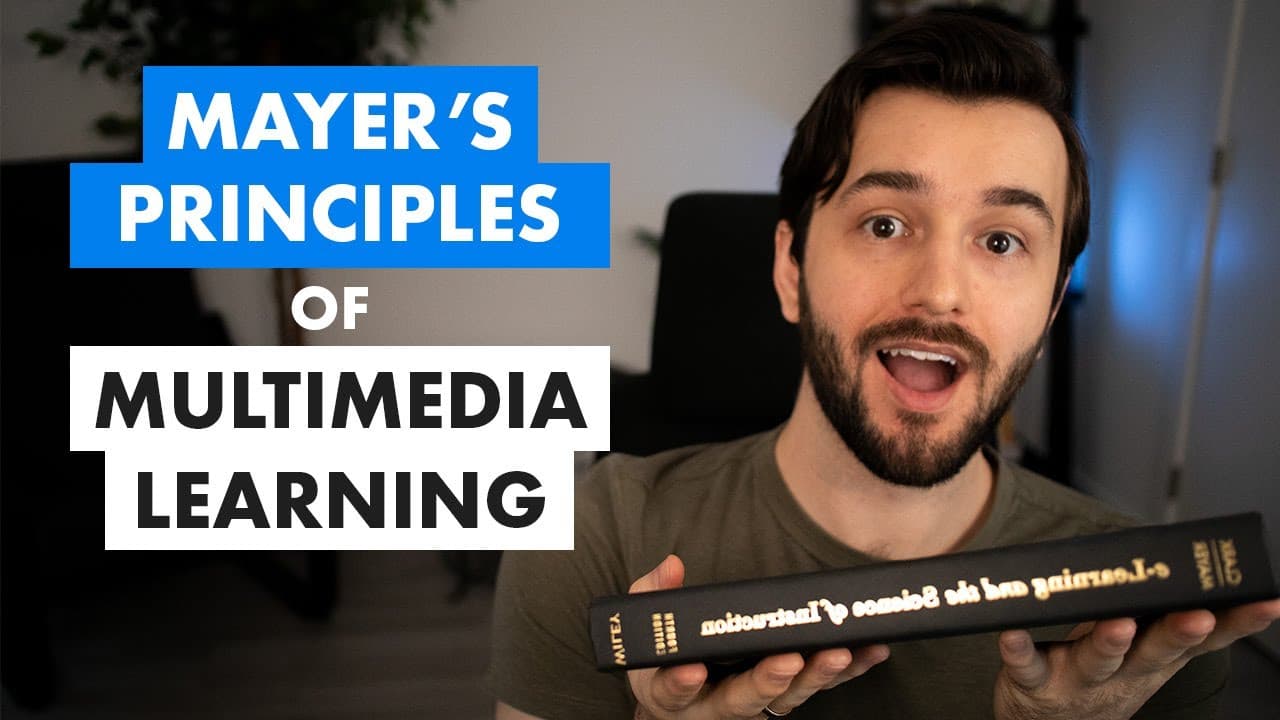
Mayer's Principles of Multimedia Learning
TL;DR
Understanding Mayer's principles for engaging e-learning with graphics, narration, and segmentation.
Transcript
if you're trying to create e-learning that's more engaging and effective or if you're just trying to become an instructional designer then you should learn more about how to apply Mayer's principles for multimedia learning so Mayer's principles are research-backed and science-driven so by applying these to your e-learning projects it's a ... Read More
Key Insights
- 😀 Mayer's principles for multimedia learning advocate for using graphics and narration together to improve e-learning engagement.
- 🔑 The contiguity principle emphasizes aligning words and graphics spatially and temporally to enhance comprehension.
- 😀 Applying the modality principle involves describing graphics with narration to reduce cognitive load in e-learning.
- 😒 The redundancy principle suggests avoiding the use of text and narration simultaneously in e-learning content.
- ❓ The coherence principle focuses on eliminating extraneous material and maintaining alignment with learning objectives.
- 😒 The personalization principle encourages a conversational tone and the use of on-screen characters for improved engagement.
- 🤩 Segmenting content into bite-sized segments based on complexity is key according to the segmenting principle.
Install to Summarize YouTube Videos and Get Transcripts
Explore YouTube Video Summarizer or Get YouTube Transcript Extractor
Questions & Answers
Q: What is the multimedia principle according to Mayer?
The multimedia principle states that using words and graphics together, instead of words alone, enhances the learning experience in e-learning projects. Graphics should aid understanding and organization of information.
Q: How does the contiguity principle impact e-learning design?
The contiguity principle emphasizes aligning words with graphics spatially and temporally. Labels and explanations should be close to the corresponding visuals to reduce cognitive load and enhance comprehension.
Q: Why is the modality principle important for describing graphics?
The modality principle suggests describing graphics with narration rather than on-screen text to avoid overloading the visual channel. Narration helps learners focus on visuals without the distraction of reading text simultaneously.
Q: How does the personalization principle enhance e-learning experiences?
The personalization principle encourages a conversational tone and human voice in e-learning content to improve learning outcomes. Using on-screen coaches or characters adds a relatable element to the learning process.
Summary & Key Takeaways
-
Mayer's principles for multimedia learning emphasize the use of graphics and narration to enhance e-learning.
-
The principles include multimedia, contiguity, modality, redundancy, coherence, personalization, embodiment, segmenting, pre-training, and signaling.
-
Applying these principles can create more engaging and effective e-learning experiences.
Read in Other Languages (beta)
Share This Summary 📚
Summarize YouTube Videos and Get Video Transcripts with 1-Click
Try YouTube Summary with ChatGPT & Claude or YouTube Transcript Generator
Explore More Summaries from Devlin Peck 📚





Summarize YouTube Videos and Get Video Transcripts with 1-Click
Try YouTube Summary with ChatGPT & Claude or YouTube Transcript Generator