How Does the 13 Trick Card Magic Work?
TL;DR
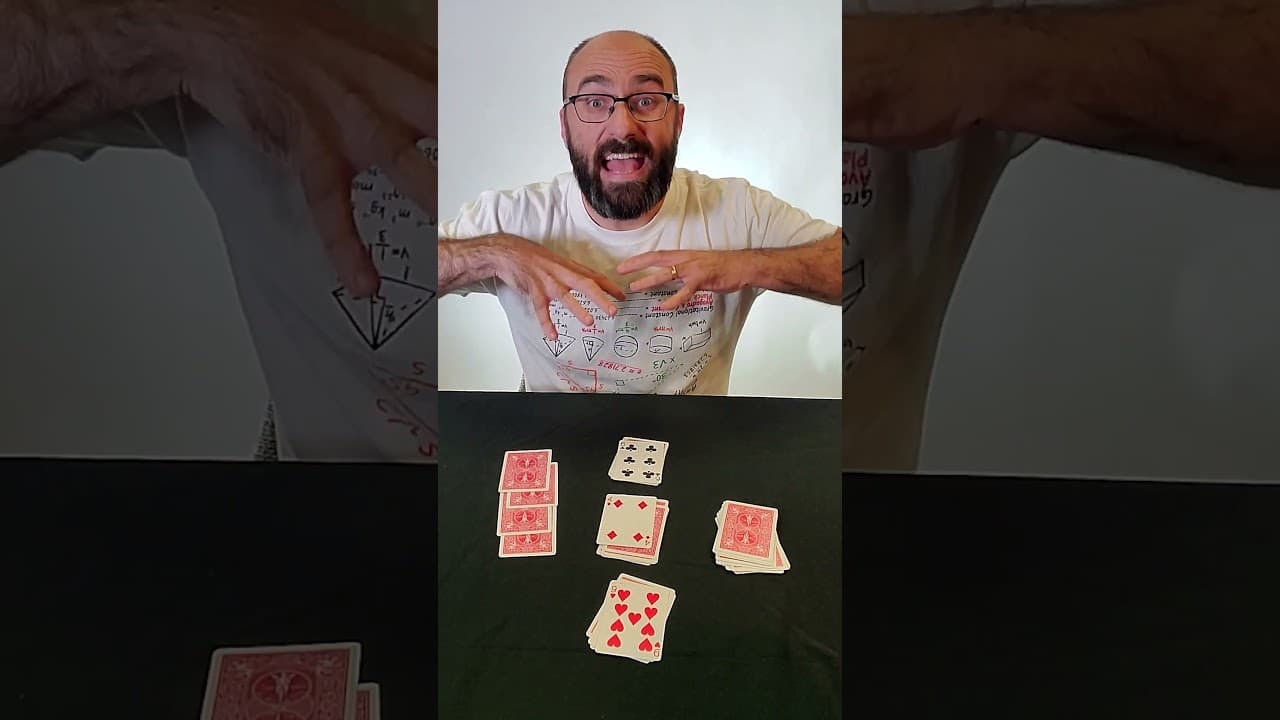
The 13 Trick is a mathematical card trick that reveals the value of a selected card based on the piles formed during the performance. By creating piles that add up to 13 and calculating the sum of the top cards chosen by a participant plus 10, the magician can predict the number of remaining cards in hand, which correlates with the value of one top card. The trick's success relies on its mathematical structure and strategic placement of cards.
Transcript
i want to show you the magic trick that literally changed the direction of my life my mother showed me this trick a long time ago but when I asked her what its secret was she told me "Michael I don't know it just happens." And ever since that day I have loved math and recreational mathematics here's how you do it you start with a deck of 52 cards i... Read More
Key Insights
- The 13 Trick is a mathematical card trick that uses a deck of 52 cards to reveal hidden card values.
- The trick involves creating piles of cards where each pile adds up to 13, using the value of the top card to determine how many more cards are needed.
- Face cards are assigned numerical values: aces equal 1, jacks equal 11, queens equal 12, and kings equal 13.
- After creating piles, the participant selects three piles, and the magician calculates the sum of the top card values plus 10.
- The magician deals out cards equal to the calculated sum, and the remaining cards in hand match the value of a top card.
- The trick works because the number of cards left in hand correlates with the value of the top card of unselected piles.
- Each pile theoretically contains 14 cards, but the magician skips cards based on the top card's value, leaving some cards in hand.
- The trick consistently works due to the mathematical relationship between the piles, skipped cards, and the total number of cards.
Install to Summarize YouTube Videos and Get Transcripts
Explore YouTube Video Summarizer or Get YouTube Transcript Extractor
Questions & Answers
Q: How does the 13 Trick begin?
The 13 Trick begins with a standard deck of 52 cards, shuffled in any way. The magician starts by pulling out a card, turning it over, and counting up to 13 from its value. This process is repeated to create multiple piles, each with a total value of 13.
Q: What values are assigned to face cards in the 13 Trick?
In the 13 Trick, face cards are assigned specific numerical values to facilitate the counting process. Aces are valued at 1, jacks at 11, queens at 12, and kings at 13. These values are crucial for building piles that add up to 13.
Q: How are the piles used to reveal a card's value?
The piles are used to reveal a card's value by having the participant select three piles. The magician then calculates the sum of the top card values from the selected piles, adds 10, and deals out that number of cards. The remaining cards in hand match the value of a top card.
Q: Why does the trick work consistently?
The trick works consistently due to the mathematical relationship between the piles, skipped cards, and the total number of cards. Each pile theoretically contains 14 cards, but cards are skipped based on the top card's value, leaving a specific number of cards in the magician's hand.
Q: How does the magician calculate the number of cards to deal?
The magician calculates the number of cards to deal by taking the sum of the top card values from the selected piles and adding 10. This total determines how many cards are dealt from the magician's hand, with the remaining cards matching the value of one top card.
Q: What happens if there aren't enough cards for another pile?
If there aren't enough cards for another pile, the remaining cards stay in the magician's hand. This situation is part of the trick's design and doesn't affect the outcome, as the remaining cards will still correlate with the value of one of the top cards.
Q: How does the magician use the number of cards in hand?
The magician uses the number of cards in hand to reveal the value of a top card. After dealing out the calculated number of cards, the remaining cards in hand should exactly match the value of the top card of one of the unselected piles, demonstrating the trick's effectiveness.
Q: What is the significance of the number 13 in the trick?
The number 13 is significant because it serves as the target value for each pile. By counting up to 13 from the value of the first card in each pile, the magician creates a consistent mathematical framework that allows the trick to work seamlessly, revealing the value of a card.
Summary & Key Takeaways
-
The 13 Trick is a self-working mathematical card trick using a deck of 52 cards, where each pile is built to reach a value of 13. Participants select piles, and the magician calculates the sum of the top card values plus 10, revealing the remaining cards in hand.
-
Face cards are assigned values: aces equal 1, jacks equal 11, queens equal 12, and kings equal 13. The trick involves skipping cards based on the top card's value, leaving a specific number of cards in the magician's hand, matching the value of one top card.
-
The trick relies on the mathematical relationship between the piles, skipped cards, and the total number of cards. It consistently works because the number of cards left in hand correlates with the value of the top card of unselected piles, creating a surprising and entertaining effect.
Read in Other Languages (beta)
Share This Summary 📚
Summarize YouTube Videos and Get Video Transcripts with 1-Click
Try YouTube Summary with ChatGPT & Claude or YouTube Transcript Generator
Explore More Summaries from Vsauce 📚

Summarize YouTube Videos and Get Video Transcripts with 1-Click
Try YouTube Summary with ChatGPT & Claude or YouTube Transcript Generator