11. More on spacetime curvature.
TL;DR
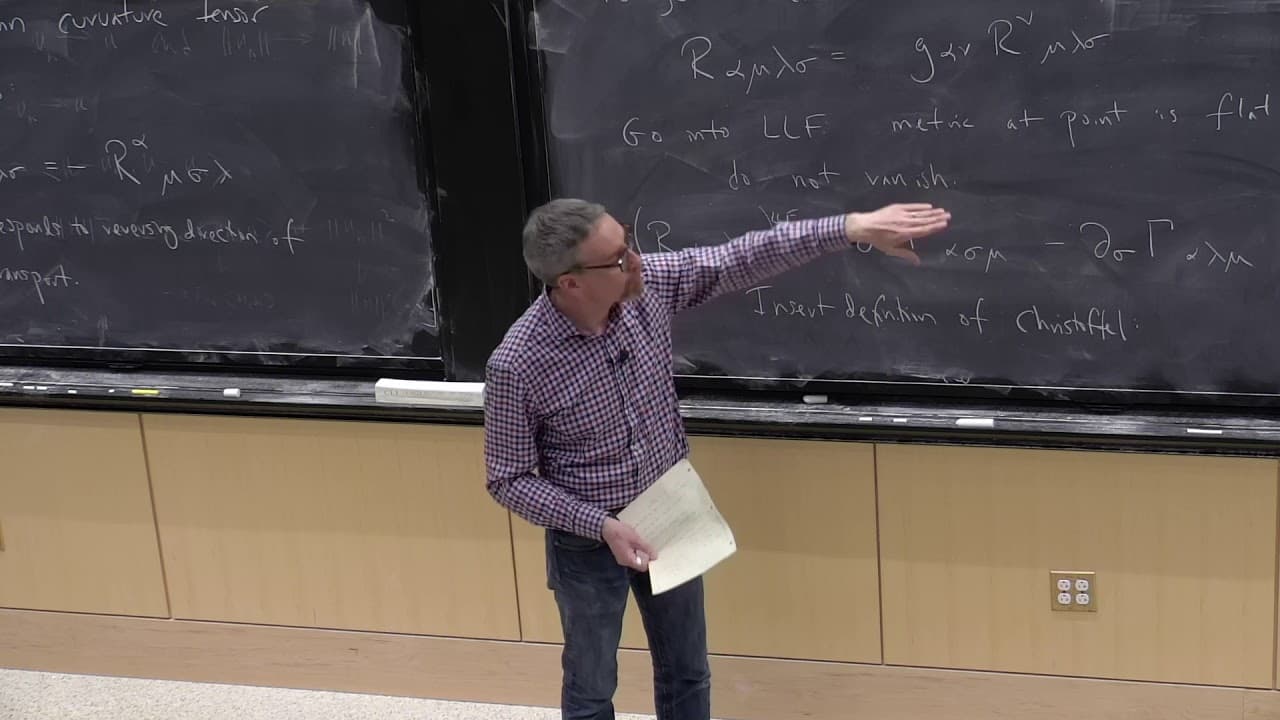
The lecture discusses curvature in spacetime and introduces the Einstein curvature tensor, which describes the behavior of geodesics and tides in general relativity.
Transcript
[SQUEAKING] [RUSTLING] [CLICKING] SCOTT HUGHES: So this is unfortunately a rather sad lecture, [LAUGHS] since this will be the last one that I'm giving to a live audience here, although any of you who are grad students, if you want to come and keep me company while I'm recording my next couple of lectures-- I'm actually not joking. It's really weir... Read More
Key Insights
- 🤬 The Riemann tensor describes the nonlinear behavior of spacetime curvature and is assembled from the Christoffel symbols, resulting in a tensor object.
- #️⃣ The Ricci curvature tensor is derived from the Riemann tensor and has symmetries that reduce the number of independent components.
- ❓ The Weyl tensor describes the remaining degrees of freedom in the Riemann tensor and is significant in vacuum regions and gravitational radiation.
- 🛀 The equation of geodesic deviation shows how initially parallel geodesics deviate in a curved spacetime, explaining tidal forces.
Install to Summarize YouTube Videos and Get Transcripts
Explore YouTube Video Summarizer or Get YouTube Transcript Extractor
Questions & Answers
Q: What is the difference between the Riemann tensor and the Ricci curvature tensor?
The Riemann tensor is a mathematical object that encapsulates the nonlinear behavior of spacetime curvature, while the Ricci curvature tensor is derived from the Riemann tensor and describes the intrinsic curvature of a manifold. The Ricci tensor has symmetries that reduce the number of independent components compared to the Riemann tensor.
Q: What is the significance of the Weyl tensor in general relativity?
The Weyl tensor represents the remaining degrees of freedom in the Riemann tensor that are not captured by the Ricci curvature tensor. It describes the behavior of gravity in vacuum regions and plays a key role in understanding gravitational radiation and conformal transformations.
Q: How does the equation of geodesic deviation relate to tidal forces in general relativity?
The equation of geodesic deviation quantifies how initially parallel geodesics in a curved spacetime diverge from each other. This is the key concept behind tidal forces, which occur when different parts of an extended object experience different accelerations due to the curvature of spacetime.
Q: What is the significance of the Einstein curvature tensor?
The Einstein curvature tensor is a divergence-free two-index tensor that describes the curvature of spacetime and serves as the basis for the gravitational field equations in general relativity. It relates the curvature of spacetime to the distribution of matter and energy through the stress-energy tensor.
Summary & Key Takeaways
-
The lecture introduces the Riemann curvature tensor, which quantifies the deviation of initially parallel geodesics in a curved spacetime.
-
The Riemann curvature tensor is antisymmetric under exchange of its final two indices and encodes the nonlinearity of spacetime.
-
The Ricci curvature tensor, derived from the Riemann tensor, has symmetries that reduce the number of independent components.
-
The Weyl tensor represents the remaining degrees of freedom in the Riemann tensor and describes the behavior of gravity in vacuum regions.
-
The equation of geodesic deviation demonstrates how nearby geodesics in a curved spacetime evolve apart from each other.
-
The Bianchi identity and the Einstein curvature tensor link the divergence of Ricci curvature to the stress-energy tensor and serve as a basis for the gravitational field equations.
Read in Other Languages (beta)
Share This Summary 📚
Summarize YouTube Videos and Get Video Transcripts with 1-Click
Try YouTube Summary with ChatGPT & Claude or YouTube Transcript Generator
Explore More Summaries from MIT OpenCourseWare 📚



Summarize YouTube Videos and Get Video Transcripts with 1-Click
Try YouTube Summary with ChatGPT & Claude or YouTube Transcript Generator