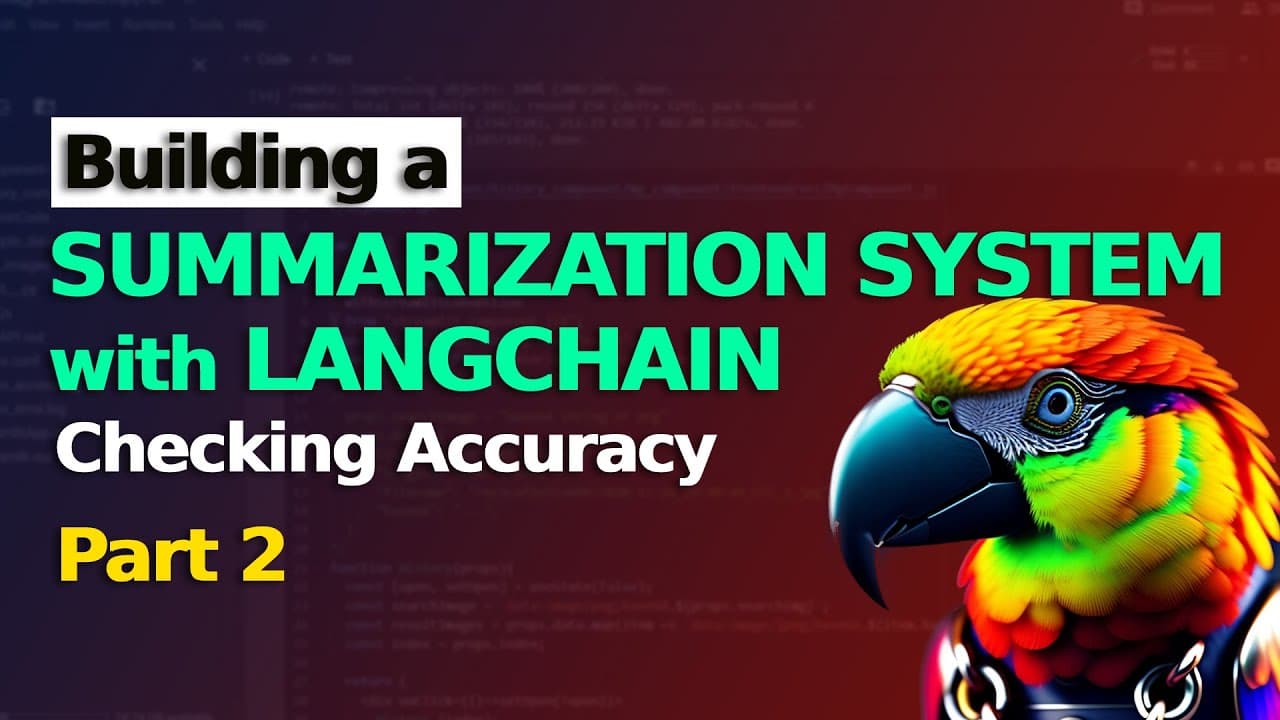
Building a Summarization System with LangChain and GPT-3 - Part 2
TL;DR
Learn how to use the Summarization Checker and other strategies to address issues with summarization hallucination in large language models.
Transcript
okay in this video we're going to look at using the summarization Checker and other ways that you can deal with hallucination related to summarization in the large language models so you can see I've just got normal Imports nothing different there so first off I'm just going to set up a very simple sort of idea of a prompt and this is going to be l... Read More
Key Insights
- 🧑🏭 Extracting key facts using simple prompts and formatting them as a bulleted list can be an effective way to summarize articles and perform fact-checking.
- 😫 Setting the language model temperature to zero improves the accuracy of the summarization results.
- 📈 Combining the Summarization Checker with graphs or knowledge graphs can enhance fact-checking and provide informative responses.
- 🧑🏭 The Summarization Checker can generate suggestions for correcting false facts, improving the overall accuracy of the summary.
- 😵 Larger summaries or books may pose challenges due to limited token span width and cross-referencing of facts.
- 🍰 The Summarization Checker offers a valuable tool for short summaries, but its effectiveness for longer texts may vary.
- 🤝 Knowledge graphs can be utilized alongside the Summarization Checker to provide comprehensive responses and deal with customer inquiries.
Install to Summarize YouTube Videos and Get Transcripts
Explore YouTube Video Summarizer or Get YouTube Transcript Extractor
Questions & Answers
Q: How can the Summarization Checker be used to extract key facts from text?
The Summarization Checker can be used by providing a simple prompt that asks for the extraction of key facts and formatting them as a bulleted list. By setting the language model temperature to zero, the results are more precise.
Q: Can the Summarization Checker be used for fact-checking?
Yes, by treating the user as an expert fact checker hired by a news organization, the Summarization Checker can be used to determine the truth or falsehood of each fact extracted. In cases where the fact cannot be determined, the output can be labeled as "undetermined".
Q: Can the Summarization Checker automatically correct false facts?
The Summarization Checker can generate suggestions for correcting false facts. By using the suggestions provided and the original article, the summary can be rewritten to ensure accuracy.
Q: Can the Summarization Checker be applied to larger summaries or books?
While the Summarization Checker is useful for article summaries, it may face challenges with larger summaries or books. Establishing facts in one section and referring to them in another could lead to limited token span width issues.
Key Insights:
- Extracting key facts using simple prompts and formatting them as a bulleted list can be an effective way to summarize articles and perform fact-checking.
- Setting the language model temperature to zero improves the accuracy of the summarization results.
- Combining the Summarization Checker with graphs or knowledge graphs can enhance fact-checking and provide informative responses.
- The Summarization Checker can generate suggestions for correcting false facts, improving the overall accuracy of the summary.
- Larger summaries or books may pose challenges due to limited token span width and cross-referencing of facts.
- The Summarization Checker offers a valuable tool for short summaries, but its effectiveness for longer texts may vary.
- Knowledge graphs can be utilized alongside the Summarization Checker to provide comprehensive responses and deal with customer inquiries.
- Exploring different prompt structures and leveraging triples in a Knowledge Graph can help extract and utilize relevant information for summarization purposes.
Summary & Key Takeaways
-
The video introduces the use of the Summarization Checker and demonstrates how to extract key facts from text using a prompt.
-
By setting the language model to a temperature of zero, more accurate results can be obtained.
-
The video also explores the possibility of using graphs and knowledge graphs for fact-checking and providing informative responses.
Read in Other Languages (beta)
Share This Summary 📚
Summarize YouTube Videos and Get Video Transcripts with 1-Click
Try YouTube Summary with ChatGPT & Claude or YouTube Transcript Generator
Explore More Summaries from Sam Witteveen 📚


Summarize YouTube Videos and Get Video Transcripts with 1-Click
Try YouTube Summary with ChatGPT & Claude or YouTube Transcript Generator