Jun Tani: The self-Organizing Functional Hierarchy: a neuro-robotics study - Part 1
TL;DR
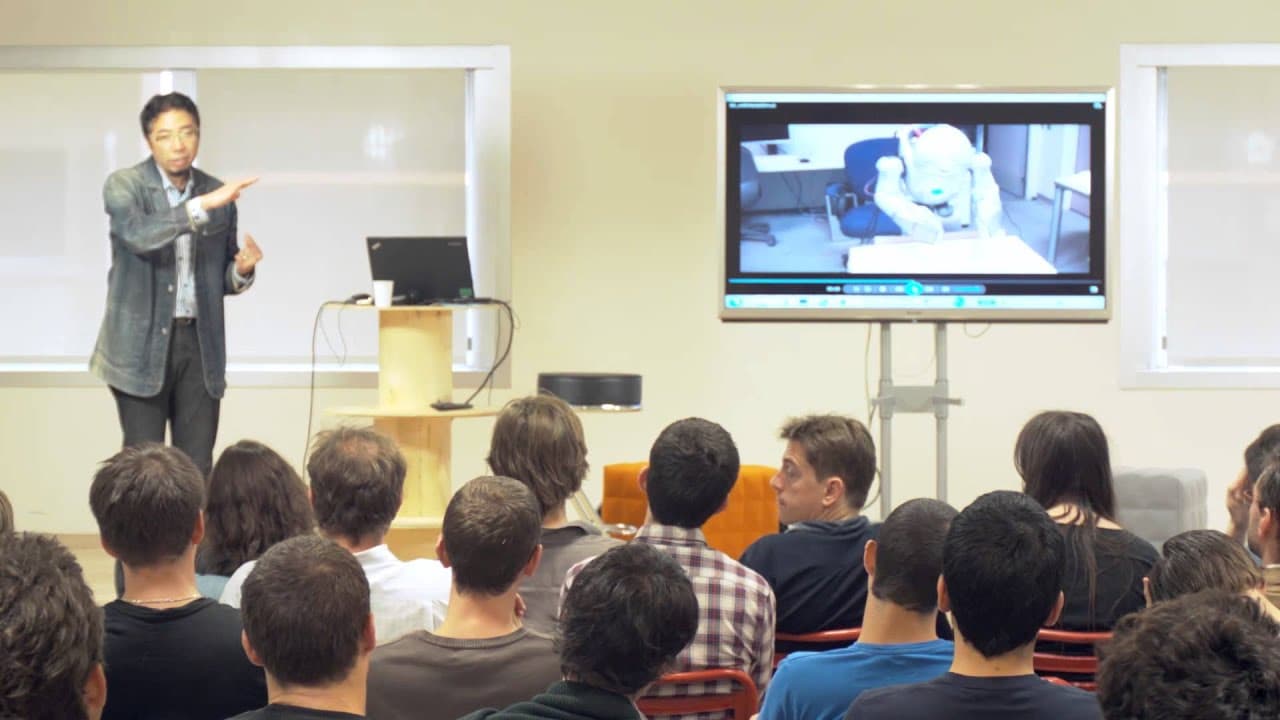
This talk explores the development of hierarchies of abstract representations in robotics through sensory-motor interactions and the potential for compositional manipulation of behavior and thoughts.
Transcript
good evening and thank you for coming for this new a talk where we have the high pleasure of welcoming june taney professor juntani from caist in korea professor juntani has a long career in research in the robotics neural networks he has worked in particular among other places at sony computer science lab in tokyo is going to talk about tonight is... Read More
Key Insights
- 🤖 Sensory-motor interaction is essential for robots to acquire higher order abstract knowledge.
- 🖐️ Functional hierarchy plays a crucial role in visual and motor behavior in both artificial and biological brains.
- ❓ Symbolic representation may not be necessary for the development of functional hierarchy.
- 🧑🦼 Mutual interaction between symbolic processing and sensory-motor levels is a challenge in building functional hierarchy.
- ❓ Dynamical systems and neural networks can be used to create analog representations of knowledge.
- 🤖 Self-organization plays a significant role in the development of functional hierarchy in robots.
- 👨💻 Compositional action can be achieved through hierarchical predictive coding schema.
Install to Summarize YouTube Videos and Get Transcripts
Explore YouTube Video Summarizer or Get YouTube Transcript Extractor
Questions & Answers
Q: How does sensory-motor interaction contribute to the acquisition of abstract knowledge in robots?
Sensory-motor interaction allows robots to develop higher order abstract representations of the world through iterative behavior. This helps them understand and manipulate their environment.
Q: Does functional hierarchy in robots require symbolic representation?
Functional hierarchy does not necessarily require symbolic representation. Professor Juntani proposes the use of neural networks and dynamical systems to create an analog representation of knowledge, avoiding the symbol grounding problem.
Q: How can the interaction between symbolic processing and sensory-motor levels be achieved?
Stephen Harnad suggests that categorization through neural networks can enable smooth interaction between symbolic processing and sensory-motor levels. The challenge lies in bridging the gap between the different conceptual spaces of symbols and sensory-motor experiences.
Q: How can compositional action be developed in robots?
Compositional action can be developed through a hierarchical predictive coding schema. By combining primitive behaviors with specific intentions, robots can generate complex and fluid sequences of actions.
Summary & Key Takeaways
-
Professor Juntani discusses the acquisition of higher order abstract knowledge through iterative sensory-motor interactions in robots.
-
He explains the concept of functional hierarchy and its role in visual and motor behavior.
-
The talk focuses on the challenges of building functional hierarchy without symbolic representation and the potential for self-organization in artificial and biological brains.
Read in Other Languages (beta)
Share This Summary 📚
Summarize YouTube Videos and Get Video Transcripts with 1-Click
Try YouTube Summary with ChatGPT & Claude or YouTube Transcript Generator