Point Cloud Classification - Keras Code Examples
TL;DR
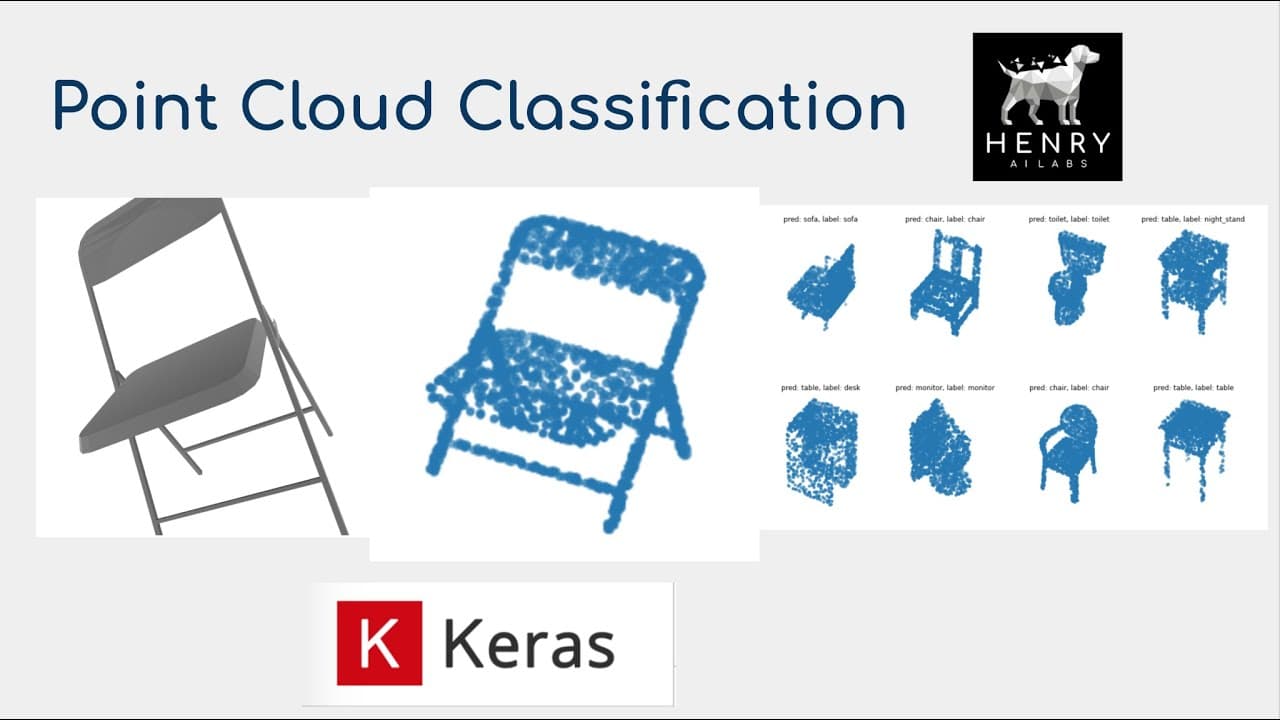
Keras provides a detailed framework for classifying 3D point clouds using advanced deep learning techniques.
Transcript
welcome to the henry ai labs walkthrough of keras code examples keras has provided 56 code examples implementing popular ideas in deep learning this ranges from the basics such as simple mnist and imdb text classification all the way to cutting edge research ideas such as knowledge distillation supervised contrastive learning and transformers we'll... Read More
Key Insights
- 👈 Keras offers comprehensive code examples that facilitate hands-on learning of deep learning concepts, especially in point cloud classification.
- 😶🌫️ Point clouds provide a unique way to represent 3D data, offering flexibility and precision in machine learning applications.
- 😶🌫️ The T-Net architecture plays a pivotal role in transforming raw point cloud data into usable formats for effective neural network processing.
- ❓ Data augmentation via jittering and shuffling improves model robustness and generalization by diversifying training data characteristics.
- 🚂 The ModelNet dataset serves as a foundational resource for training deep learning models on 3D object classification tasks.
- 😥 Orthogonal regularization in T-Net encourages the preservation of relationships among point features, enhancing learning outcomes in neural networks.
- ❓ The achieved model accuracy demonstrates the effectiveness of deep learning techniques applied to classify complex 3D structures.
Install to Summarize YouTube Videos and Get Transcripts
Explore YouTube Video Summarizer or Get YouTube Transcript Extractor
Questions & Answers
Q: What is the main purpose of the Keras code examples discussed in the content?
The Keras code examples aim to demonstrate various deep learning concepts, specifically focusing on point cloud classification. They highlight techniques from simple tasks to advanced methods, enabling users to understand and implement models that classify 3D objects based on their spatial coordinates.
Q: How do point clouds differ from traditional 3D representation methods like voxels?
Point clouds represent 3D objects as sets of individual points defined by their x, y, and z coordinates, unlike voxels, which are volumetric pixels that occupy specific space within a defined grid. Point clouds allow for more flexible representations in computer graphics and vision applications.
Q: What is the role of the T-Net block in PointNet architecture?
The T-Net block is crucial in the PointNet architecture as it performs affine transformations to represent the input point cloud in a canonical form. This transformation ensures that the internal feature space is well-aligned for deep learning processes, improving the model's learning efficiency.
Q: What techniques are used for data augmentation in point cloud classification?
Data augmentation techniques for point cloud classification include jittering, which adds randomness to the positions of 3D points to create variability in the training data, and shuffling the order of points to prevent the model from learning patterns specific to point arrangements.
Q: How is the ModelNet dataset utilized in the point cloud classification task?
The ModelNet dataset consists of over 125,000 CAD models categorized into various object classes. In the point cloud classification task, it provides 3D objects for training and testing the model, with labeled data that helps in learning the recognition of different object categories.
Q: What is the significance of the orthogonal regularization technique in the T-Net architecture?
Orthogonal regularization in the T-Net architecture helps maintain the spatial relationships between points during transformation. It minimizes the distance between the features and identity matrix, promoting an effective projection of point clouds into a feature space suitable for further processing in neural networks.
Q: What results were achieved from training the classification model using Keras?
The classification model achieved approximately 80% accuracy on the training set and around 76-77% on the validation set after 20 epochs of training. These results indicate that the model was able to effectively learn to classify the 3D point cloud representations into correct object categories.
Q: Why is the Keras code tutorial relevant to developers interested in 3D graphics and machine learning?
The tutorial provides essential guidance on implementing advanced deep learning techniques for 3D graphics through practical examples. It equips developers with knowledge and skills to handle complex data types like point clouds, enhancing their ability to apply machine learning in fields such as computer vision and autonomous vehicles.
Summary & Key Takeaways
-
The content discusses Keras code examples that cover various deep learning concepts, with a focus on point cloud classification using PointNet architecture.
-
The tutorial explains the process of converting 3D mesh data into point cloud format, sampling points, and applying data augmentation techniques for model training.
-
Finally, the content examines the architecture and training of a neural network model capable of classifying various objects based on their 3D coordinates, achieving impressive accuracy.
Read in Other Languages (beta)
Share This Summary 📚
Summarize YouTube Videos and Get Video Transcripts with 1-Click
Try YouTube Summary with ChatGPT & Claude or YouTube Transcript Generator
Explore More Summaries from Connor Shorten 📚
Summarize YouTube Videos and Get Video Transcripts with 1-Click
Try YouTube Summary with ChatGPT & Claude or YouTube Transcript Generator