Weak Interaction: The Four Fundamental Forces of Physics #2
TL;DR
The weak force, operating within a tiny range, can change the identity of particles by altering their quark flavor through particle decay.
Transcript
Today we continue our series on the four fundamental forces of physics, a mere four forces that make the whole universe work. And in this installment, we're talking about a force that acts over very very teeny teeny tiny distances: the weak force. [Intro] Without it, the sun would not shine, we would not have elements like radium or plutonium, and ... Read More
Key Insights
- 💁 The weak force is essential for processes like carbon-14 dating and the formation of elements like radium and plutonium.
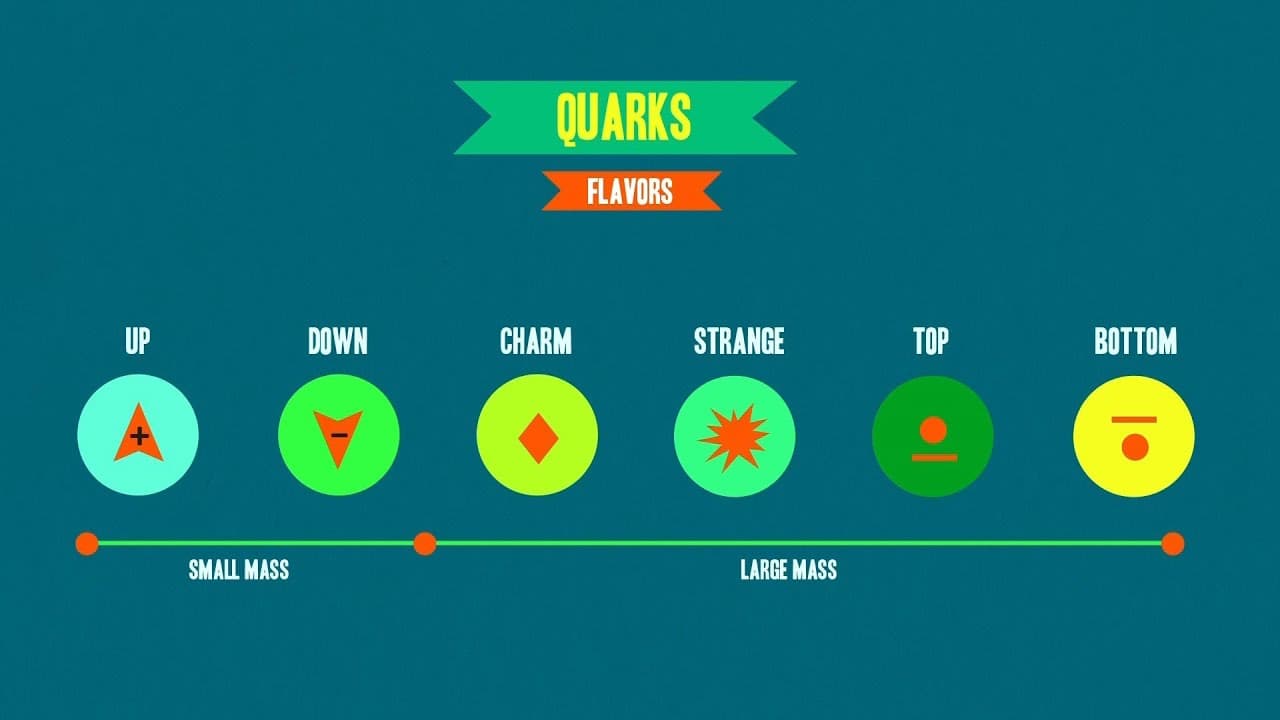
- 🙂 Quarks have different flavors, with up and down quarks being the most common and lighter in mass.
- ❓ The weak force can also interact with leptons, such as electrons and neutrinos.
- 🤪 Force carriers, like the W and Z bosons, mediate the weak force between particles.
- 🔸 The weak force operates within a very small range, about 0.1% of the diameter of a proton.
- 🥺 Particle interactions through the weak force can lead to the creation of entirely new elements.
- ❓ Understanding the weak force is crucial for comprehending the fundamental structure and behavior of matter in the universe.
Install to Summarize YouTube Videos and Get Transcripts
Explore YouTube Video Summarizer or Get YouTube Transcript Extractor
Questions & Answers
Q: What is the weak force and why is it important?
The weak force is one of the four fundamental forces of physics and is responsible for particle decay. It is crucial for understanding the behavior of elements, such as in carbon-14 dating.
Q: How does the weak force change the identity of particles?
The weak force acts on quarks within particles, altering their flavor. This can change a proton into a neutron or vice versa, resulting in a change of the particle's identity.
Q: What are force carriers in the weak force?
The weak force involves the exchange of particles called force carriers. These include the W bosons, which can be positively or negatively charged, and the Z bosons, which have no charge.
Q: How does the weak force relate to neutron decay?
Neutrons can decay into protons when a neutrino passes by. The weak force causes a positively-charged W boson to interact with the neutron's down quark, changing its charge and converting the neutron into a proton.
Summary & Key Takeaways
-
The weak force is responsible for particle decay and plays a crucial role in processes like carbon-14 dating.
-
The weak force changes quark flavors, thus altering the identity of particles like protons and neutrons.
-
Neutrons can decay into protons when the weak force interacts with a neutrino, resulting in a change of element.
Read in Other Languages (beta)
Share This Summary 📚
Summarize YouTube Videos and Get Video Transcripts with 1-Click
Try YouTube Summary with ChatGPT & Claude or YouTube Transcript Generator
Explore More Summaries from SciShow 📚


Summarize YouTube Videos and Get Video Transcripts with 1-Click
Try YouTube Summary with ChatGPT & Claude or YouTube Transcript Generator