How to Write the Equilibrium Expression for Reactions
TL;DR
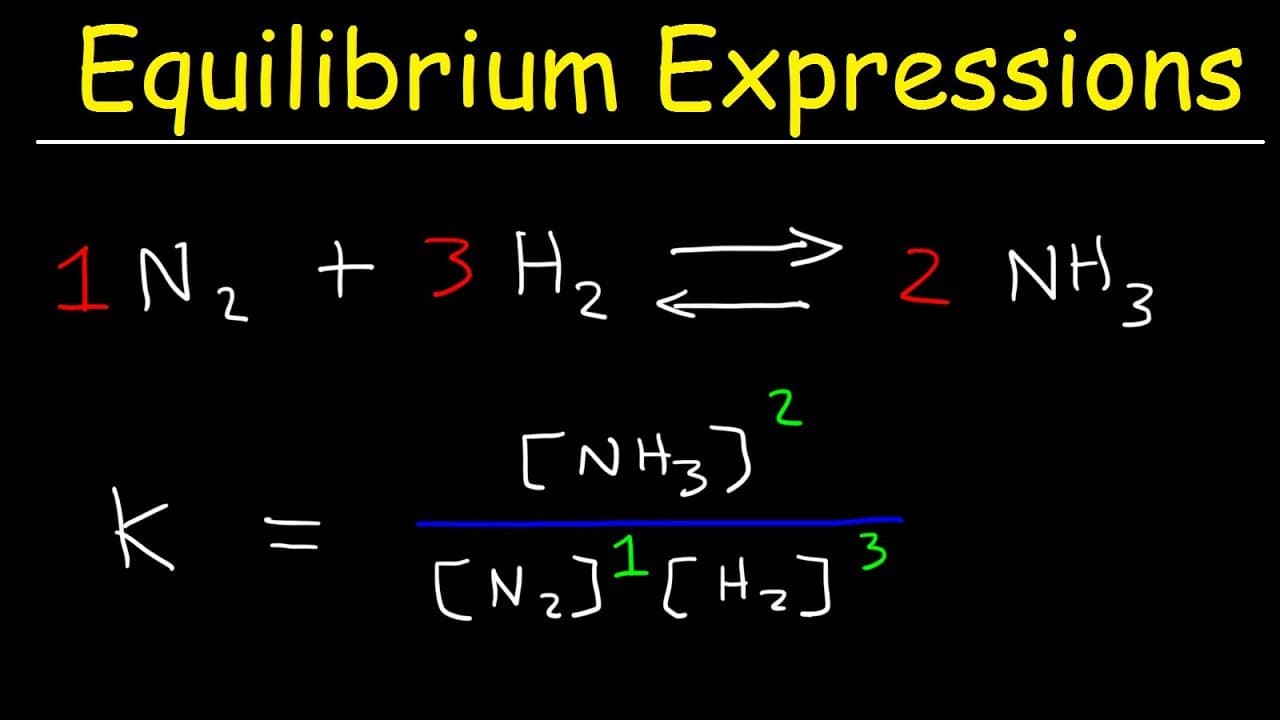
To write the equilibrium expression for a chemical reaction, use the formula K = [products]/[reactants], incorporating coefficients as exponents. Remember to exclude solids and liquids from the expression; only include gaseous and aqueous species.
Transcript
in this video we're going to talk about how to write the equilibrium expression for a reaction so let's say if nitrogen gas reacts with hydrogen gas to produce ammonia now let's make sure the reaction is balanced we need a one a three and a two so given this reaction how can we write the equilibrium expression for it so the law of mass action can b... Read More
Key Insights
- 😑 The equilibrium expression is derived from the law of mass action, representing the ratio of products to reactants.
- 😑 Coefficients in the balanced reaction become exponents in the equilibrium expression.
- 🫢 Solids and liquids are excluded from the equilibrium expression, while only gases and substances in the aqueous phase are included.
- 🫢 Kp and Kc represent equilibrium constants for gases and substances dissolved in the aqueous phase, respectively.
Install to Summarize YouTube Videos and Get Transcripts
Explore YouTube Video Summarizer or Get YouTube Transcript Extractor
Questions & Answers
Q: What is the law of mass action and how does it relate to the equilibrium expression?
The law of mass action states that the rate of a chemical reaction is directly proportional to the product of the concentrations of the reactants. The equilibrium expression is derived from this law, representing the ratio of products to reactants.
Q: How do coefficients in a balanced reaction affect the equilibrium expression?
Coefficients become exponents in the equilibrium expression. For example, if the balanced reaction has a coefficient of 2 in front of a species, the equilibrium expression will have that species raised to the power of 2.
Q: Can solids and liquids be included in the equilibrium expression?
No, solids and liquids are excluded from the equilibrium expression. Only gases and substances in the aqueous phase are included. Solids and liquids are replaced with a coefficient of 1 in the expression.
Q: What is the difference between using Kp and Kc in equilibrium expressions?
Kp refers to the equilibrium constant expressed in terms of partial pressures of gases, while Kc represents equilibrium concentrations for substances dissolved in the aqueous phase. The choice between Kp and Kc depends on the state of the reactants and products.
Summary & Key Takeaways
-
The equilibrium expression for a reaction is determined by the law of mass action, which is the ratio of products to reactants.
-
Coefficients in the balanced reaction become exponents in the equilibrium expression.
-
Solids and liquids are excluded from the equilibrium expression, while only gases and substances in the aqueous phase are included.
Read in Other Languages (beta)
Share This Summary 📚
Summarize YouTube Videos and Get Video Transcripts with 1-Click
Try YouTube Summary with ChatGPT & Claude or YouTube Transcript Generator
Explore More Summaries from The Organic Chemistry Tutor 📚


Summarize YouTube Videos and Get Video Transcripts with 1-Click
Try YouTube Summary with ChatGPT & Claude or YouTube Transcript Generator