NMOS NAND gate | Generalised | Digital Systems Design | Lec-108
TL;DR
This video explains the structure and operation of the generalized NMOS NAND gate.
Transcript
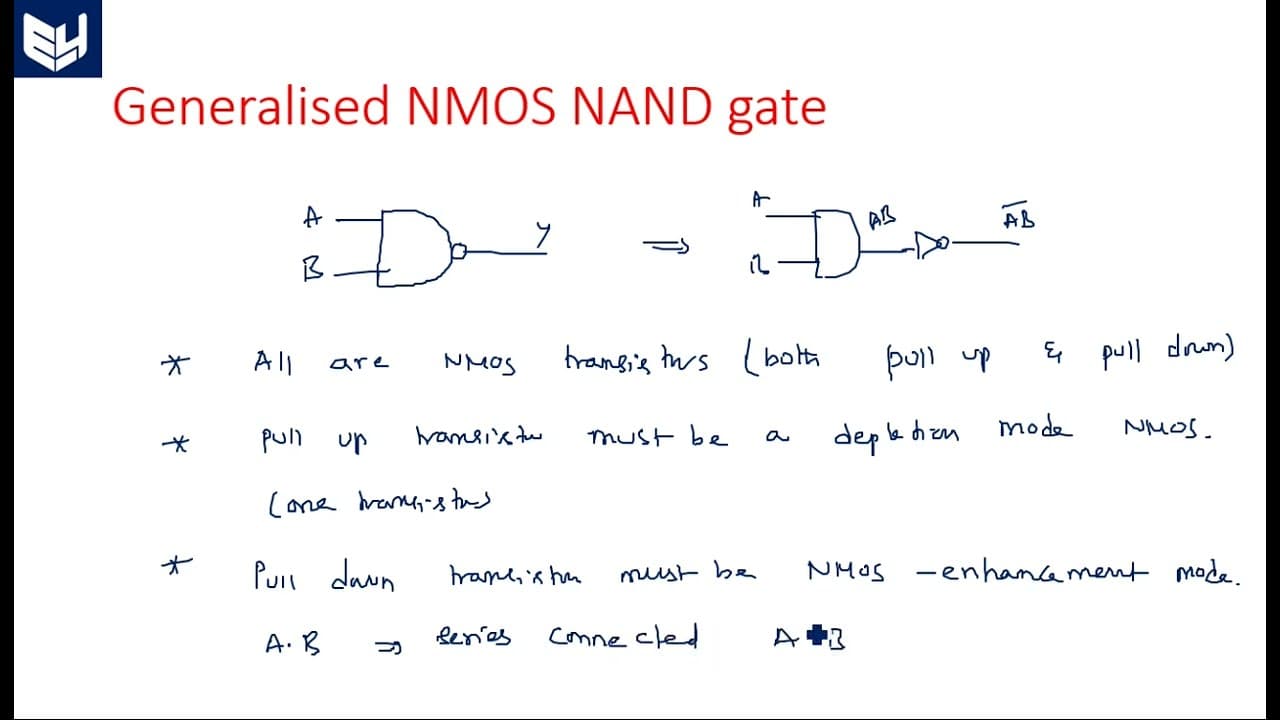
hi everyone in this video I'm going to explain about generalized Enos Navigator so generalized nmos nandate before going into the general format let us consider what are the main uh designs of this nmos land gate so first we'll see the basic normal land symbol land symbol we know and gate followed by not and followed by not uh in general representa... Read More
Key Insights
- 😒 NMOS technology uses depletion mode transistors for pull-up operations due to their ability to stay on without input signals.
- 🔬 The structure of NMOS NAND gates requires careful arrangement of transistors in series and parallel to achieve logical outcomes.
- 🎨 Understanding the configurations of enhancement and depletion mode transistors is crucial for successful circuit design and function.
- 🔬 Each additional input in a generalized NMOS NAND gate necessitates an additional enhancement mode transistor to maintain the integrity of the NAND operation.
- 🎨 The output logic state directly reflects the arrangement of NMOS transistors, emphasizing the importance of design clarity.
- 🌥️ The video showcases how integrating multiple transistors can affect overall circuit behavior, particularly in larger, more complex logic systems.
- ❓ Designers must consider how PMOS and NMOS configurations differ to effectively create complementary circuits that function in tandem.
Install to Summarize YouTube Videos and Get Transcripts
Explore YouTube Video Summarizer or Get YouTube Transcript Extractor
Questions & Answers
Q: What are the main differences between enhancement mode and depletion mode transistors in an NMOS circuit?
In NMOS circuits, enhancement mode transistors require an input voltage to conduct, whereas depletion mode transistors are always in an 'on' state unless a voltage is applied to turn them off. Depletion mode devices serve as pull-up transistors, maintaining a continuous connection to VDD without additional control signals.
Q: How does the connection of transistors influence the output of an NMOS NAND gate?
In an NMOS NAND gate, pull-down transistors are connected in series, meaning that for the output to be low (0), both transistors must conduct. If either transistor is off, the output remains high (1), illustrating the gate's NAND function of providing a low output only when all inputs are high.
Q: Can you explain the significance of the output being in complemented form in NMOS designs?
The output being in complemented form means that the circuit inherently produces the opposite value of input logic states without requiring additional inverters. This complements the efficiency of NMOS designs, as they can minimize the number of components needed while achieving desired logical operations.
Q: How would you design a two-input NMOS NAND gate circuit?
To design a two-input NMOS NAND gate, one would use a depletion mode transistor as the pull-up component, connected to VDD, and two enhancement mode transistors in series as the pull-down part. This setup ensures that the output is low only when both inputs are high, satisfying the NAND gate condition.
Summary & Key Takeaways
-
The video introduces the basic design and operation of NMOS NAND gates, explaining the need for both depletion and enhancement mode transistors in the circuit.
-
The presenter describes how to realize NAND gates using NMOS technology, detailing the series and parallel connections of transistors depending on input configuration.
-
The complexities of generalized NMOS NAND gates with multiple inputs are clarified, emphasizing the design differences required for NMOS versus PMOS transistors.
Read in Other Languages (beta)
Share This Summary 📚
Summarize YouTube Videos and Get Video Transcripts with 1-Click
Try YouTube Summary with ChatGPT & Claude or YouTube Transcript Generator