Cavity resonator | Measurement of Q | Microwave Engineering | Lec-123
TL;DR
This video explains three methods to measure the quality factor of cavity resonators.
Transcript
hi everyone in this video I am going to explain about the measurement of Q or quality factor of a cavity resonator so we know what is the cavity resonator cavity resonator is nothing but made up of a complete closed path if a normal waved we will consider and which is closed on either ends then the way which enters into the resonate cavity resonato... Read More
Key Insights
- 🧑🏭 Cavity resonators are essential components in electromagnetic applications, acting as resonant filters.
- 💨 The transmission method is the most established technique for measuring the quality factor, providing a reliable way to derive output power data.
- ❓ The concept of resonant frequency is integral to understanding the behavior of cavity resonators in circuits.
- 🇶🇦 The relationship between loaded Q and unloaded Q illustrates the impact of coupling on resonator performance.
- ✋ Accurate Q measurement is vital for applications requiring high fidelity and performance in communication systems.
- ✋ The bandwidth of operation directly influences measurement accuracy, especially in systems with high quality factors.
- 🈸 Each measurement method has distinct applications and suitability depending on the system's requirements and characteristics.
Install to Summarize YouTube Videos and Get Transcripts
Explore YouTube Video Summarizer or Get YouTube Transcript Extractor
Questions & Answers
Q: What is a cavity resonator and how does it function?
A cavity resonator is a closed structure designed to allow electromagnetic waves to travel within it. These waves reflect multiple times, creating a condition where specific frequencies resonate, leading to enhanced amplitude at resonant frequencies. Essentially, it acts as a filter for certain frequencies while attenuating others.
Q: What are the three methods to measure the quality factor (Q) of a cavity resonator?
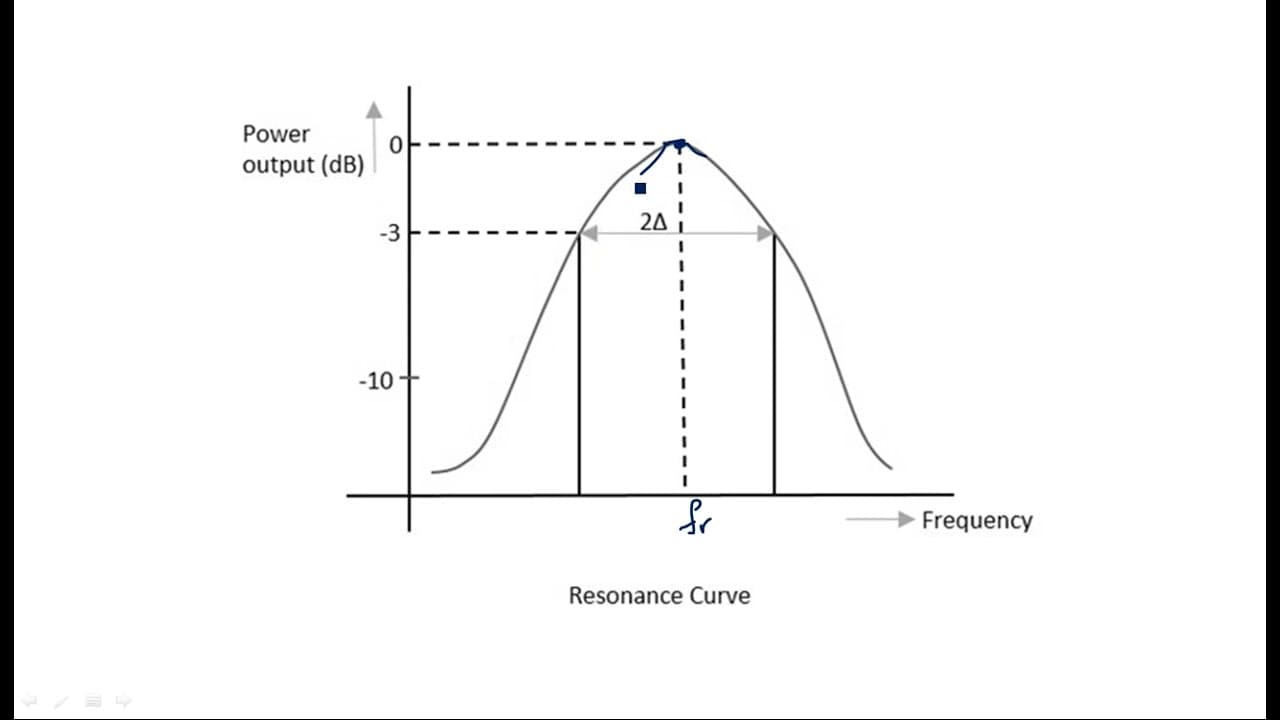
The three methods to measure the quality factor are the transmission method, impedance method, and transient decay method. The transmission method is the most widely used and involves measuring output signals as a function of frequency to derive the Q factor from the resonance curve.
Q: Why is the transmission method preferred for measuring Q in cavity resonators?
The transmission method is considered the oldest and best approach for measuring Q due to its straightforward setup and ability to yield reliable data. It allows for the plotting of output power against frequency, enabling the calculation of the half-power bandwidth, which is critical for determining the Q factor.
Q: What is the significance of the resonant frequency in the context of cavity resonators?
The resonant frequency is where the capacitive and inductive reactance in the cavity resonator are equal. At this frequency, the system exhibits maximum amplitude and gain, which is essential for applications in electronic circuits. This frequency is pivotal for efficient energy storage and transfer in resonant systems.
Q: What are the limitations associated with the transmission method of Q measurement?
A significant limitation of the transmission method is its accuracy at very high quality factor systems, where the operational bandwidth becomes narrow. This can lead to measurement inaccuracies, making it less reliable for systems requiring precise Q calculations.
Q: How is the relationship between loaded Q (QL) and unloaded Q (Q0) defined in cavity resonators?
The loaded quality factor (QL) is related to the unloaded quality factor (Q0) through the coupling effects experienced in the resonator. If the coupling between the microwave source and the cavity, as well as between the detector and the cavity, is ignored, QL can be assumed equivalent to Q0, representing ideal measurement conditions.
Q: What primary role does the microwave source play in the transmission method?
In the transmission method, the microwave source generates EM signals that are fed into the cavity resonator. The source's output is critical for establishing the frequency range over which the resonator's response is measured, helping to generate the resonance curve necessary for calculating the Q factor.
Q: Why is resonance important in electronic circuit design?
Resonance is crucial in electronic circuit design because it determines the efficiency of energy transfer and storage. It is fundamental for tuning circuits, filters, and oscillators, where specific frequencies are amplified while unwanted frequencies are suppressed, thus optimizing circuit performance.
Summary & Key Takeaways
-
The video introduces the concept of cavity resonators and their function as closed paths for wave propagation, leading to resonance through multiple reflections.
-
Three main methods for measuring the quality factor (Q) of cavity resonators are explained, with the transmission method being the most commonly used due to its effectiveness.
-
The transmission method setup, involving a microwave source and various components, allows for measuring output signals and calculating the resonance curve to determine the Q factor.
Read in Other Languages (beta)
Share This Summary 📚
Summarize YouTube Videos and Get Video Transcripts with 1-Click
Try YouTube Summary with ChatGPT & Claude or YouTube Transcript Generator